Bifröst Myth Meaning & Symbolism
The shimmering, trembling bridge of the gods, a perilous link between worlds, guarded by a silent watcher, destined to shatter at the end of all things.
The Tale of Bifröst
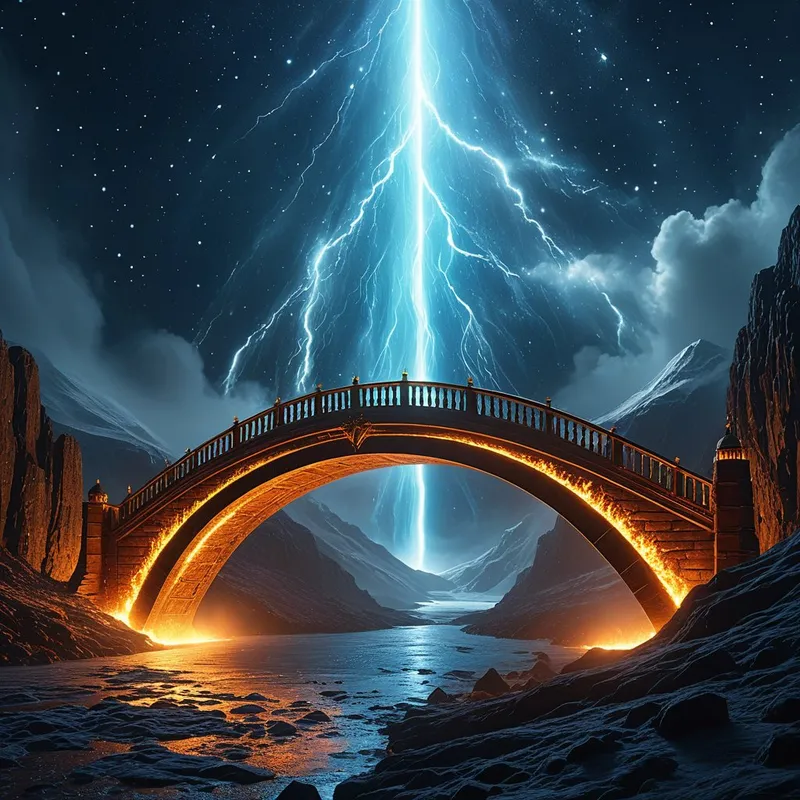
Hear now of the trembling way, the quaking road that none but the most mighty dare to tread. In the time before memory, when the bones of the earth were still cooling and the great tree Yggdrasil drank from the well of fate, the gods looked down from their high seat in Asgard. Below them lay Midgard, green and teeming, and the other eight worlds, each humming with its own secret life. But between them was only the Ginnungagap, the yawning void, a chasm of chaos and potential.
The Æsir were builders. From the spark of a star and the breath of a giant, from the shimmer of a northern light and the resolve of a solemn oath, they wrought a bridge. They did not build it of stone or timber, but of three impossible things: fire, for its unyielding spirit; water, for its flowing connection; and air, for its boundless reach. Woven together by the cunning of Loki and the steadfast will of Thor, it solidified into a radiant, humming causeway. They named it Bifröst, the "Shimmering Path." To mortal eyes, it appeared as the rainbow after a storm, a fleeting promise. But to the gods, it was a permanent, thrumming artery, a road of three vibrant colors—red as forge-fire, blue as deepest ice, green as Yggdrasil’s heartwood.
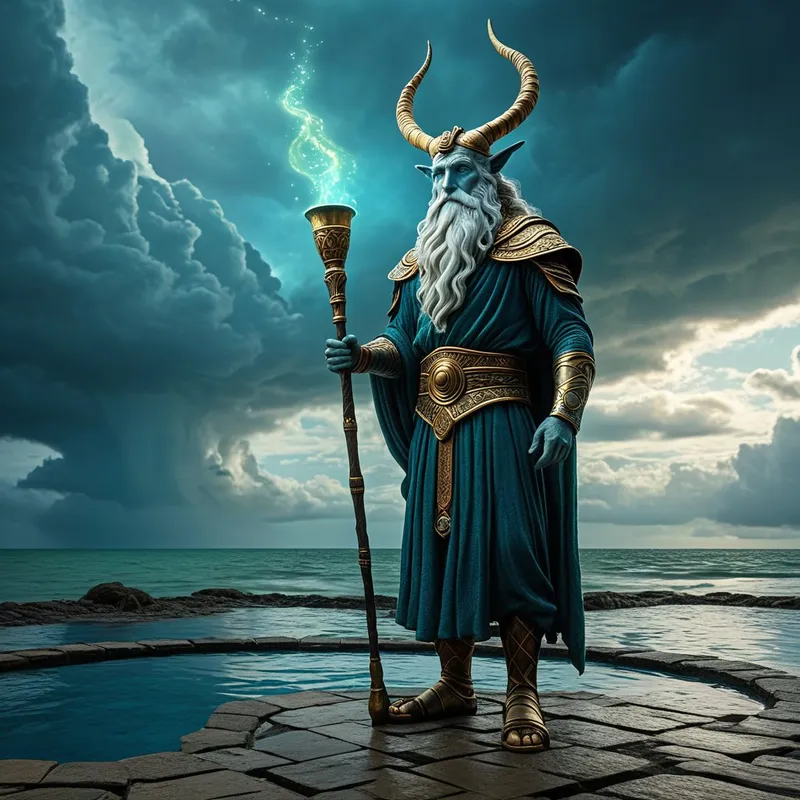
Yet this bridge was no gentle path. To walk it was to feel the very elements of its making vibrate beneath one’s feet, a constant, perilous tremor. It could bear the weight of a god, but it would scorch the feet of any frost-giant or creature of pure chaos who tried to cross. Seeing its vulnerability, the All-Father, Odin, placed the most vigilant of all beings at its Asgard-ward end. This was Heimdallr, the shining one, born of nine mothers. His hearing was so keen he could hear the grass grow in Midgard and the wool grow on a sheep. His sight was so sharp he could see for a hundred leagues by night or day. He stood, the silent watcher, with his great horn Gjallarhorn at his side, waiting for the day he must sound the final alarm.
For the prophets and the Norns who weave fate knew what the gods themselves dared not forget: Bifröst was born to be broken. It was not a monument of eternity, but a covenant of the present, a glorious, fragile connection that held the cosmos in a delicate balance. Its end was written in its first trembling. And so it stands, in the mythic now, a brilliant, shuddering arc over the abyss, traversed by gods on urgent errands, guarded by a god who never sleeps, waiting for the thunder of the final march.
Cultural Origins & Context
The myth of Bifröst comes to us primarily through the Poetic Edda and the later Prose Edda of Snorri Sturluson. For the Norse peoples, living in a world of formidable fjords, treacherous seas, and long, dark winters, the concept of a bridge was profoundly practical and deeply symbolic. Bifröst transcends mere practicality; it is a cosmological infrastructure. It was not a story told to children at bedtime, but a vital piece of a complex, interlocking worldview shared by skalds (poets), warriors, and farmers alike around the hearth-fire or in the great hall.
Its primary societal function was to map the cosmos, defining the sacred geography that separated and connected the divine (Asgard) from the human (Midgard) and the chaotic "other" (the realms of giants and the dead). It reinforced a hierarchical but connected universe. The gods could descend, and in some tales, the worthy dead (the Einherjar) could ascend. It was a symbol of order imposed upon chaos, a visible, radiant law. The myth also served as a crucial narrative device, explaining the mechanism of divine interaction and setting the stage for the ultimate drama of Ragnarök. The bridge’s destined destruction was a sobering reminder of the impermanence of all things, even the works of the gods, instilling a sense of fatalistic courage central to the Norse ethos.
Symbolic Architecture
Bifröst is the ultimate symbol of the liminal—the threshold state. It is not a place, but a process of crossing. Its tripartite construction (fire, water, air) mirrors the tripartite structure of the Norse cosmos (Asgard, Midgard, Hel/Utgard) and suggests that true connection requires the integration of multiple, often opposing, elements.
The bridge is not the journey's goal, but the journey itself made manifest—a vibrating, alive tension between one state of being and another.
Psychologically, Bifröst represents the connective tissue of consciousness. It is the ego's fragile link between the soaring heights of the spiritual Self (Asgard) and the grounded reality of the personal and collective human experience (Midgard). Heimdallr, the watcher, symbolizes the discriminating function of consciousness—the acute awareness and vigilance required to maintain this connection, to guard against the incursion of unconscious, chaotic contents (the giants) that would destroy the delicate psychic structure. The bridge’s inevitable breaking at Ragnarök signifies that no structure of consciousness, no matter how brilliantly built, is permanent. It must eventually shatter so that a new, more comprehensive consciousness can be born from the waters of the unconscious abyss.
The Dreamer's Resonance
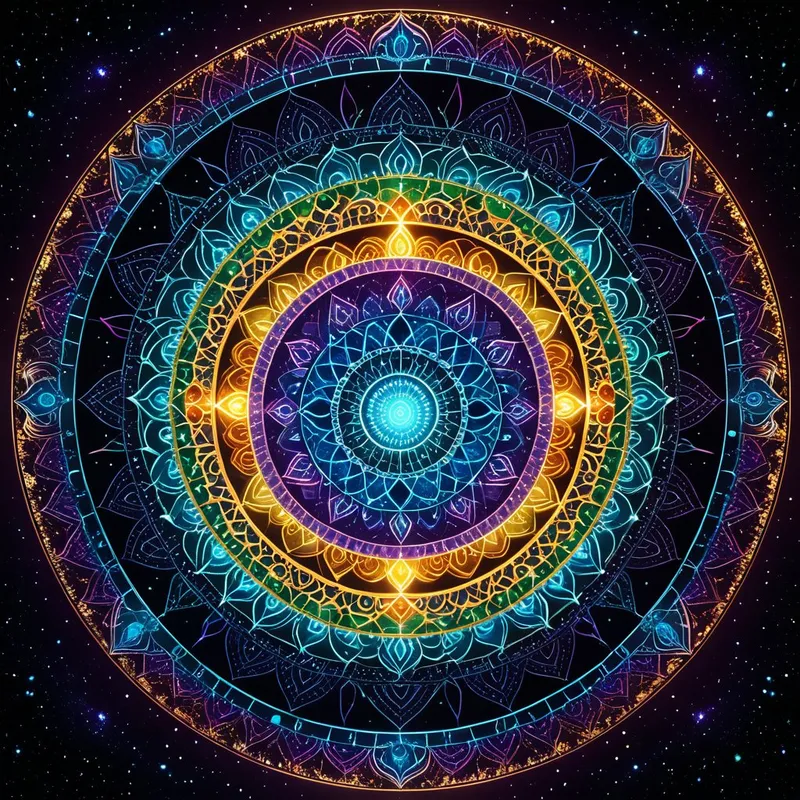
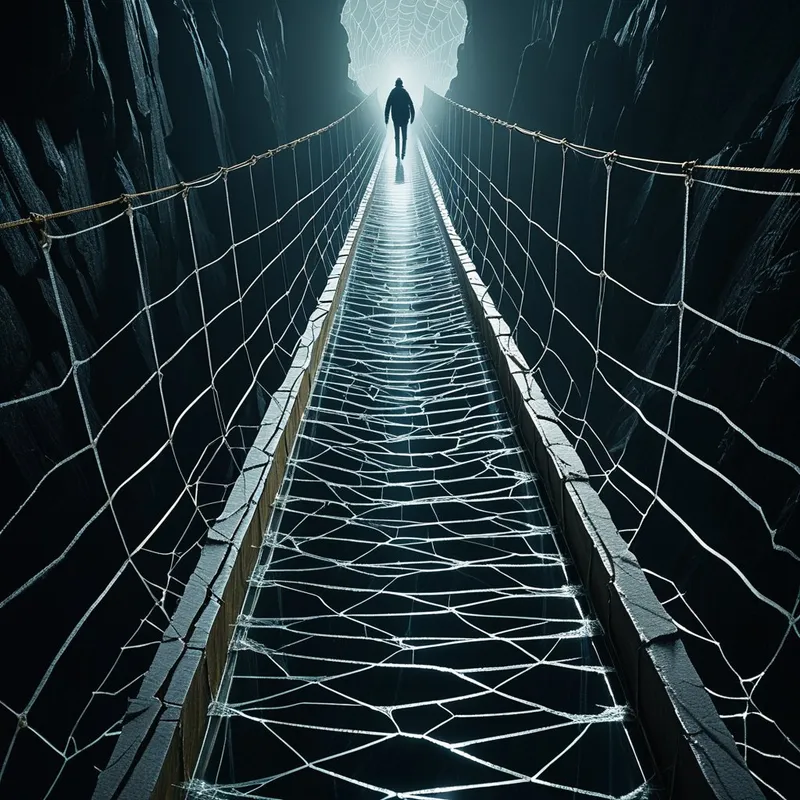
When Bifröst appears in a modern dream, it rarely presents as a literal rainbow. It may be a breathtaking but terrifying glass walkway between skyscrapers, a narrow mountain pass shrouded in auroral light, or a fragile rope bridge over a bottomless canyon in one's own psyche. The dreamer is in a profound state of transition. The somatic feeling is one of trembling, vibrating anticipation—a mix of awe and acute anxiety.
This dream motif signals that the dreamer is navigating a critical threshold in their waking life: a career change, a spiritual awakening, the integration of a major trauma, or the conscious engagement with a powerful creative impulse. The focus is on the crossing, not the destinations. The fear is of falling into the chasm—the regression into chaos, madness, or dissociation. The presence of a vigilant, silent figure (Heimdallr) in the dream can represent an emerging aspect of the Self that is beginning to "stand watch," to bring conscious attention to this perilous but necessary psychic process. To dream of the bridge cracking is not necessarily a nightmare of failure, but often an unconscious preparation for a necessary dissolution of an old identity structure.
Alchemical Translation
The alchemical process mirrored in the Bifröst myth is the opus of connecting the transcendent and the immanent, the spiritual and the material, within the individual psyche. The initial state is separation: the god-like potential (Asgard) feels distant from the earthly human experience (Midgard). The first step is the daring act of construction—using the fiery will (fire), the fluidity of emotion and intuition (water), and the clarity of thought (air) to build a conscious pathway.
Individuation is the daily maintenance and perilous traversal of one's own Bifröst, knowing it is both glorious and doomed, essential and temporary.
Heimdallr's vigil represents the sustained, disciplined observation of the ego, necessary to protect the nascent connection from being overwhelmed by shadowy, archaic complexes (the giants). The daily traversal of the gods is the practice of bringing insights from the unconscious (the divine) into practical, lived reality, and vice-versa. The final, cataclysmic shattering of the bridge is the crucial alchemical stage of mortificatio or solutio—the dissolution of the current conscious attitude. In the individual's life, this is the painful but transformative breakdown of a long-held worldview, belief system, or identity that has served its purpose but become a rigid prison. The myth assures us that this destruction is not an error, but a destined part of the cycle. From the fall into the Ginnungagap, the fertile void, a new, more resilient consciousness—a new world—can eventually be raised. We are forever the bridge-builders, the watchers, and the ones who must walk the trembling path, only to learn, ultimately, how to fall with purpose into the creative dark.
Associated Symbols
Explore related symbols from the CaleaDream lexicon:
- Colored
- Rainbow
- Portal
- Backdoor
- Toll
- Wooden Bridge
- Swinging Bridge
- Rusted Bridge
- Chromatic Wave
- Invisible Bridge
- Fractured Light
- Rainbow Bridge
- Fleeting Rainbow
- Icy Road
- Aurora Borealis
- Rainbow After Rain
- Pedestrian Bridge
- Zipline
- Endless Bridge
- Pastel Rainbow
- Kaleidoscope Colors
- Milky Way
- Dreamy Skyscape
- Interstellar Bridge
- Bismuth Rainbow
- Fluorite Rainbow
- Labradorite Flash
- Transcendent Xenon
- Rainbow Arch
- Sundog
- Canopy Walk
- Piccolo
- Snowy Pathway
- Dreamy Color Wheel
- Surreal Skyscape
- Metaphorical Rainbow
- Mythical Bookend
- Rainbow Paintbrush
- Sunset Window
- Fractured Sound Waves
- Glass Bridge
- Stone Bridge
- Mist-Covered Bridge
- Treetop Canopy Walk
- Skybridge Walkway
- Bridges Over Water
- Overpass
- Celestial Archway
- Endless Horizon
- Rain of Colors
- Aurora Lights
- Twilight Bridge
- Bridge to Nowhere
- Bridge of Souls
- Transcendental Bridge
- Transitory Bridge
- Bridge of Reflection
- Celestial Bridge
- Zigzag
- Sunshine Through Trees
- Bamboo Bridge
- Acoustic Horizon
- Atmospheric Membrane
- Ionosphere
- Cosmic Radiation
- Modulation
- Atmospheric Scattering
- Aurora
- Event Horizon
- Conduit
- Truss
- Conductivity
- Terminal
- Spectrum
- Mistbow
- Flare
- Exosphere
- Escarpment
- Prism
- Beacon