
Bi Disc Myth Meaning & Symbolism
A myth of a celestial artisan forging a jade disc to mend the fractured sky, creating a symbol of cosmic unity and inner perfection.
The Tale of Bi Disc
In the time before time, when the sky was a raw and unfinished canvas, a great disharmony shook the pillars of the cosmos. The celestial dome, woven from the breath of the primordial Dao, had developed a hairline fracture. It was not a crack one could see, but one that could be felt—a creeping chill in the summer noon, a discordant note in the wind's song, a subtle tilt in the balance of Yin and Yang.
From this fracture seeped a formless chaos, a grey mist that dulled the colors of the world and brought a deep unease to the hearts of mortals. Crops grew stunted under a sun that seemed pale and distant. Dreams became troubled, filled with shapeless anxieties. The world was out of true.
In the highest court of the heavens, the Yu Huang perceived this disturbance. He summoned the master artisan of the cosmos, Gong Gong. "The axis wobbles," intoned the Emperor, his voice like distant thunder. "The circle is broken. The center cannot hold. You must craft a keystone, a seal, a symbol of perfect order to mend the breach."
Gong Gong bowed deeply. He did not seek ore from the deepest mines nor fire from the brightest stars. Instead, he journeyed to the heart of the Kunlun Mountains, to a hidden spring where the water was not liquid, but the very essence of concentrated potential—the Qi of the earth made tangible. There, in the silent womb of the world, he found his material: a vein of pristine jade, cold and green as a frozen forest, yet humming with an inner light.
For nine times nine days and nights, Gong Gong worked. His hammer was the will of heaven; his anvil, the patience of the earth. He did not carve the jade, but persuaded it, singing the songs of the constellations and the rhythms of the tides to the stone. He shaped it into a disc, a Bi, its circumference flawless, its surface polished to a depth that seemed to hold the night sky within it. At its center, he opened a perfect circle, a gateway, a window from one state of being to another.
On the dawn of the tenth day, he ascended to the zenith of the fractured sky. The grey chaos swirled hungrily around him. With a cry that was part command, part plea, and part creation itself, he placed the Bi Disc over the fracture. The jade flared with a cool, green radiance. The light did not attack the chaos, but encompassed it, defined it, gave its formlessness a boundary. The mist was drawn into the central hole, spiraling into infinite, ordered patterns before dissolving into harmony.
The sky sighed, a sound of profound relief. The pale sun regained its golden warmth. The world snapped back into alignment. The Bi Disc, now invisible to mortal eyes but eternally present, became the celestial template, the archetypal circle against which all order is measured. It was not a patch, but a remembrance—a permanent symbol of the whole that existed before, and after, the fracture.

Cultural Origins & Context
The myth of the Bi Disc's creation is not found in a single, canonical text but is woven from threads of Neolithic tradition, Zhou dynasty cosmology, and later Confucian and Daoist thought. The physical Bi Disc artifact predates written history; the earliest examples, found in Liangzhu culture tombs (c. 3400-2250 BCE), were placed on the chests of the deceased, a ritual practice suggesting a belief in their power to connect the human soul with the celestial realm.
The story was likely transmitted orally by ritual specialists and astronomers—the ancient "star-gazers" who mapped the heavens and sought to understand humanity's place within it. Its societal function was profound: to explain the nature of cosmic order (Dao) and humanity's role in maintaining it. The myth provided a sacred narrative for the ritual use of the Bi Disc in ceremonies to honor heaven, legitimize the <abbr title="The philosophical concept of the "Mandate of Heaven" used to justify the rule of the Emperor">Tian Ming (Mandate of Heaven), and ensure harmony between the human and celestial worlds. It taught that order is not a default state, but a sacred, crafted achievement that requires perpetual symbolic reinforcement.
Symbolic Architecture
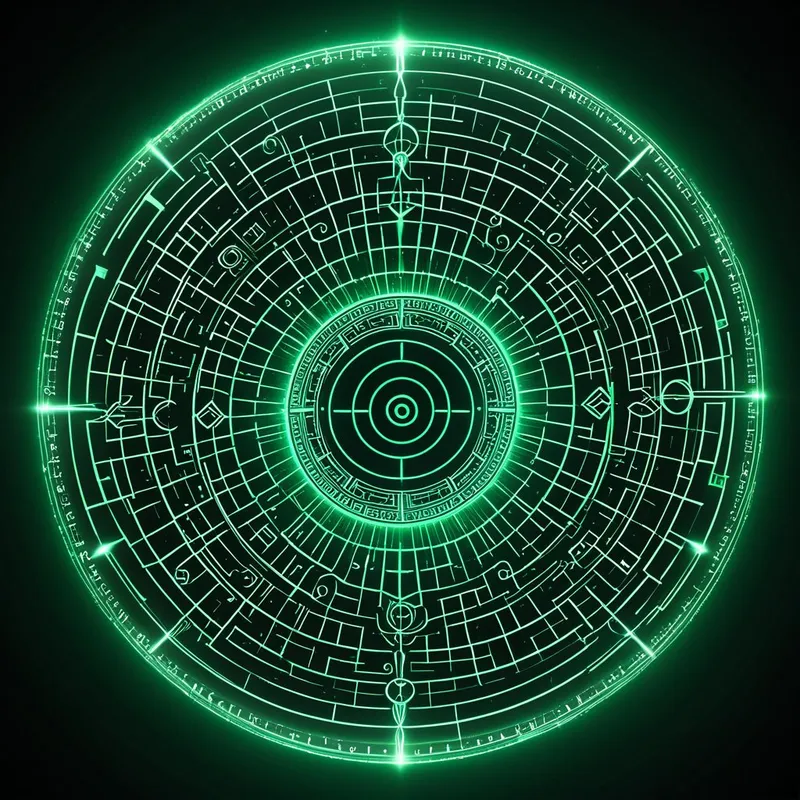
The Bi Disc is a mandala of the cosmos, a symbolic map of the psyche's ideal state. Its form is its meaning: the unbroken outer circle represents the boundless, infinite heaven and the totality of the Self. The precise inner circle represents the earth, the human realm, and the conscious ego. The solid jade between them is the liminal space where heaven and earth communicate, the realm of the psyche where transformation occurs.
The perfect circle is the psyche's deepest yearning—a state of self-containment where conflict is resolved not through victory, but through integration.
The fracture in the sky symbolizes a rupture in the collective or individual psyche—a trauma, a loss of meaning, a descent into chaos and neurosis. Gong Gong, the creator archetype, represents the conscious, shaping force of the mind that must undertake the work of repair. He does not fight the chaos (the shadow) with brute force, but engages it with artistry and reverence, using the raw material of the soul (the jade) to create a container strong enough to hold and transmute the disorder.
The central hole is perhaps the most potent symbol. It is the void, the wu-ji, the necessary emptiness that allows for circulation and connection. It is the gateway through which the infinite (heaven) touches the finite (earth), where the unconscious feeds the conscious, and where the disordered contents of the psyche are invited in to be re-ordered.
The Dreamer's Resonance
When the symbol of the Bi Disc emerges in modern dreams, it often signals a critical phase of psychic reorganization. One may not dream of a literal jade disc, but of its symbolic equivalents: a perfectly round window in a crumbling wall, a brilliant ring of light in a dark space, a circular room that feels profoundly safe and complete, or even the frustrating attempt to draw a perfect circle.
Somatically, this process can feel like a tightening or a gathering-in, a centering. There may be a sense of pressure, akin to the geological forces that create jade, as disparate parts of the self are compressed toward a new, denser integrity. Psychologically, the dreamer is undergoing the work of Gong Gong. They are confronting a personal "fracture"—perhaps a life transition, a moral crisis, or the integration of a neglected talent or traumatic memory. The dream symbol affirms that the raw material for wholeness (the jade) is already within them, but it requires the patient, artistic labor of consciousness to shape it into a form that can mend their inner sky.

Alchemical Translation
The myth models the alchemical opus of individuation—the journey from a state of fragmented, chaotic identity (the fractured sky) to one of cohesive Selfhood (the restored cosmos). The modern individual's "chaos mist" is the swirl of complexes, unresolved emotions, and societal pressures that cloud judgment and cause suffering.
The first step is the recognition of the fracture—the feeling that something is fundamentally "out of true" in one's life. This is the call to the inner Gong Gong, the creative, ordering principle of consciousness. The "jade" is the core substance of one's character, virtues, and innate potential, often buried under the debris of habit and adaptation.
Individuation is not about becoming perfect, but about becoming whole. It is the craft of fitting the ragged edges of experience into a circle so vast it renders them harmonious.
The laborious "shaping" is the disciplined work of self-reflection, therapy, creative expression, or spiritual practice. It is the act of applying conscious attention and ethical choice to the raw material of one's life. The final act, "placing the disc," is the moment of integration. It is when a new understanding, a reconciled aspect of the self, or a hard-won insight is permanently installed at the center of one's psychic structure. It becomes a lens through which reality is ordered. The central hole remains vital—this is the humility to remain open, to not become a closed system, to allow the continuous exchange between the ego and the mysteries of the unconscious. The healed sky is the individuated Self, a personal cosmos where order is dynamic, beauty is inherent, and the center, forever held by the symbolic Bi, is unshakably calm.
Associated Symbols
Explore related symbols from the CaleaDream lexicon: