Beriah the World of Creation Myth Meaning & Symbolism
The myth of the divine architect Beriah, who shapes the World of Creation from pure thought, bridging the infinite and the manifest.
The Tale of Beriah the World of Creation
In the beginning, before the beginning we know, there was a thought. Not a simple thought, but a thought of such profound and terrible clarity that it could not be contained. It was the thought of a Ein Sof, turning its endless gaze inward. From the boundless ocean of potential, a point of absolute will crystallized—the desire to create a vessel, a world, a reality that could, in some finite way, reflect the infinite.
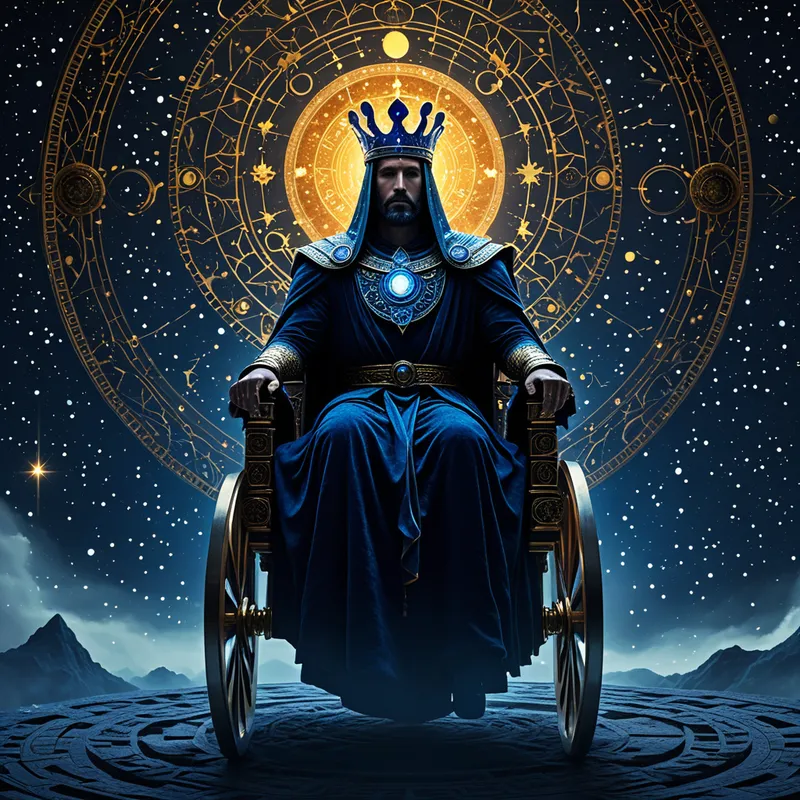
This was the birth-cry of Beriah, the World of Creation. It did not burst forth in fire and chaos, but emerged like a perfect, silent equation solving itself in the mind of God. The first entity to take form was the Merkabah, a chariot not of wood and iron, but of living consciousness. Its wheels were eyes that saw all possibilities; its creatures—the Chayot HaKodesh of Lion, Ox, Eagle, and Human—were not beasts but archetypes of service, their wings the sound of rushing intellect.
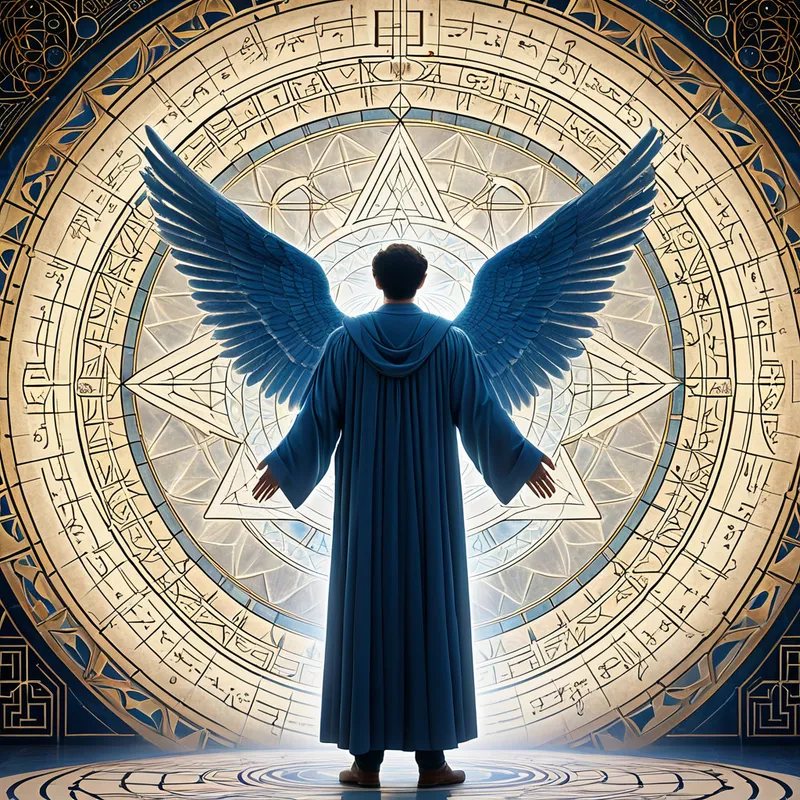
And upon this throne sat the architect, the prince of this newborn world: Metatron. His form was forged from the light that had once clothed the first human soul, now expanded to a scale that could hold a universe. His task was not to make earth or sky, but to make the ideas of earth and sky. With a quill of lightning and a scroll of nebula, he inscribed the laws of being. Here, in the sapphire halls of Beriah, gravity was a philosophical proposition. Time was a melody not yet played. Every star was a verb in the language of Sefirot, waiting to be conjugated.
The great conflict of Beriah was not a war, but a tension—the unbearable strain of the finite trying to host the infinite. The light of Atziluth, the world of pure emanation, poured into the crystalline structures of Beriah, threatening to shatter them with its intensity. Metatron, the great mediator, stood at the precipice, weaving veil after veil of angelic orders—Ophanim, Arelim, Hashmalim—each one a filter, a translator, reducing the blinding white fire into the coherent colors of intellect, will, and discernment.
The resolution was not an end, but an establishment. Beriah became the immutable blueprint, the divine court where the decrees of existence are sealed. It is a world of absolute truth, but truth so abstract it cannot be touched, only comprehended. The chariot rests, yet is perpetually in motion. The archangel writes, and his writing is the ongoing act of creation itself. From here, the distilled light descends, ready to be clothed in the emotions of Yetzirah and, finally, the substance of Assiah. The story of Beriah is the story of the moment a dream becomes a plan.
Cultural Origins & Context
The mythos of Beriah is not a single narrative but a complex theological framework born from the mystical heart of Judaism, developed over centuries by Kabbalists. Its primary sources are the foundational texts of Jewish mysticism, particularly the Zohar (13th century) and the earlier Merkabah and Heichalot literature. These were not tales for the public square but guarded teachings transmitted from master to initiated disciple in secret.
The societal function was profound. It provided a cosmic map for the adept, explaining the origin of evil (as the "shattering of vessels" in the lower worlds), the structure of the divine, and the path of prayer and ethical action as a means to influence these upper realms. To understand Beriah was to understand the architecture behind reality itself, to see one's own soul and the Torah as microcosms of this grand design. It was a myth for those seeking not just faith, but gnosis—a direct, intellectual apprehension of the divine machinery.
Symbolic Architecture
Beriah represents the pure realm of archetypal ideas, the mundus imaginalis where thought itself becomes the primary substance. It is the world of the blueprint, the patent, the philosophical law—the stage after inspiration but before manifestation.
Beriah is the divine mind in the act of conception, where potential takes its first definitive form. It is the realm where ‘Let there be light’ is formulated as a cosmic principle before any photon is emitted.
Psychologically, Beriah symbolizes the birth of the logos—the structuring principle of consciousness. It is the faculty that takes the raw, intuitive flash from Atziluth (the unconscious) and gives it form, name, and order. Metatron, as the ruler of this realm, embodies the transformed and elevated human intellect (his origin as the prophet Enoch) now serving as the mediator between the unknowable infinite and the structured world. The struggle with the overwhelming light is the psyche’s necessary act of creating boundaries, categories, and ego-structures to contain and channel the powerful, often disruptive, forces of the unconscious and the spirit.
The Dreamer's Resonance
When the pattern of Beriah stirs in modern dreams, it often manifests as dreams of profound intellectual clarity or architectural grandeur. One might dream of discovering a hidden library containing the book of one’s own destiny, written in a luminous, geometric script. Or of standing in a vast, silent cathedral of thought, where pillars are equations and stained glass windows depict archetypal stories.
Somatically, this can correspond to a feeling of mental expansion, a "click" of understanding, or a tension headache born from intense concentration. Psychologically, the dreamer is undergoing a process of conceptualization. They are at the threshold where a vague feeling, a nascent talent, or a spiritual impulse is seeking to become a conscious plan, a life philosophy, or a creative project. The dream may also reveal the "angelic orders"—the internal filters and belief systems (the Ophanim, Arelim) we use to translate raw insight into something we can understand and use. A blockage here might appear as crumbling structures or illegible texts, signaling that one's current mental frameworks are inadequate to contain a new level of awareness.
Alchemical Translation
The alchemical process mirrored in Beriah is coagulatio—the fixing of the volatile spirit into a stable, defined form. In the journey of individuation, this is the critical phase following the inspiratio of Atziluth. You have received a vision, a calling, or a deep insight. Beriah is the work of taking that mercury and turning it into philosophical sulfur—giving it a defined shape and property.
The triumph of Beriah is not in making something physical, but in making something possible. It is the internal act of legislation that declares, "This shall be the law of my being."
For the modern individual, this translates to the often-overlooked work of inner governance. It is writing the personal constitution after the revolution of awakening. It is defining your core values, articulating your life's purpose in clear terms, designing the structures (habits, routines, boundaries) that will support your growth. Metatron’s role is akin to activating the inner sage or administrator, the part of the self that can hold a grand vision without being overwhelmed by it, and can patiently draft the plans for its gradual, sustainable manifestation. To skip Beriah is to have brilliant ideas that never leave the realm of fantasy, or spiritual experiences that fail to translate into a changed life. One must sit in the throne-room of one's own intellect and, with sober clarity, sign the decrees of one's own becoming.
Associated Symbols
Explore related symbols from the CaleaDream lexicon:
- Throne — The central symbol of Beriah, representing established divine authority, the seat of consciousness, and the structured mind from which governance of the lower worlds emanates.
- Circle — Represents the perfection of divine thought in Beriah, the wholeness of the archetypal idea before it descends into the linearity and duality of lower manifestation.
- Order — The fundamental principle of Beriah, the divine intellect imposing harmony, hierarchy, and law upon the pure creative potential flowing from above.
- Light — In Beriah, light is not illumination but pure intelligibility, the substance of divine mind and the abstract radiance that must be filtered into comprehensible forms.
- Temple — Symbolizes Beriah as the supernal sanctuary, the perfectly designed cosmic house of God built not from stone but from the geometry of thought and will.
- Merkabah — The divine chariot-throne, representing the vehicle of consciousness that traverses and stabilizes the World of Creation, connecting the sefirot and angelic realms.
- Spirit — The essential quality of Beriah; it is the world of pure spirit-intellect, where beings are defined by their essence and function rather than material form.
- Blueprint — The core function of Beriah: the immutable archetypal plan, the divine design that contains all potential manifestations in ideal form.
- Crown — Corresponds to the sefirah Keter as it manifests in Beriah, the crown of divine will and authority that legitimizes and directs the creative process.
- Key — Represents the intellectual comprehension granted in Beriah, which unlocks the mysteries of the upper worlds and provides the template for building reality below.