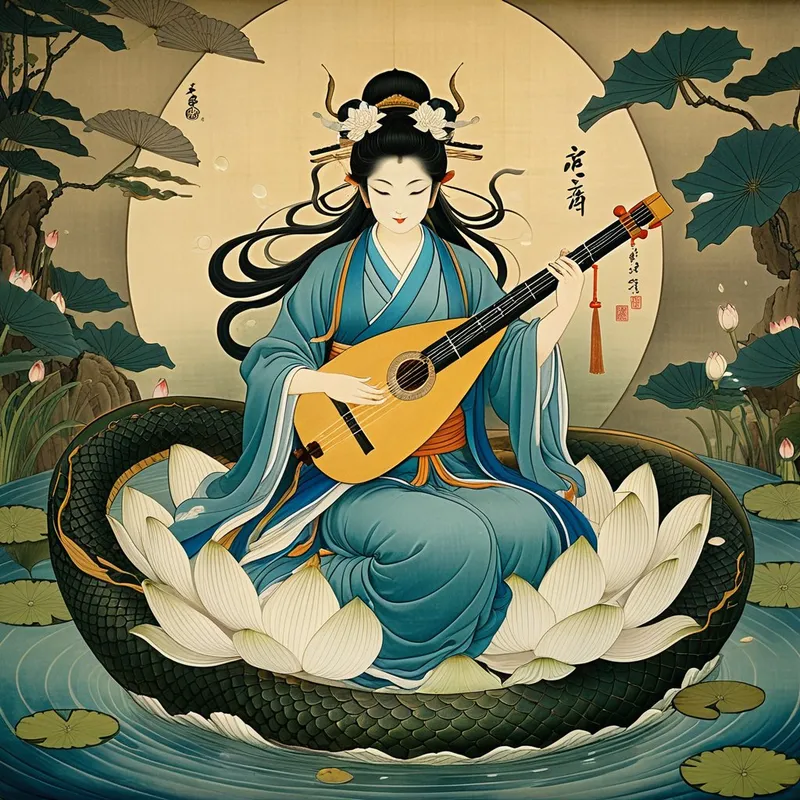
Benzaiten Myth Meaning & Symbolism
The goddess Benzaiten emerges from the sea, bringing music, wisdom, and the power to harmonize opposing forces through the sacred flow of water and sound.
The Tale of Benzaiten
Listen. Before the first note was ever plucked from a lute’s string, there was only the deep, wordless roar of the sea. It was a time of formless potential, a churning void where nothing was separate, and everything was one. From this primordial soup of consciousness, a longing arose—a desire for articulation, for a voice to speak the world into being.
And so, she emerged.
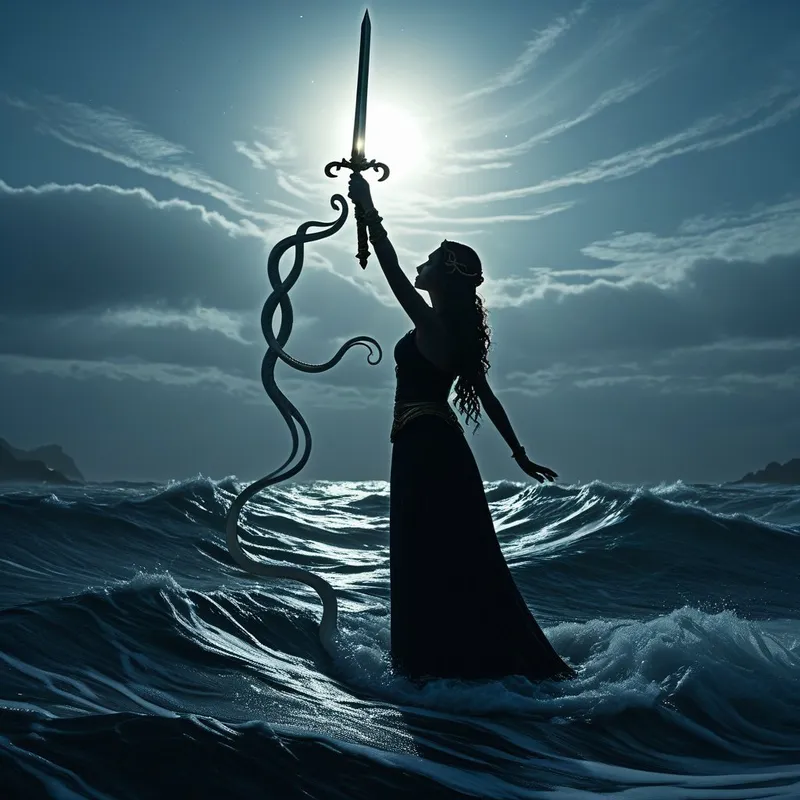
Not with a crash, but with a rising melody. The waters parted not in fury, but in a graceful, swelling chord. She was Benzaiten, and she rose from the ocean’s heart cradling the sacred Cintamani jewel in one hand, a sword of discerning wisdom in another. Her skin was the pale luminescence of moonlit foam, her robes the shifting hues of twilight on water. Around her coiled the great ryu, its scales like polished jade, its presence an echo of the deep’s untamed power. In her other hands, she held a bow, an arrow, a key, a mallet, and, most importantly, the biwa.
She did not speak. She sang. Her voice was the sound of a waterfall meeting the pool below, of wind through river reeds, of the first drop of rain on a still pond. With each note, form coalesced from chaos. The random crash of waves began to find rhythm. The howl of the wind discovered melody. She played her biwa, and the very landscape listened—mountains softened their slopes, rivers carved their beds with more grace, and the stars in the night sky seemed to pulse in time.
But a dissonance remained. A serpentine spirit of the old, formless chaos, a great orochi of noise, thrashed in the depths, resisting the order of her song. It was pure, undifferentiated sound, a cacophony that threatened to unravel the harmonies she wove. Benzaiten did not fight it with force. She descended, biwa in hand, into the abyss where the orochi dwelt. There, in the absolute dark, she began to play. Not a song of conquest, but of invitation. She played the chaos itself, reflecting its wildness back in a form it could recognize.
The orochi’s thrashing slowed. Its roars softened to rumbles, then to deep, resonant tones. One by one, its many heads ceased their mindless shrieking and began to listen, then to harmonize. The formless noise was not destroyed, but transformed—incorporated into the grander symphony. The orochi became the dragon upon which she now often rides, no longer an enemy of order, but its powerful, foundational bass note. From that day, every stream’s babble, every storm’s fury, and every human composition carried within it the memory of that reconciliation: the moment chaos was sung into music.
Cultural Origins & Context
The figure of Benzaiten is a profound example of cultural syncretism, a river fed by many tributaries. Her origins lie in the Hindu goddess Saraswati, who traveled the Silk Road, transformed by Buddhist theology in China, and finally arrived on Japanese shores. By the Heian period, she was fully enshrined in the Japanese spiritual landscape, not as a foreign import, but as a vital native deity.
She was adopted into the <abbr title="The "Seven Gods of Fortune," a popular grouping of deities from different traditions in Japanese folklore.">Shichifukujin, the Seven Gods of Fortune, as the bestower of artistic talent, eloquence, and wealth—the latter understood as the wealth of flowing prosperity, not stagnant coin. Her worship was particularly fervent among the aristocracy, artists, and court musicians, who saw in her the divine source of their craft. Temples dedicated to her, like the iconic Enoshima Shrine, were often built on islands or near water, emphasizing her connection to the elemental and the liminal spaces between land and sea. Her myth was not just a story to be told, but a spiritual technology for invoking creativity and harmonizing one’s life with the natural and social order.
Symbolic Architecture
Benzaiten is the archetypal embodiment of everything that flows. This is her core symbolic architecture. She is not the goddess of a static object called “music,” but of the process of music-making—the flow of breath, the vibration of string, the transmission of emotion. She governs the flow of water in rivers, the flow of words in conversation or poetry, the flow of time, and the flow of financial fortune.
To invoke Benzaiten is to align oneself with the principle of creative current, to move from the stagnant pond of potential to the flowing river of manifestation.
Her eight arms symbolize her multifaceted capacity to act in the world simultaneously—to create, protect, bless, and cut away illusion. The biwa is the instrument of formation, turning amorphous feeling into structured beauty. The sword is the tool of discrimination, cutting through ignorance and muddy thinking to reveal clarity. The Cintamani jewel represents the luminous, wish-fulfilling mind that emerges when flow is achieved. Most critically, her subjugation of the dragon-serpent represents the ultimate symbolic act: the taming and integration of the primal, chaotic unconscious (the shadow) into the conscious ego. The chaos is not killed; its immense energy is harnessed and given a voice in the symphony of the self.
The Dreamer's Resonance
When the pattern of Benzaiten stirs in the modern dreamer, it often signals a confrontation with a creative or emotional logjam. One might dream of a frozen river, a broken instrument that cannot be played, or being unable to speak while underwater. These are somatic metaphors for stagnation. The psyche is signaling that a vital flow—of ideas, of feeling, of expression—has been blocked.
Conversely, dreams of finding oneself playing music effortlessly to a captivated audience, of swimming powerfully in a clear current, or of speaking with unexpected eloquence, mark the release of this flow. The appearance of snakes or dragons in such dreams is crucial. Are they threatening, representing a feared creative chaos or emotional outburst? Or are they companionable, even majestic, suggesting the dreamer is beginning to integrate that raw power? The dream of Benzaiten is ultimately a dream of reconciliation between the structured, composed self and the wild, intuitive, often frightening depths of one’s own nature.

Alchemical Translation
The alchemical journey modeled by Benzaiten is the transmutation of Nigredo—the primal, dark, chaotic matter of the soul—into the gold of authentic creativity and wisdom. It is a path of individuation that does not seek to purge the unconscious, but to converse with it.
The first stage is the descent, mirroring Benzaiten’s journey into the abyss to meet the orochi. Psychologically, this is the often-uncomfortable dive into one’s own shadow material: the repressed emotions, the unruly desires, the “noise” we try to silence. The modern seeker must, like Benzaiten, hold both the sword (conscious analysis) and the biwa (receptive creativity) when facing this inner chaos.
The alchemical secret is that the prima materia for your greatest creation is often the very chaos you fear.
The second stage is resonance. Benzaiten does not attack the chaos; she plays to it. This is the psychological act of engaging with the shadow not in battle, but in dialogue. Journaling, active imagination, artistic expression—these are forms of “playing the biwa” for the inner dragon. The goal is to find the fundamental frequency, the core truth, within the noise.
The final stage is integration, where the chaotic energy becomes a source of power. The orochi becomes the mount. The furious anxiety becomes passionate focus. The inarticulate rage becomes powerful prose. The eight-armed form of the integrated self can now act with grace in multiple domains, its creativity fed by a deep, well-managed connection to the primal source. One becomes a conduit for what wants to flow through them, achieving a state of being in which life itself feels like a form of music.
Associated Symbols
Explore related symbols from the CaleaDream lexicon: