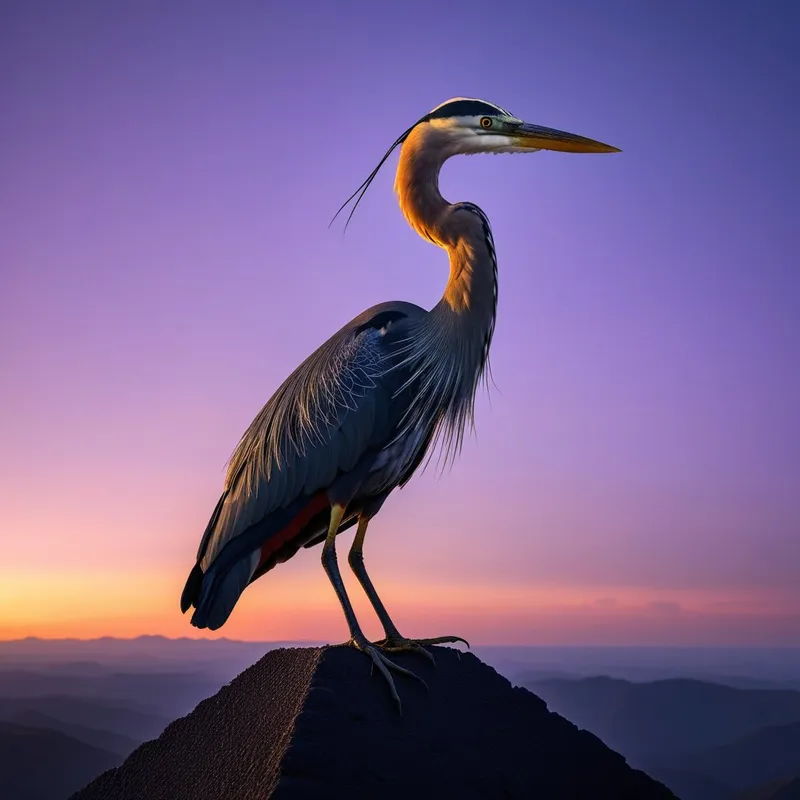
Benu Bird Myth Meaning & Symbolism
The solitary Benu Bird, self-created at the dawn of time, heralds new cycles of cosmic and personal rebirth from the ashes of the old.
The Tale of Benu Bird
In the beginning, there was only Nun—a boundless, silent, and dark ocean of potential. No sun had yet carved [the sky](/myths/the-sky “Myth from Persian culture.”/), no land had broken the waters, no voice had ever spoken a name. There was only the deep, patient waiting of what could be.
Then, from within that liquid darkness, a mound emerged. Not of earth or stone, but of the very essence of order itself. It was the Benben stone, the first solid [thing](/myths/thing “Myth from Norse culture.”/) in a universe of flux. And upon its peak, a stillness gathered, a concentration of silence so profound it became a presence.
From that stillness, a light kindled. It was not a light that shone upon the mound, but one that emanated from it. The light coalesced, took form, and stretched wings of gold and fiery red. It was the Benu. With a sound that was both a whisper and a [thunderclap](/myths/thunderclap “Myth from Various culture.”/)—the first sound ever made—it opened its beak and cried out across the face of Nun. That cry was not a song of joy or sorrow, but a Word. It was the sound of a name being spoken, the name of the sun, Ra.
And with that utterance, the sun disc broke upon [the horizon](/myths/the-horizon “Myth from Various culture.”/), flooding the newborn world with light and time. The Benu had sung [the world](/myths/the-world “Myth from Tarot culture.”/) into being. It perched, watching the first day unfold, the master of its own beginning. It knew no father, no mother. It was [the self](/myths/the-self “Myth from Jungian culture.”/)-created one, the [Khepri](/myths/khepri “Myth from Egyptian culture.”/), the becoming.
Eons would pass. Kingdoms of men would rise and fall along the Nile. The Benu would vanish, only to return when the world grew weary, when cycles neared their end. It would build a nest not of twigs, but of sacred spices—myrrh and cinnamon—at the pinnacle of a holy sycamore or upon the sacred obelisk at Iunu. There, it would set itself alight with the pure fire of the sun. It would be consumed in a blaze of fragrant smoke and brilliant flame, a willing sacrifice to the ending.
From the pyre, from the nest of ashes, a new Benu would emerge—identical, yet renewed. It would lift the ashes of its former self, encase them in an egg of myrrh, and carry them to [the temple](/myths/the-temple “Myth from Jewish culture.”/) of the sun, depositing them upon the [altar](/myths/altar “Myth from Christian culture.”/) of Ra. Its flight was the [herald](/myths/herald “Myth from Greek culture.”/) of a new Sothic cycle, a new age for the world. It was the promise written in ash and flame: what ends is only a prelude to a more glorious beginning.
Cultural Origins & Context
The myth of the Benu is woven into the very fabric of ancient Egyptian cosmology, originating in the theology of Iunu (Heliopolis), the “City of the Pillar.” Here, the physical Benben stone was venerated as the seed of creation. The Benu was not merely a story for the populace; it was a central pillar of priestly and royal ideology.
It functioned as the ba (soul-manifestation) of the sun god Ra, and later, of [Osiris](/myths/osiris “Myth from Global/Universal culture.”/), linking solar cycles with the promise of resurrection. [The pharaoh](/myths/the-pharaoh “Myth from Egyptian culture.”/), as the living incarnation of divine order, was intimately connected to the Benu. Its cyclical [death](/myths/death “Myth from Tarot culture.”/) and rebirth mirrored the eternal kingship, ensuring the stability of Maat across millennia. The myth was passed down in temple liturgies, funerary texts like the [Book of the Dead](/myths/book-of-the-dead “Myth from Egyptian culture.”/), and royal inscriptions. It was a sacred narrative that explained the nature of time itself—not as a linear march, but as a series of decaying and renewing cosmic seasons, each heralded by the solitary, majestic bird.
Symbolic Architecture
The Benu is a master [symbol](/symbols/symbol “Symbol: A symbol can represent an idea, concept, or belief, serving as a powerful tool for communication and understanding.”/) of autogenesis—the act of self-creation. It represents the primordial spark of [consciousness](/symbols/consciousness “Symbol: Consciousness represents the state of awareness and perception, encompassing thoughts, feelings, and experiences.”/) that arises from the undifferentiated waters of the unconscious (Nun). It is the archetypal [moment](/symbols/moment “Symbol: The symbol of a ‘moment’ embodies the significance of transient experiences that encapsulate emotional depth or pivotal transformations in life.”/) of inspiration, the “aha!” that emerges not from external teaching, but from the deep, inner well of the [psyche](/myths/psyche “Myth from Greek culture.”/).
To be the Benu is to recognize oneself as the author of one’s own existence, to take responsibility for the creative word that brings one’s inner world into being.
Its association with the sun and the obelisk grounds it as a symbol of spiritual [ascension](/symbols/ascension “Symbol: A profound sense of rising upward, often representing spiritual enlightenment, personal growth, or transcendence beyond physical limitations.”/) and [illumination](/symbols/illumination “Symbol: A sudden clarity or revelation, often representing spiritual awakening, intellectual breakthrough, or the dispelling of ignorance.”/). The [bird](/symbols/bird “Symbol: Birds symbolize freedom, perspective, and the connection between the earthly and spiritual realms, often representing the soul’s aspirations or personal growth.”/) does not flee the world but becomes the [conduit](/symbols/conduit “Symbol: A passage or channel that transfers energy, information, or substance from one place to another, often hidden or structural.”/) through which [divine light](/myths/divine-light “Myth from Christian culture.”/) ([awareness](/symbols/awareness “Symbol: Conscious perception of self, surroundings, or internal states. Often signifies awakening, insight, or heightened sensitivity.”/)) enters the [material](/symbols/material “Symbol: Material signifies the tangible aspects of life, often representing physical resources, desires, and the physical world’s influence on our existence.”/) [plane](/symbols/plane “Symbol: Dreaming of a plane often symbolizes a desire for freedom, adventure, and new possibilities, as well as transitions in life.”/). Its fiery [death](/symbols/death “Symbol: Symbolizes transformation, endings, and new beginnings; often associated with fear of the unknown.”/) is not an annihilation, but an [alchemical process](/symbols/alchemical-process “Symbol: A symbolic transformation of base materials into spiritual gold, representing inner purification, integration, and the journey toward wholeness.”/) of purification. The [nest](/symbols/nest “Symbol: A ‘nest’ symbolizes safety, home, and the nurturing aspects of personal and familial connections.”/) of sacred spices signifies that the [material](/symbols/material “Symbol: Material signifies the tangible aspects of life, often representing physical resources, desires, and the physical world’s influence on our existence.”/) of one’s [life](/symbols/life “Symbol: The symbol of ‘Life’ represents a journey of growth, interconnectedness, and existential meaning, encompassing both the joys and challenges that define human experience.”/)—even its suffering and experiences—can be transformed into the very fuel for renewal. The Benu teaches that destruction is in service of a more essential [pattern](/symbols/pattern “Symbol: A ‘Pattern’ in dreams often signifies the underlying structure of experiences and thoughts, representing both order and the repetitiveness of life’s situations.”/). The “old self”—be it an outworn [identity](/symbols/identity “Symbol: Identity represents the sense of self, encompassing personal beliefs, cultural background, and social roles.”/), a crippling belief, or a finished phase of [life](/symbols/life “Symbol: The symbol of ‘Life’ represents a journey of growth, interconnectedness, and existential meaning, encompassing both the joys and challenges that define human experience.”/)—must be ritually surrendered to the flame so the core, eternal essence can be reborn, unburdened.
The Dreamer’s Resonance
When the Benu pattern stirs in the modern dreamer, it often manifests in periods of profound transition or existential crisis. One may dream of solitary birds of striking beauty, of spontaneous fires that cleanse rather than destroy, or of finding a single, luminous egg in a place of desolation. Somatic sensations might include a feeling of pressure or heat at [the crown](/myths/the-crown “Myth from Various culture.”/) of the head (the “Benben” of the self), or a profound, eerie silence that feels pregnant with potential.
Psychologically, this marks the psyche’s preparation for a nodal point—a death and rebirth of the personality. The dreamer is at the end of a major life cycle: a career, a relationship, a long-held self-concept. The unconscious is presenting the archetype of the Benu as both a map and a promise. The feeling of solitude in the dream is critical; the Benu’s work is not social. It is the deeply personal, often lonely, labor of allowing a part of oneself to die so that a more authentic self can take flight. The dream is an invitation to build one’s own “nest of spices”—to consciously gather the valuable lessons and essences of the ending phase—and to have the courage to set it alight.
Alchemical Translation
The journey of the Benu is the quintessential model of psychic transmutation, or what Jung termed individuation. It begins in the [nigredo](/myths/nigredo “Myth from Alchemical culture.”/), the blackness of Nun—a state of depression, confusion, or felt meaninglessness. From this dark sea, [the ego](/myths/the-ego “Myth from Jungian culture.”/) must find the will to erect its own Benben, a point of conscious focus and stability.
The fire is not an enemy to be feared, but the divine spark of Ra itself, the catalyst that transmutes leaden despair into golden awareness.
The [albedo](/myths/albedo “Myth from Alchemical culture.”/) and citrinitas (whitening and yellowing) are represented by the bird’s radiant plumage and its solar cry—the emergence of clarity and a new, guiding vision. The culmination is the [rubedo](/myths/rubedo “Myth from Alchemical culture.”/), the reddening: the fiery immolation. This is the most critical stage for the modern individual. It is the voluntary sacrifice of the outmoded [persona](/myths/persona “Myth from Greek culture.”/), the burning away of attachments to who we thought we were supposed to be. We must become both the priest and the offering.
The rebirth is not into a different self, but into a more complete and essential version of the original. The new Benu that rises, carrying the ashes of the old to the altar, symbolizes the integrated consciousness that honors its past transformations without being bound by them. It has mastered the cycle. To integrate the Benu is to understand that our deepest crises are not interruptions of our path, but the very mechanism of its creation. We are perpetually rising from our own ashes, self-created, anew.
Associated Symbols
Explore related symbols from the CaleaDream lexicon: