Beltane & Summer Solstice Fires Myth Meaning & Symbolism
The myth of two great fires marking the year's bright half, celebrating the union of the Dagda and the Danu, and the triumph of solar power at midsummer.
The Tale of Beltane & Summer Solstice Fires
Listen, and hear the tale of the year’s turning, written not on parchment, but in flame and shadow upon the land itself.
When [the world](/myths/the-world “Myth from Tarot culture.”/) was younger and [the veil](/myths/the-veil “Myth from Various culture.”/) between what is seen and unseen was as thin as morning mist, the people marked time by the breath of [the earth](/myths/the-earth “Myth from Hindu culture.”/). The dark half of the year, ruled by the Cailleach, held the land in a sleep of stone and frost. But as the wheel turned, a longing stirred—a warmth in the deep soil, a quickening in the hidden root.
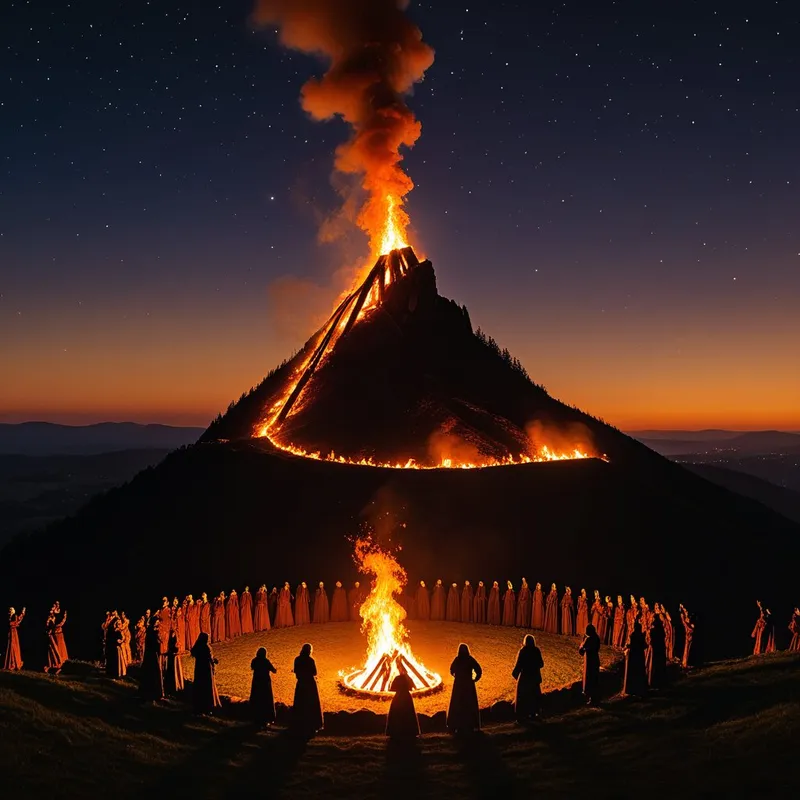
It began on the eve of the first of Bealtaine. The air itself was charged, thick with the scent of [hawthorn](/myths/hawthorn “Myth from Celtic culture.”/) and possibility. On sacred hills, the people gathered as twilight bled into a velvet dark. All hearth fires in the tribe were extinguished, a collective breath held in the blackness. Then, from the heart of the community, two great fires were kindled by [the druids](/myths/the-druids “Myth from Celtic culture.”/). Not from common spark, but from the sacred friction of oak and rowan, woods of sun and protection. These were the Teine Éiginn, the need-fires, born of pure ritual.
Between these twin pillars of flame, the people drove their cattle—a river of lowing life passing through a gateway of purifying light and smoke, to safeguard them for the season of plenty. And the people themselves leaped the fires! Young and old, they soared over the burning line, their shouts mingling with the crackle of wood. It was a spell cast with their very bodies: a prayer for fertility, for health, for the burning away of the old year’s stagnation. This was the work of the [Dagda](/myths/dagda “Myth from Celtic culture.”/) and the Danu—their divine union celebrated in the human act, the fertile earth now wed to the strengthening sun.
The land answered. It grew lush and green, a riot of life under the sun’s long gaze. But the sun, in its glory, must be met, celebrated at its peak, lest its power wane too soon. And so came the Litha fire. On the highest hill, where the world seemed closest to [the sky](/myths/the-sky “Myth from Persian culture.”/), a bonfire was built as the sun reached its zenith and hesitated. As dusk finally gathered on the longest day, the fire was lit—not for purification now, but for strength. It was a beacon of solidarity with the sun, a pillar of light to bolster the solar king in his coming decline. Torches were lit from this central fire and carried down to every field and home, weaving a web of protective light across the sleeping land. The fire was a promise and a plea: Remember this strength. Carry this light into the gathering dark.
Cultural Origins & Context
The fires of [Beltane](/myths/beltane “Myth from Celtic culture.”/) (Bealtaine) and the Summer Solstice were not mere festivals but vital, communal technologies of the spirit for the insular Celtic peoples. These were primarily pastoral and agricultural societies whose survival was inextricably tied to the cycles of their cattle and crops. The myths were not written down by their original bearers; they were enacted, performed, and embedded in the ritual itself, passed through the oral traditions maintained by the druidic orders and later, in fragmented forms, through folk practice.
The societal function was multifaceted and profoundly practical on a metaphysical level. Beltane (along with its counterpart [Samhain](/myths/samhain “Myth from Celtic culture.”/)) divided the year into its bright and dark halves. The rituals were a form of sympathetic magic and communal reset. Extinguishing all hearth fires and relighting them from a common, sacred source physically manifested the rebirth of the community and its connection to the divine. Driving cattle between fires was a literal act of purification and protection against supernatural and natural disease. The solstice fire, meanwhile, was an act of cosmic alignment—a human participation in the celestial drama to ensure the sun’s return. These were moments where the community collectively negotiated its relationship with the powerful, often capricious, forces of nature, sovereignty, and [the Otherworld](/myths/the-otherworld “Myth from Celtic culture.”/).
Symbolic Architecture
At its core, this mythic complex is a profound [dialogue](/symbols/dialogue “Symbol: Conversation or exchange between characters, representing communication, relationships, and narrative flow in games and leisure activities.”/) between opposites, mediated by the transformative element of fire.
The Beltane fire represents the fire of kindling, of sacred union. It is the spark of [life](/symbols/life “Symbol: The symbol of ‘Life’ represents a journey of growth, interconnectedness, and existential meaning, encompassing both the joys and challenges that define human experience.”/) itself, the [moment](/symbols/moment “Symbol: The symbol of a ‘moment’ embodies the significance of transient experiences that encapsulate emotional depth or pivotal transformations in life.”/) of [conception](/symbols/conception “Symbol: The beginning of new life, ideas, or projects; a moment of profound creation and potential.”/)—both of the land’s [fertility](/symbols/fertility “Symbol: Symbolizes creation, growth, and abundance, often representing new beginnings, potential, and life force.”/) and of new endeavors in the [human](/symbols/human “Symbol: The symbol of a human represents individuality, complexity of emotions, and social relationships.”/) sphere. It symbolizes the conscious, willed [decision](/symbols/decision “Symbol: A decision in a dream reflects the choices one faces in waking life and can symbolize the pursuit of clarity and resolution.”/) to step from the introspective, dark half of the [year](/symbols/year “Symbol: A unit of time measuring cycles, growth, and passage. Represents life stages, progress, and mortality.”/) into the expressive, bright half. The act of leaping the fire is a classic [rite](/symbols/rite “Symbol: A formal, ceremonial act marking a significant transition, initiation, or passage in life or spiritual journey.”/) of [passage](/symbols/passage “Symbol: A passage symbolizes transition, movement from one phase of life to another, or a journey towards personal growth.”/): a willing confrontation with a dangerous, purifying threshold to emerge transformed on the other side.
Fire does not ask permission to consume what is dead and dry; it is the agent of the will to live, transforming decay into warmth and light.
The [Summer Solstice](/symbols/summer-solstice “Symbol: The Summer Solstice symbolizes the peak of energy and growth, representing abundance and the full expression of life’s potential.”/) fire represents the fire of [culmination](/symbols/culmination “Symbol: A point of completion or climax in a process, often marking the end of a cycle and the achievement of a goal.”/), of peak power and conscious sacrifice. It is [the ego](/myths/the-ego “Myth from Jungian culture.”/), or the solar principle, at its maximum [strength](/symbols/strength “Symbol: ‘Strength’ symbolizes resilience, courage, and the ability to overcome challenges.”/), immediately followed by the acknowledgment of its necessary decline. This fire is not about [birth](/symbols/birth “Symbol: Birth symbolizes new beginnings, transformation, and the potential for growth and development.”/), but about fortification for the [journey](/symbols/journey “Symbol: A journey in dreams typically signifies adventure, growth, or a significant life transition.”/) ahead into the unknown. It symbolizes the moment of greatest [clarity](/symbols/clarity “Symbol: A state of mental transparency and sharp focus, often representing resolution of confusion or attainment of insight.”/) and [achievement](/symbols/achievement “Symbol: Symbolizes success, mastery, or reaching a goal, often reflecting personal validation, social recognition, or overcoming challenges.”/), which must be consciously honored and then released, its essence carried forward like a [torch](/symbols/torch “Symbol: A portable light source symbolizing illumination, guidance, and the transfer of knowledge or life force.”/) into the coming [night](/symbols/night “Symbol: Night often symbolizes the unconscious, mystery, and the unknown, representing the realm of dreams and intuition.”/).
Together, these two fires bookend the [season](/symbols/season “Symbol: Represents cycles of life, change, and the passage of time. Symbolizes growth, decay, renewal, and different phases of existence.”/) of growth. One ignites potential; the other consolidates and defends what has been achieved. They frame the human and psychic journey from impulsive beginning to mature, defended realization.
The Dreamer’s Resonance
When this mythic pattern stirs in the modern dreamer, it often signals a critical phase of psychic energy management and transition. Dreaming of lighting a large, communal fire may point to a burgeoning creative or relational energy seeking expression—a “Beltane” moment in the [psyche](/myths/psyche “Myth from Greek culture.”/) where a new project, relationship, or aspect of [the self](/myths/the-self “Myth from Jungian culture.”/) is demanding to be born and celebrated. There is often an accompanying somatic sense of quickening, restlessness, or fertile anticipation.
Conversely, dreams of a towering, solitary fire on a height at dusk, or of carefully carrying a fragile flame through darkness, speak to a “Solstice” process. This is the psyche working with the integration of a peak experience, a hard-won achievement, or a moment of supreme confidence. The dream may be modeling the necessary task of honoring this peak while consciously preparing for a natural phase of contraction, conservation, or introspection that must follow. The somatic resonance here can be one of proud exhaustion, vigilant protection, or the bittersweet acknowledgment of a cycle’s turning point.
Alchemical Translation
For the individual on the path of individuation, this myth maps the alchemical process of [solutio](/myths/solutio “Myth from Alchemical culture.”/) (dissolution in the [Beltane fires](/myths/beltane-fires “Myth from Celtic culture.”/)) followed by [coagulatio](/myths/coagulatio “Myth from Alchemical culture.”/) (solidification in the Solstice light).
The Beltane leap is the courage to dissolve old, rigid structures—outmoded habits, identities, or narratives—in the purifying flames of conscious choice. It is the “lover” archetype in full expression: the ecstatic, risky union with life that precedes all creation. One must willingly step into the fire of one’s own passions and vulnerabilities to be remade.
The Solstice vigil is the subsequent, equally vital stage of coagulatio: taking the essence of that experience and giving it durable form. It is the work of the “ruler” or “sage” archetype, consolidating gains, establishing boundaries, and creating a conscious ethos from the raw material of lived experience. The light is no longer a wild, spreading blaze, but a focused torch to illuminate the next step on the path.
The ultimate alchemy is not in avoiding the dark, but in learning to carry the sun within, lighting a small, steadfast fire against the vast and necessary night.
Thus, the psychic journey modeled here is not a linear ascent, but a spiraling dance. We continually kindle new beginnings from the ashes of old forms, celebrate our peaks, and then gather our light to navigate the inevitable descents. The myth teaches that both the kindling and the vigilant tending of our inner fire are sacred, non-negotiable acts in the soul’s eternal summer.
Associated Symbols
Explore related symbols from the CaleaDream lexicon: