
Bed of straw in peasant homes Myth Meaning & Symbolism
A tale where a humble straw bed becomes a sanctuary for the divine, weaving ancestral warmth and the sacred hearth into the fabric of daily life.
The Tale of Bed of straw in peasant homes
Listen, and hear the whisper in the smoke, the story woven into the very reeds beneath your rest. It was not in the glittering halls of Valhalla that this tale was spun, but in the low, earth-scented dark of a peasant’s home, where the wind from the fjords bit through the chinks in the wall.
The winter was a Jötunn that year, its breath so fierce it stole the warmth from the sun itself. In a small steading, a family huddled around a meager fire, their stores dwindling, their hope a thin thread. The father, Bjorn, was a man whose back was bent from the soil, and his wife, Astrid, whose hands were raw from weaving what little they had. Their children slept fitfully, pressed together for warmth.
One night, as the storm screamed like a pack of wolves, a knock came—not a thunderous blow, but a faint, weary tapping. Bjorn, thinking it a trick of the wind, hesitated. But Astrid, her heart a softer hearth, rose. She opened the heavy door to reveal a figure shrouded in a travel-stained cloak, hood pulled low against the blizzard’s teeth. No weapon was visible, only a staff of gnarled wood, and the stranger seemed to carry the weight of the world in his slumped shoulders. He asked not for mead or meat, but simply for shelter from the storm—a place to rest his bones until the dawn.
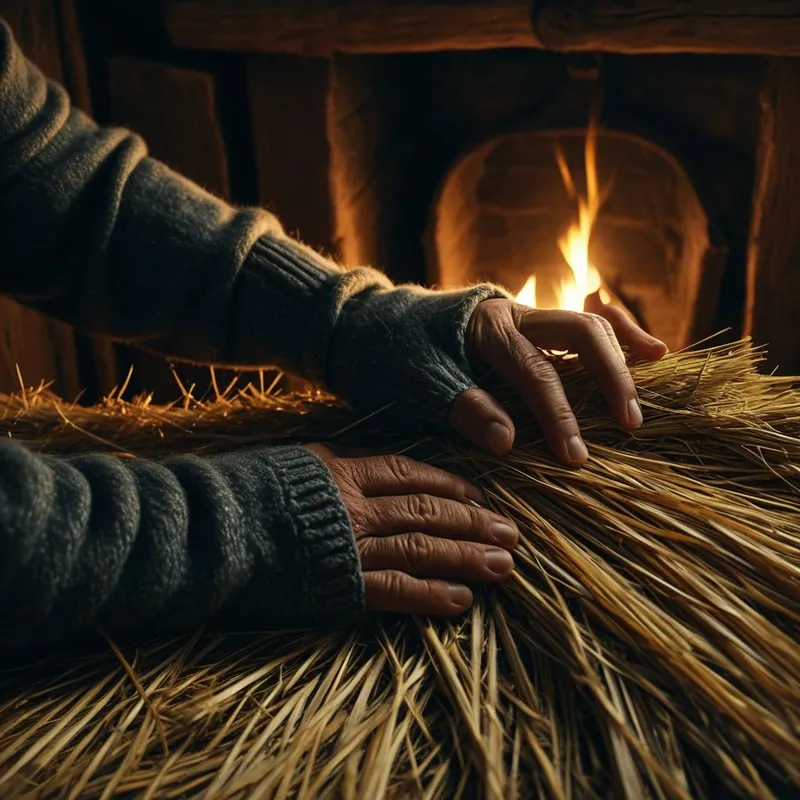
They had so little. A corner of hard-packed earth, a pile of firewood that would not last the week. Yet, Astrid looked at their own bed, a simple frame layered with the last of the autumn straw and their only good woolen blanket. Without a word, she went to it. She gathered the blanket and the sweetest, driest straw from its center. With Bjorn’s silent help, they built a new bed in the warmest corner, near the fire’s glow. They gave the stranger their own comfort, taking for themselves the older, damper straw.
The stranger said nothing, only nodded, a glint perhaps of an eye from within the hood. He lay upon the humble offering. The family retreated to their colder rest. That night, the storm did not abate, but inside the longhouse, a profound quiet descended. The fire, which had been sputtering, burned steadily with a calm, golden flame. The air grew thick with the scent of drying hay and earth, a scent of security. The children’s shivering ceased, and they fell into a deep, dreamless sleep.
At first light, the storm had passed. The stranger was gone. Where he had lain, the straw gleamed as if touched by the summer sun, and upon the blanket rested two simple items: a perfect, ripe apple, out of season, and a small, smooth river stone that was warm to the touch. And from that day, no matter how harsh the winter, that house knew a peculiar warmth. The hearth fire was always easier to light, the sleep of its inhabitants was always deep and restoring, and a subtle, protective peace settled over the threshold. The straw bed remained, and it was said that to lie upon it was to feel the safety of the earth itself, a sanctuary woven from simple offering.
Cultural Origins & Context
This story belongs not to the Poetic Edda or the Prose Edda, but to the oral tapestry of hearth and home. It is a folk myth, passed from mother to daughter, father to son, in the long dark of the Nordic winter, whispered alongside practical knowledge of sowing and harvest. Its tellers were the farmers, the fishermen, the shepherds—people for whom hospitality (gestrisni) was not merely a virtue but a sacred law, a necessary pact of survival in a world ruled by capricious elements.
The societal function was twofold. Practically, it reinforced the critical importance of offering shelter, a code that could mean the difference between life and death in a sparse landscape. On a deeper level, it sacralized the domestic sphere. While the gods of Asgard waged epic battles, the divinity of the home was found in the straw on the floor and the warmth of the fire. This myth elevated the peasant’s dwelling from a mere shelter into a potential temple, where any stranger at the door could be a disguised deity—perhaps Odin the wanderer, or a benevolent land-spirit (landvættir)—testing the heart of the household. It taught that the greatest magic was not in runes alone, but in the conscious act of creating sanctuary.
Symbolic Architecture
The straw bed is the central symbol, a masterpiece of humble alchemy. Straw, the discarded husk of the grain, represents what is common, leftover, and seemingly without value. The bed frame, often of rough-hewn wood, is the structure of daily life. Together, they form the literal and psychological foundation of rest, vulnerability, and regeneration.
The offering of one’s own comfort is the primal ritual that transforms straw into sanctuary. It is the moment the mundane becomes consecrated.
The mysterious traveler embodies the archetype of the psychopomp in its gentlest form—not a guide to the land of the dead, but a guide to the depths of the soul’s own hearth. He represents the unknown, the Other, whose arrival disrupts the fragile equilibrium of the ego (the family’s scarce resources). His acceptance of the humble gift and his silent blessing signify that the true "wealth" of the psyche is not in hoarding, but in the courageous vulnerability of giving from one’s core. The gifts left behind—the apple (fruitfulness, eternal life from the goddess Iðunn) and the warm stone (the enduring, grounded heart of the home)—are symbols of the psychic rewards of this integration: renewed vitality and unshakable, grounded peace.

The Dreamer's Resonance
To dream of making, finding, or resting in a bed of straw in a simple, earthy home speaks to a profound somatic and psychological process. It is the psyche’s signal of a deep yearning for grounding and essential comfort. This is not the ornate comfort of the ego’s desires, but the primal comfort of the body and soul feeling utterly held and safe.
Somatically, it may arise during periods of burnout, over-intellectualization, or existential anxiety—when one feels "ungrounded." The dream is an invitation to return to the basics: the body’s need for rest, the soul’s need for a non-negotiable sanctuary. Psychologically, it often appears when one is called to offer "hospitality" to a neglected or exiled part of the self—a grief, a fear, a simple need that has been turned away at the door of consciousness. The dream bed becomes the container where that wounded part can finally rest and be integrated. The feeling upon waking, if the dream is positive, is often one of deep, cellular peace, as if the very bones have been allowed to sigh.
Alchemical Translation
The myth models the individuation process as the alchemy of the humble self. The initial state is one of scarcity consciousness—the ego aware only of its limitations (the dwindling fire, the harsh winter). The arrival of the stranger is the eruption of the Self, the totality of the psyche, often in a form that is weary, disguised, and demanding accommodation.
The critical, transformative act is not a heroic slaying, but a caregiver’s sacrifice: the ego willingly gives up its prized resting place (its identified comforts, its defended positions) to make space for the unknown, numinous element. This is the sacrifice of the superior function to serve the whole.
The straw, the discarded husk, becomes the golden cradle of the divine. Individuation is found not in acquiring glittering new traits, but in recognizing the sacred potential hidden within what we already are and have overlooked.
The resulting blessing—the enduring warmth, the protective peace—symbolizes the new psychic foundation. The ego, having made its offering, does not return to a state of lack but is re-embedded in a psyche that is now self-sustaining and resilient. The hearth fire that burns easily represents the libido (life energy) that now flows without constant struggle, because the inner sanctuary is maintained. The modern individual’s journey is thus mirrored: our wholeness is forged not in seeking external validation or grandeur, but in the courageous, quiet work of preparing a bed of straw in the corner of our own being, and offering it, without guarantee, to the stranger who knocks in our storm.
Associated Symbols
Explore related symbols from the CaleaDream lexicon: