
Beaver People Myth Meaning & Symbolism
A myth of primordial beings who sacrificed their world to build a new one from the mud, embodying the transformation of chaos into sacred order.
The Tale of Beaver People
In the time before time, when the world was only water and sky, and the great World-Turtle floated in the endless deep, there was a stirring in the dark. Not a stirring of wind, for there was no land for wind to touch, but a stirring of purpose. From the dreaming culture.") mud of the primordial bottom rose the Beaver People.
They were not as beavers are now. They were larger, their eyes holding the patience of mountains yet unborn, their hands both paw and human, skilled beyond measure. They lived in a lodge of incredible size, woven from the roots of water-plants that remembered the shape of trees. It was a perfect world beneath the waves, a realm of quiet industry and communal warmth. But in their hearts, a knowing grew—a knowing that the world above was empty, a canvas of pure potential waiting for the first mark.
The great Maker came to them, a voice in the current, a pressure in the water. "The Turtle is ready," the voice murmured. "But its shell is bare and smooth. It needs foundation. It needs substance. It needs the bones of the earth."
The Beaver People gathered in their sacred lodge. The eldest, whose fur was silver like moonlit foam, spoke. "To build the world above, we must break the world below. Our home must become the material of creation. Our safety must become the world's stability." A profound silence followed, broken only by the lap of water against their walls. It was not a silence of fear, but of solemn acceptance.
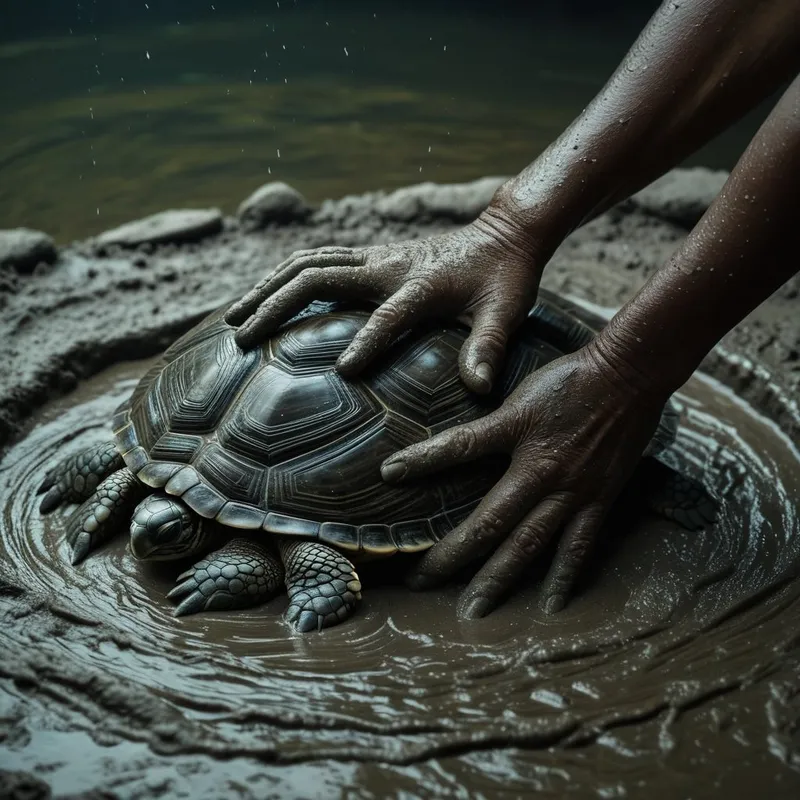
And so, they began. With a collective breath that was also a prayer, they dismantled their perfect lodge. Stick by sacred stick, daub of precious mud by daub, they carried the pieces of their own paradise up through the murky water, breaking the surface into the startling brightness of the first dawn. They swam to the vast, waiting curve of the World-Turtle's back.
There, upon that infinite, slippery dome, they worked. They pressed their mud, still warm with the memory of their home, onto the shell. They wove their sticks into the first frameworks. They dove, again and again, to the now-barren bottom, gathering more. They built not for shelter, but for foundation. They were not constructing a lodge, but the very possibility of land. Their exhaustion was absolute; their fur matted, their paws cracked. Yet, their purpose was a fire that water could not quench. Finally, as the last lump of mud was placed, the first solid ground emerged from the waters—a small, wet, miraculous island. The world had its beginning. The Beaver People, their task complete, looked upon their sacrifice and saw that it was good. And in that moment, they diminished, their mythic size and ancient consciousness flowing into the form of the earthly beavers, eternal keepers of the memory of how worlds are built.
Cultural Origins & Context
The myth of the Beaver People finds its roots among several Algonquian and other Eastern Woodlands nations, including the Anishinaabe peoples. It is a classic Earth-Diver creation narrative, a widespread motif where an animal plunges into the primal waters to retrieve a speck of mud that is then expanded to form the earth. Here, the beaver is not a lone diver but a collective, a people.
This story was not written but breathed—passed down through generations in the longhouse, by the winter fire, or during seasonal gatherings. Elders and storytellers would recount it not as mere history, but as a living map of values: community, sacrifice, skilled labor, and the sacred duty of stewardship. The beaver itself, a central figure in the ecosystem and economy of these cultures, was respected as a master builder. The myth elevated this everyday observation into a cosmic principle, explaining not only the origin of land but also the origin of the beaver's nature and humanity's debt to the animal world. Its societal function was to bind the people to their environment through a narrative of shared creation and profound interdependence.
Symbolic Architecture
At its heart, this is a myth about the alchemy of transformation, where one state of being must be deconstructed to serve a higher order. The perfect, submerged lodge symbolizes a contained, unconscious paradise—a state of potential that is comfortable but ultimately limited to the depths. The Primordial Waters represent the undifferentiated chaos of the unmanifest.
The first act of creation is not addition, but a sacred subtraction: the willing dissolution of a smaller world to seed a greater one.
The Beaver People embody the Creator Archetype in its most grounded form. Their creation is not ex nihilo (from nothing), but ex profundis (from the depths). They are the architects of order, but the material they use is the very substance of their former security. Psychologically, they represent the aspect of the psyche that can take the raw, muddy material of our instincts, our past, and our hidden depths (the subconscious lodge) and, through diligent, conscious effort, shape it into a foundation for conscious life. The mud is primal instinct; the woven sticks are the structures of culture, thought, and identity. The myth tells us that our foundational strength is built from the processed material of our own submerged experiences.
The Dreamer's Resonance
When this myth stirs in the modern dreamer, it often surfaces during periods of foundational life change—the end of a relationship, a career shift, a spiritual awakening, or any process that requires the dismantling of an old "lodge" of identity to build something new. To dream of being a Beaver Person, or of building tirelessly with mud and sticks in water, is to dream the process of psychic restructuring.
Somatically, this might manifest as a feeling of being submerged, of laboring against a resistant medium, or of profound fatigue paired with unwavering determination. The dreamer is psychologically engaged in the "Great Work" of their own soul. They are diving into their own chaotic, emotional waters (the unconscious) to retrieve tangible material (insights, memories, strengths) to build a more stable conscious standpoint. The old, comfortable patterns—the subconscious lodge—are being taken apart. This dream is a sign of the psyche's innate, archetypal wisdom activating a creator-instinct, urging the dreamer to participate consciously in their own rebirth, even when it feels like a sacrifice of a known world.

Alchemical Translation
The journey of the Beaver People is a perfect map for the Jungian process of Individuation. Their initial state in the underwater lodge represents the ego's comfortable identification with a limited, unconscious state. The call from the Maker is the summons from the Self, the total, archetypal core of the personality, demanding greater wholeness and engagement with the world.
The sacrifice of the lodge culture.") is the crucial nigredo—the blackening, the dissolution of the old form. It is the painful but necessary deconstruction of outmoded attitudes and complexes. The act of bringing mud to the turtle's back is the albedo—the whitening, the conscious labor of purification and construction. Here, the base material (instinct, trauma, shadow) is worked with intentionality.
Individuation is not about finding a pre-built home, but about developing the skill to architect your own world from the very substance of your struggles.
Finally, the emergence of the first island is the rubedo—the reddening, the realization of the "Philosopher's Stone," which in psychological terms is the achieved, grounded Self. The new land is the stable, expansive consciousness built from integrated unconscious material. The Beaver People's transformation into ordinary beavers signifies that this creative power does not leave us; it becomes a natural, instinctual part of our being. For the modern individual, the myth teaches that our most profound creations—a coherent identity, a meaningful life, a resilient spirit—are always built from the sacred, often difficult, material of our own lived experience. We are all Beaver People, tasked with building a world of meaning upon the shell of our given existence.
Associated Symbols
Explore related symbols from the CaleaDream lexicon: