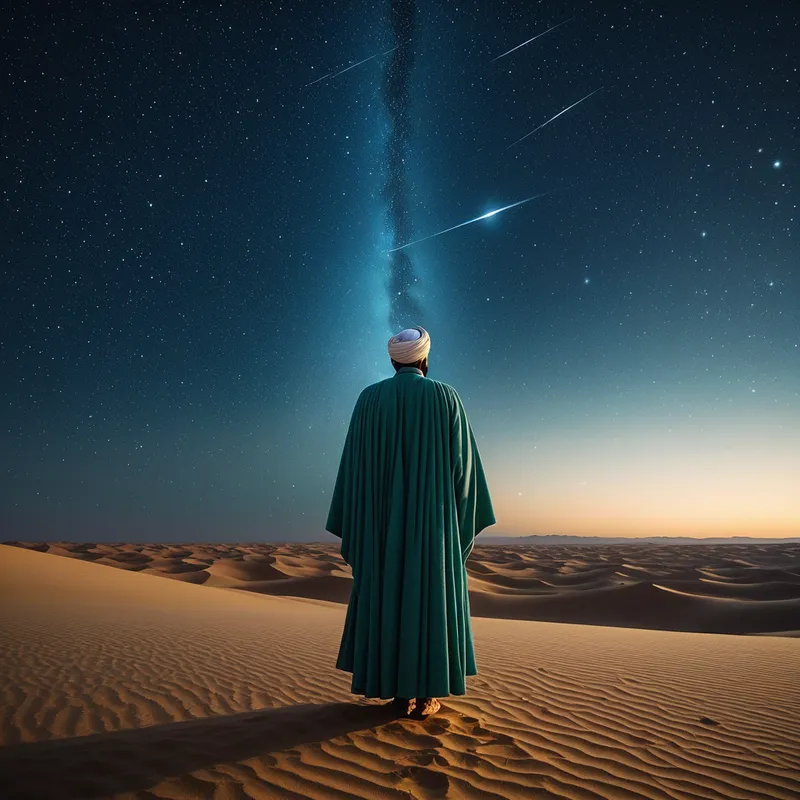
Bayazid Bistami's Ascent Myth Meaning & Symbolism
A Sufi mystic's ecstatic journey through the heavens, where the seeker's identity is annihilated and reborn in the ultimate truth of divine unity.
The Tale of Bayazid Bistami's Ascent
In the deep, silent hours when the world holds its breath, in a humble cell in Bistam, a man named Bayazid knelt upon the bare earth. The oil lamp had guttered out, leaving only the cold light of the desert stars piercing the darkness. For years, he had sought with a thirst that cracked the stone of his heart. On this night, the prayer was not on his lips but was the very pulse of his blood, a single, burning word: You.
Then, it began. Not with sound, but with a pulling at the core of his being, as if his soul were a iron shard and the heavens a mighty lodestone. He felt the clay of his body become insubstantial. The walls of his cell dissolved into streaks of shadow and starlight. He was rising. The sleeping town of Bistam fell away beneath him, a scattering of dim embers. The wind of ascent was not air, but a rushing current of divine attraction.
He passed through the first heaven, a realm of shimmering silver light. A voice like crystalline water spoke: "Welcome, O Bayazid!" But he, driven by that relentless pull, cried out, "I seek not Bayazid! I seek the Beloved!" And he soared onward.
Through the second heaven, a dome of burnished copper, and the third, of brilliant gold, he ascended. At each, angelic hosts and radiant prophets offered honors, garlands of light, and titles of sainthood. To each, he gave the same anguished, ecstatic reply: "I am not he! I am a stranger to myself! I seek only the Source!" His very identity, his name, his deeds, began to unravel like a worn cloak in the hurricane of his journey.
The heavens unfolded—the fourth of pearl, the fifth of ruby, the sixth of diamond light. With each passage, a layer of self was scoured away: his pride, his knowledge, his spiritual accomplishments. He was becoming pure seeking, a naked arrow shot from the bow of longing.
Then, the seventh heaven, a boundless plain of emerald. Here sat the Preserved Tablet and the Pen. The awe of this place would freeze a thousand souls for eternity. Yet Bayazid, now a flickering flame of consciousness, did not pause. The pull was fiercer, more intimate.
He entered the realm of the Throne. Here, concepts ceased. There was only immensity, a presence that was both overwhelming and deeply familiar. And still, he was drawn further, to the final, gossamer veil that hangs before the Unseen Essence. Here, all motion, all seeking, reached its crescendo.
From beyond the veil, a Voice spoke, not in words, but in the foundational vibration of existence: "O Bayazid, what do you seek?"
What remained of him—a spark, a sigh—responded with the totality of his journey: "I seek not to seek. I seek You."
The command thundered in the silence: "Then step forth."
With the last shred of his will, which was no longer his own, he stepped. The veil did not part; it dissolved, for there was nothing left to separate. The seeker, the seeking, and the Sought became one. In that annihilating union, a final cry echoed back into the cosmos, a testament from the abyss of unity: "Glory be to Me! How great is My Majesty!"

Cultural Origins & Context
The tales of Mi'raj are central to Islamic spirituality, most famously the Prophet Muhammad's Night Journey. Within the Sufi tradition, this archetype was internalized and personalized. The story of Bayazid Bistami's ascent is not a canonical hadith but a foundational teaching narrative, passed down orally for generations within Sufi orders before being recorded in texts like "Tazkirat al-Awliya" by Farid al-Din Attar.
Bayazid (Abu Yazid al-Bistami, d. 874 CE) was a historical figure, a radical proponent of fana. His reported ecstatic utterances, like the one climaxing this myth, were often shocking to the orthodox, blurring the line between servant and Lord. The myth served multiple functions: it was a map for the inner journey of the disciple, a warning against spiritual pride (even the heavens are not the goal), and a validation of the ultimate, ineffable goal of Sufism—direct experiential union. It was a story told in khanqahs to inspire awe and clarify the terrifying, glorious destination of the path.
Symbolic Architecture
The myth is a perfect allegory for the death of the ego and the birth of the true Self. The seven heavens are not astronomical places but seven layers of the psyche—the realms of personal identity, social persona, rational intellect, and deeper spiritual constructs—that must be consciously traversed and transcended.
The journey to God is a journey from yourself. It is a departure from you and an arrival to Him.
Each honor rejected by Bayazid represents a potential trap: the allure of becoming a "holy person," the satisfaction of profound insights, the comfort of spiritual status. His repeated cry, "I seek the Beloved," is the unwavering compass of the heart (qalb) that refuses all substitutes. The final, shocking utterance—"Glory be to Me!"—is not the boast of an inflated ego, but the only possible report from the state of baqa. When the drop has vanished into the ocean, only the ocean can speak.

The Dreamer's Resonance
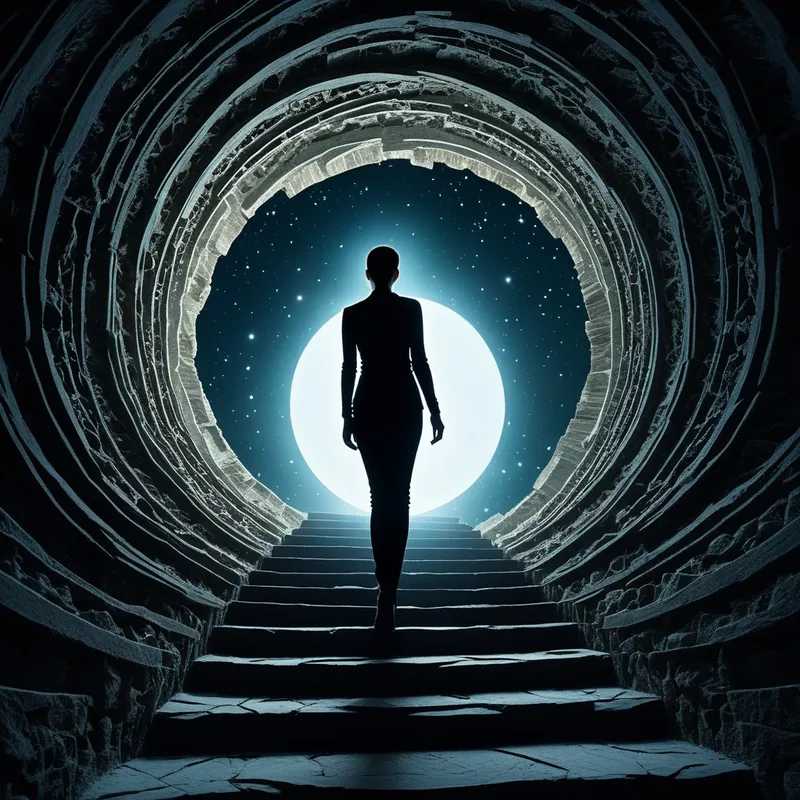
When this mythic pattern stirs in modern dreams, it often manifests not as a celestial flight, but as powerful somatic and psychological processes. One might dream of climbing an infinite ladder where each rung breaks away after use, or of being in an elevator that shoots past every floor label (Manager, Parent, Expert) into blinding light. There is a profound sense of vertigo and shedding.
The dreamer is undergoing a necessary de-structuring. The conscious personality, built over a lifetime, is being called to dissolve its rigid boundaries. This can feel like a crisis, a "dark night of the soul," where old values and identities lose meaning. The somatic signature is often in the chest—a feeling of expansion, pressure, or the heart cracking open. It is the psyche's innate intelligence guiding the individual beyond the comfortable, known heavens of their personal world toward a more integrated, and initially terrifying, wholeness.
Alchemical Translation
In Jungian terms, this is the ultimate process of individuation—the journey of the ego to relinquish its central command and relate to the larger, transpersonal Self. The alchemical operation is solutio (dissolution) and sublimatio (ascent and purification).
The gold is not found in the polishing of the persona, but in the incineration of the personal in the fires of the transpersonal.
The modern individual engages this myth when they ask, "Who am I beyond my job, my relationships, my achievements?" The first steps are the rejection of inauthentic lives (the lower heavens). The middle stages involve facing the inflation of the "spiritual" ego (the honors offered). The climax is the terrifying, ecstatic surrender where one's entire self-concept is offered up. The triumph is not becoming a god, but realizing that the separate, seeking "I" was a necessary illusion. The reborn consciousness that returns—for Bayazid did return to the world—is one that acts from a center of unity, carrying the "secret" of its origin. It is the transformation of leaden, ego-bound life into the gold of a life lived in service to the deeper, universal Self within.
Associated Symbols
Explore related symbols from the CaleaDream lexicon:
- Ascent — The vertical journey of the spirit, representing the soul's effort to transcend its limitations and rise from the mundane toward the ultimate source of being.
- Sky — The domain of the ascent, symbolizing the higher consciousness, the spiritual realm, and the infinite potential that lies beyond earthly confines.
- Mirror — Represents the final veil and the nature of reality; in the moment of union, the mirror reveals no other, for the seeker has become the pure reflection of the divine.
- Door — The threshold of the final veil, the ultimate liminal space between individual existence and absolute unity, which must be passed through via annihilation.
- Light — The illuminating force of divine attraction that pulls the seeker upward, and the final, formless essence into which the mystic dissolves.
- Journey — The core narrative structure of the myth, emblematic of the lifelong, inward spiritual quest that is the central work of the Sufi path.
- Mountain — A symbolic parallel to the heavens; the arduous, vertical climb necessary to reach the summit of spiritual understanding and perspective.
- Soul — The essential protagonist of the tale, the entity that undergoes purification, stripping, and ultimate transformation in its quest for its origin.
- God — The ultimate goal and source of the magnetic pull; not a distant figure but the fundamental reality in which the seeker's identity is reabsorbed.
- Shadow — All that is cast off during the ascent—the attachments, identities, and spiritual pretensions that must be acknowledged and left behind.
- Rebirth — The paradoxical outcome of the annihilation; the emergence of a new mode of being that "subsists" in the world, informed by the unity it has realized.
- Fire — The burning longing that initiates the journey and the purifying agent that consumes all that is false, leaving only essential truth.