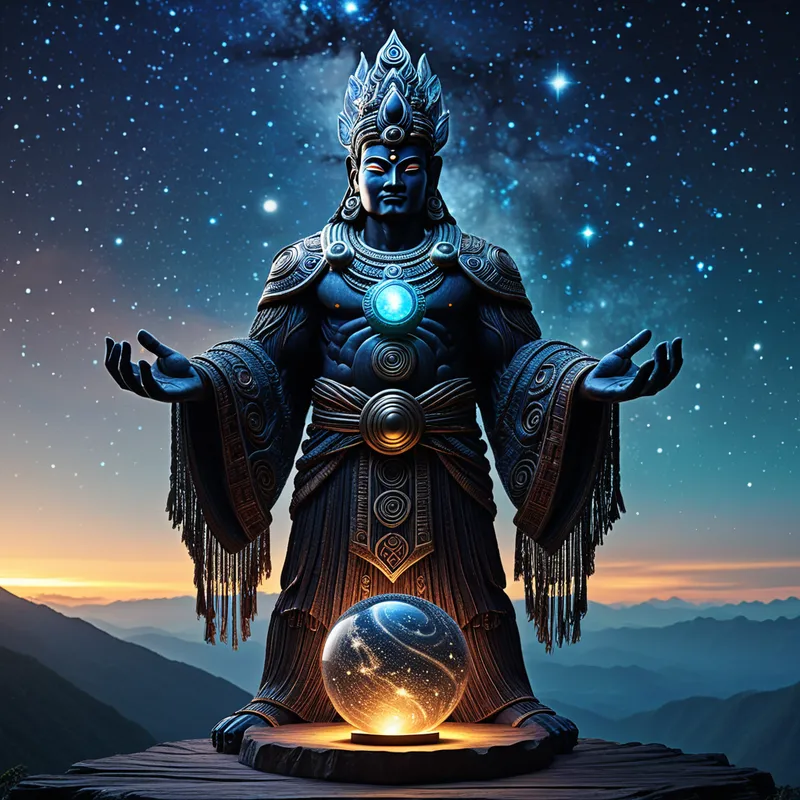
Bathala Myth Meaning & Symbolism
The myth of the supreme creator Bathala, who shaped the world from chaos and established the first order, embodying the primal act of consciousness.
The Tale of Bathala
In the beginning, there was only the great, yawning Kawalan. No sky arched above, no earth rested below—only a silent, formless sea, dark and deep. From this endless nothing, a presence stirred. A thought formed in the void, and that thought was Bathala.
He awoke not on a throne, but within the very essence of potential. With a will that was the first light, he reached into the swirling chaos. He gathered the mists and the vapors, the whispers of substance, and from them, he fashioned the Kaluwalhatian, a vast and beautiful dome to hold the future. Below, he pressed the formless waters, condensing them until the first islands, the first mountains, rose like the bones of the world from the deep.
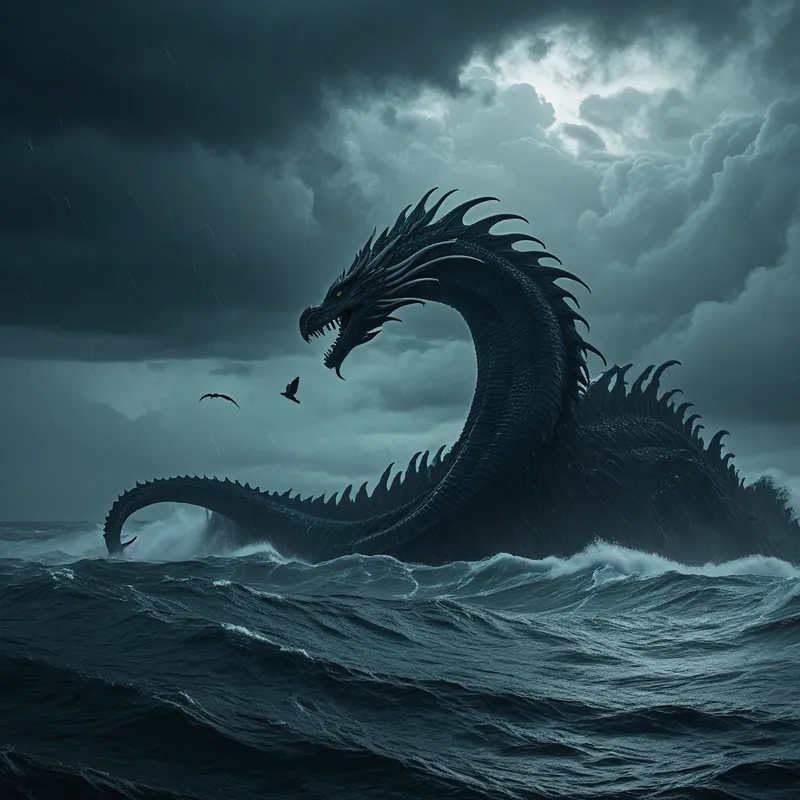
But the world was not empty. From the ancient, untouched corners of the sea, the old powers stirred. Ulilang Kaluluwa, the Orphaned Spirit, a serpent of immense scale and primordial hunger, slithered from the abyss. It saw the new land, the new order, and felt only a cold, possessive rage. This was its domain of chaos, and the creator’s work was an intrusion. From another quarter came Galang Kaluluwa, the Wandering Spirit, a giant bird whose wings blotted out the young sun, its cries echoing with a lonely, eternal sorrow.
Bathala beheld them not as mere monsters, but as spirits of the old world—forces of pure, untamed element. Ulilang Kaluluwa, the coiled power of the watery deeps; Galang Kaluluwa, the restless wind of the unbounded sky. They were chaos itself, challenging the very principle of form. A great battle shook the new foundations of the world. The serpent’s coils threatened to drag the islands back into the sea; the bird’s tempests sought to tear the sky asunder.
Yet Bathala, the architect of being, did not seek to destroy them utterly. In a act of profound alchemy, he met their raw force with sovereign will. He subdued Ulilang Kaluluwa, and where the great serpent fell, its body did not vanish but became one with the land, its strength becoming the fertile soil, its sinews the mountain ranges. He calmed Galang Kaluluwa, and from its essence, he wove the changing winds and the paths of the clouds.
From this integration of the old chaos into the new order, life sprang forth. Bathala took the rich earth, now imbued with the serpent’s power, and from it shaped the first humans: Malakas, strong as the bamboo, and Maganda, beautiful as the dawn. He breathed into them the spirit, the kaluluwa, a spark of his own divine consciousness, and set them upon the world he had forged from the struggle between his creative light and the primordial dark.
Cultural Origins & Context
The narratives of Bathala (also known as Maykapal or Abbla) are not drawn from a single, canonical text, but from the rich, living tapestry of oral traditions across the pre-colonial Philippine archipelago. These stories were the sacred knowledge of the babaylan and catalonan—the community shamans, healers, and ritualists—who served as the living vessels of myth. They recited these tales during rituals, initiations, and community gatherings, often under the canopy of ancient trees or within the sacred space of the home.
The myth functioned as a cosmological anchor. It explained the origin of the world (sandaigdigan), the nature of the divine, and humanity's privileged yet precarious place within creation. It was a map of reality, where every mountain could be the body of Ulilang Kaluluwa, and every gust of wind the breath of Galang Kaluluwa. This worldview emphasized balance (timbang): the balance between sky and earth, order and wildness, the creative deity and the primordial spirits he encompassed. Bathala was not a distant, detached god, but a sovereign who engaged directly with the raw materials of existence, modeling a relationship with the world that was both authoritative and integrative.
Symbolic Architecture
At its heart, the myth of Bathala is a profound allegory for the birth of consciousness from the unconscious. The primordial sea of Kawalan represents the undifferentiated, potential-filled state of the psyche before the emergence of the ego—the "I."
Bathala is the archetypal spark of consciousness itself, the first act of attention that says, "Let there be form." He is the differentiating principle that carves identity from anonymity, order from chaos.
The struggle with Ulilang Kaluluwa and Galang Kaluluwa is not merely a physical battle, but the inevitable conflict that arises when consciousness (order, structure, identity) asserts itself against the autonomous, powerful forces of the unconscious (chaos, emotion, instinct). The serpent symbolizes the deep, chthonic, and often possessive energies of the instinctual world. The bird represents the airy, restless, and unbounded aspects of spirit or thought that resist containment. Bathala’s triumph is not annihilation, but integration. He does not banish chaos; he transforms it into the very substance of the ordered world. The serpent becomes the fertile earth; the bird becomes the guiding wind. This is the core symbolic act: the conscious ego does not conquer the unconscious, but must learn to incorporate its immense power, making it foundational to the structure of the self.

The Dreamer's Resonance
When this mythic pattern stirs in the modern dreamer, it often manifests as a profound period of psychic reorganization. One might dream of titanic, shadowy figures—serpents in the deep or great birds in stormy skies—threatening to overwhelm a fragile, newly built structure in the psyche, perhaps a new sense of self, a relationship, or a career path. These are the Ulilang Kaluluwa and Galang Kaluluwa of the personal unconscious, rising to challenge the emerging order of the conscious mind.
Somatically, this can feel like a deep, chaotic stirring in the gut (the serpent) or a frantic, anxious restlessness that cannot be settled (the bird). The dreamer is in the Bathala position, tasked with the supreme creative act: to face these formless, powerful energies not with panic, but with a sovereign, creative intent. The process is one of containment and translation. The dream asks: Can you take the raw, chaotic emotion (rage, grief, fear) and not be dissolved by it? Can you take your restless, scattered thoughts and give them a coherent direction? The dream is the psyche's workshop where the primordial materials of experience are being forged into something structured and livable.

Alchemical Translation
The individuation journey modeled by Bathala is the opus of self-creation. It begins in the nigredo, the black chaos of Kawalan—a state of depression, confusion, or life crisis where all former structures have dissolved. From this dark sea, the call emerges: the need to become someone, to create a cohesive identity.
The alchemical fire is the focused will of consciousness, applied not to destroy the base matter of our nature, but to transmute it into the gold of authentic selfhood.
The confrontation with the serpent and the bird is the separatio and coniunctio combined. We must first separate from identifying with the chaos ("I am my rage," "I am my anxiety") to see it as a powerful, autonomous content within the psyche. Then, we perform the sacred conjunction: we integrate these forces. The instinctual energy (serpent) is not repressed but grounded, becoming the fertile soil of passion, vitality, and embodied presence. The restless spirit (bird) is not clipped but harnessed, becoming the wind of inspiration, intuition, and perspective. The result is the lapis philosophorum, the philosopher's stone: a stable, resilient, and authentic self, capable of creating its own world (a life of meaning) from the raw materials of its experience. Bathala shows us that to be a creator of one's own life is to engage in a perpetual, sacred dialogue with the primordial forces within, not as a conqueror, but as a wise and sovereign architect.
Associated Symbols
Explore related symbols from the CaleaDream lexicon:
- Sky — The Kaluwalhatian created by Bathala, representing the realm of consciousness, order, and divine aspiration.
- Earth — The land formed from the subdued body of Ulilang Kaluluwa, symbolizing the grounded, material world and the integration of instinctual power.
- Ocean — The primordial sea of Kawalan, representing the formless, potential-filled unconscious from which all creation emerges.
- Serpent — Ulilang Kaluluwa, embodying the chthonic, possessive, and fertile powers of the deep unconscious and instinctual life.
- Bird — Galang Kaluluwa, symbolizing the restless, wandering spirit, unbounded thought, and the airy aspects of the psyche.
- Mountain — The first land rising from the sea, representing the emergent ego, stability, and the meeting point of sky and earth.
- Creation — The central act of Bathala, symbolizing the primal psychological drive to bring form, identity, and meaning into being.
- Order — The divine principle Bathala imposes on chaos, reflecting the psyche's need for structure, hierarchy, and coherence.
- Chaos — The primordial state of Kawalan and the nature of the old spirits, representing the undifferentiated, raw material of the unconscious.
- Spirit — The kaluluwa breathed into the first humans, symbolizing the divine spark of consciousness and individual soul.
- Light — The first act of Bathala's will, representing awareness, enlightenment, and the differentiating power of consciousness.
- Stone — The foundational element of the world, symbolizing the enduring, transformed substance resulting from the integration of chaos into order.