Batak Creation Myth Myth Meaning & Symbolism
From the sacrifice of a primordial being, the world and humanity are born, establishing a sacred covenant between the divine, nature, and humankind.
The Tale of Batak Creation Myth
Listen. In the time before time, there was only the great, silent void. Not darkness, not light, but a formless, breathless potential. From this stillness, the divine consciousness stirred. Mula Jadi Na Bolon, the Creator, existed. And with Mula Jadi Na Bolon came the first thought, the first division: the Above and the Below.
But the world was not yet made. It was a swirling, chaotic soup of elements—earth, water, air, and fire—tumbling in the abyss without form or purpose. The Creator saw this chaos and knew a vessel was needed, a foundation upon which order could be built. And so, from the very substance of the divine thought, a being was formed. This was Debata Idup, the Living God, a being of immense power and scale, a bridge between the formless divine and the world yet to be.
Debata Idup stood in the chaos, a colossus adrift. Yet, a world could not be born from a being whole and complete. Creation requires an act of profound giving. A sacred decision was made, not of violence, but of ultimate purpose. Debata Idup consented, offering its own form as the substance of all that would be.
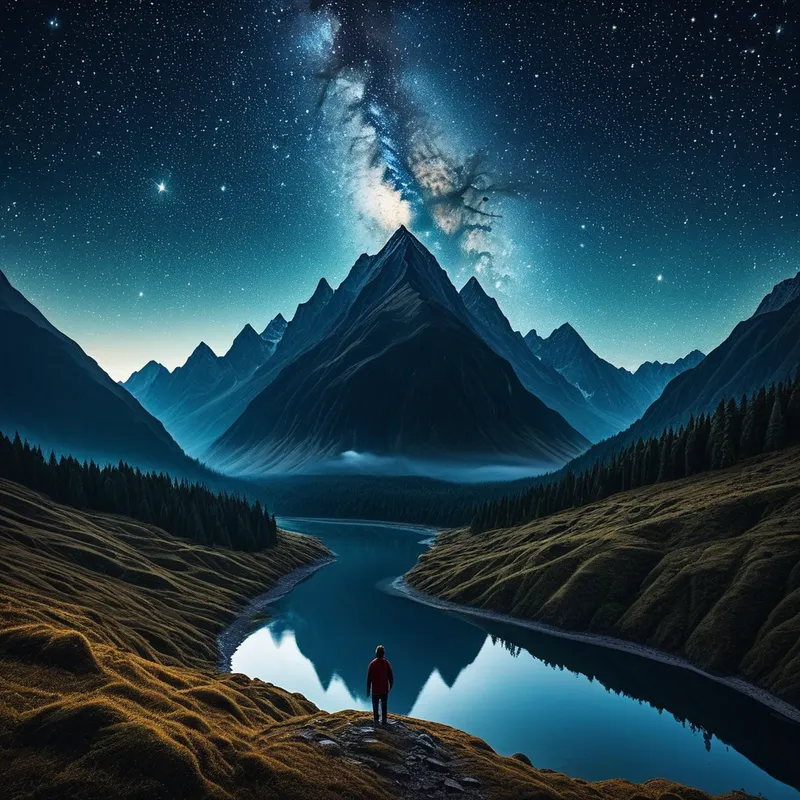
And so, the great transformation began. The colossal body of Debata Idup began to dissolve and reform. Its flesh did not rot; it transmuted. The soft parts of its body sank and spread, becoming the rich, fertile earth of the plains and valleys. Its bones, strong and unyielding, pushed upwards, rising to become the mighty mountains that pierce the clouds. The rivers and lakes? They flowed from its lifeblood, coursing through the new land like vital veins. Its hair became the vast, whispering forests, and its breath became the winds that move through them. Its eyes, lifted to the heavens, became the sun and the moon, bringing light and rhythm to the newborn world.
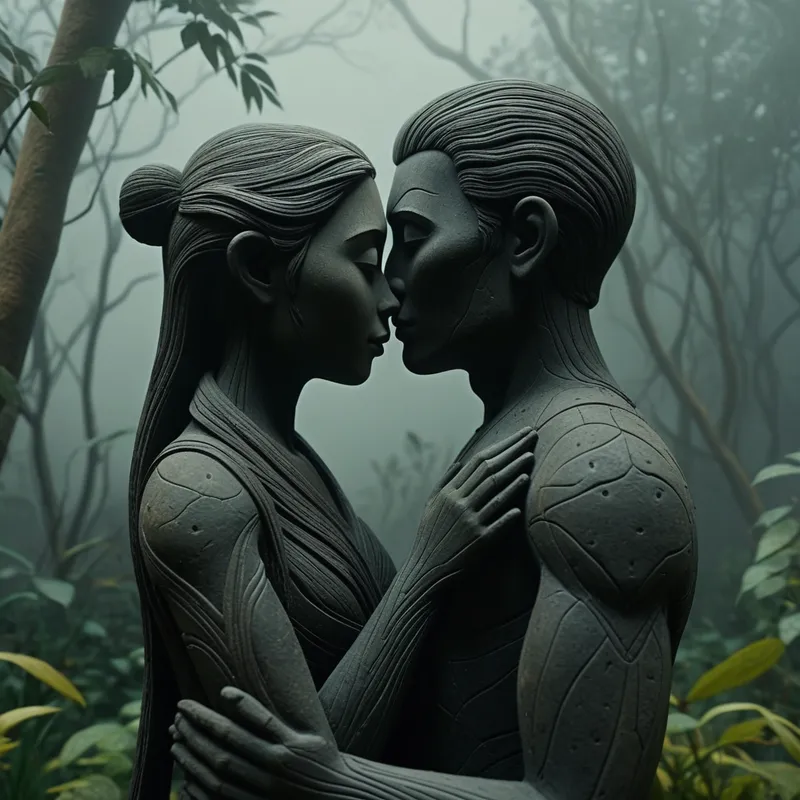
But the work was not finished. The world had a body, but it lacked a soul, a consciousness to inhabit it, to name it, and to live in relationship with it. From the remaining essence, the first humans were fashioned. It is said they were formed from earth, but an earth still humming with the divine life-force of the sacrifice. Mula Jadi Na Bolon breathed the spirit of life into them, and they awoke in the garden of the world, children of both the earth and the sky. They were placed upon the very body that had become their home, establishing an eternal, sacred covenant: humanity is not separate from the world, but born of it, forever connected to the substance of a divine sacrifice.
Cultural Origins & Context
The Batak creation myth originates from the Batak peoples of North Sumatra, Indonesia, a group comprising several distinct sub-ethnicities like the Toba, Karo, and Simalungun. This myth was not a singular, fixed text but a living oral tradition, recited by revered community figures known as datu (priest-shamans) or skilled storytellers during significant rituals, festivals, and rites of passage. Its primary function was cosmological and sociological. It did more than explain "how" the world came to be; it explained "why" the world is structured as it is and prescribed humanity's place within that structure.
The myth served as the foundational charter for Batak adat (customary law) and social order. The geographic features born from the primordial body mirrored the Batak worldview: the mountains were sacred and protective, the rivers were life-giving arteries, and the forest was a realm of both resources and spirits. The story established a theology of immanence—the divine is not remote but physically present in the landscape. This created a profound ethic of environmental respect and ritual obligation. By tracing their origin to the sacrificed body, every Batak individual understood their life, their clan (marga), and their society as part of a continuing, sacred relationship with a world that is literally ancestral. The myth was a tool for maintaining harmony (hamoraon, hagabeon, hasangapon—wealth, progeny, honor) between the human, natural, and spiritual realms.
Symbolic Architecture
At its core, the Batak creation myth is a profound allegory of differentiation and integration born from a unitary sacrifice. The primordial unity, represented by Debata Idup, must fragment to give birth to the manifold world. This is not a tragedy, but the necessary alchemy of existence.
Creation is the sacred act of the One becoming Many, so that the Many might remember the One.
The sacrificed body is the ultimate symbol of the <abbr title="The material world as a manifestation of spirit, where every physical form contains a divine essence."">unus mundus—the one world where spirit and matter are inseparable. The mountain is not like a bone; it is a bone, transformed. This collapses the Western dichotomy between the sacred and the profane. Everything is sacred because everything is literally made of divinity.
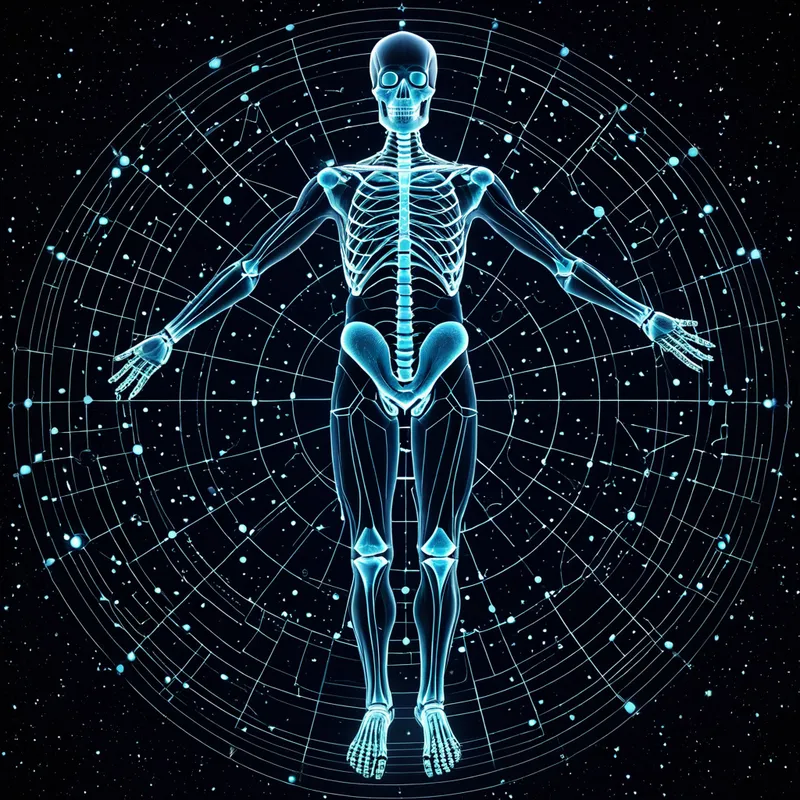
Psychologically, Debata Idup represents the undifferentiated Self, the totality of the psyche before the emergence of consciousness (the "I"). The act of creation/sacrifice mirrors the painful but necessary process of ego-formation, where the whole Self is "broken apart" to generate the various complexes, personas, and archetypes that constitute our conscious experience. The world that forms is the inner landscape of the psyche itself—its heights and depths, its flowing emotions and dense memories.
The Dreamer's Resonance
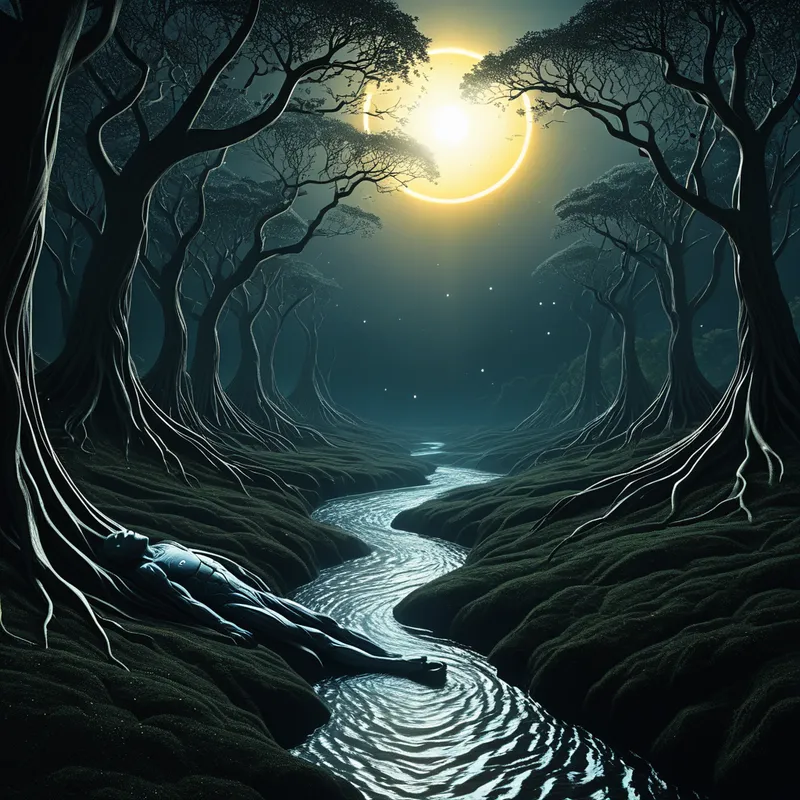
When this myth stirs in the modern unconscious, it often manifests in dreams of profound somatic transformation. A dreamer might find their own body merging with a landscape—soil sprouting from their skin, roots gripping their limbs, or a river flowing from their chest. This is not a nightmare of dissolution, but a deep somatic memory of the mythic pattern. The psyche is signaling a process of re-membering, of re-integrating a sense of primal unity that has been lost to fragmentation.
Such dreams can arise during life transitions that feel like a "breaking apart" of the old self: the end of a career, a seismic shift in identity, a deep ecological or spiritual crisis. The somatic sensation is key—a heavy, earthy pressure, or a feeling of being vast and ancient. The dreamer is experiencing what the myth describes: the necessary deconstruction of a previous, whole-but-static state to provide the raw material for a new world of consciousness. The anxiety felt is the grief of the sacrifice; the awe is the dawning recognition of the new forms being born from it.
Alchemical Translation
For the modern individual navigating the path of individuation, the Batak myth provides a master template for psychic transmutation. The alchemical process it outlines is solve et coagula—dissolve and coagulate—applied to the very substance of the self.
The first stage is the recognition of the primordial unity within: the latent, undifferentiated potential of the psyche, which often feels like a stagnant, chaotic inner void. The "sacrifice" is the courageous act of allowing this old, unconscious wholeness to be deconstructed. This is the solve. It means voluntarily confronting and breaking down rigid identifications, outworn narratives, and complexes that, while familiar, prevent new growth. It is an inner offering.
The ego must consent to its own partial death, its fragmentation, to serve the birth of the greater Self.
From this sacrificed material—the memories, the pains, the talents, the passions—the new inner world is built. This is the coagula. The bones of past trauma become the enduring mountains of character and resilience. The blood of passion and emotion is channeled into the rivers of creativity and relationship. The breath becomes the animating spirit of a new life purpose. The final, crucial step is the creation of the "inner human"—the conscious ego that is not the master of this landscape, but its mindful inhabitant and steward. This born-again ego understands it is made from the landscape of the Self, not separate from it. Individuation, in this light, is not about becoming a discrete, isolated unit, but about consciously re-inhabiting the sacred, self-created world of one's total being, in right relationship with all its parts.
Associated Symbols
Explore related symbols from the CaleaDream lexicon:
- Sacrifice — The central, voluntary act of the primordial being, representing the necessary dissolution of a prior state of unity to generate the manifold complexity of existence and consciousness.
- Earth — The physical world born from divine flesh, symbolizing the sacredness of the material realm and the foundational, bodily aspect of the Self.
- Mountain — Formed from primordial bones, representing enduring structure, resilience, and the lofty, aspirational aspects of the psyche that arise from deep sacrifice.
- River — Flowing from the lifeblood of the sacrifice, symbolizing the vital, emotional, and creative energies that course through the created world and the individual soul.
- Tree — Emerging from the hair or essence of the being, representing growth, connection, and the living link between the earthly (roots) and the heavenly (branches).
- Sun — One of the eyes of the being, now a celestial body, symbolizing consciousness, illumination, and the perceiving light that brings order and rhythm to the inner world.
- Spirit — The animating breath given to the first humans, representing the infusion of conscious awareness and divine essence into the formed material world.
- Body — The primordial vessel itself, the ultimate symbol of the unus mundus, where spirit and matter are completely unified and interchangeable.
- Creation — The entire process, not as a single event but as an ongoing alchemical transformation where sacrifice continually fuels new becoming.
- Order from Chaos — The fundamental narrative arc, depicting the emergence of a structured, habitable cosmos and a coherent psyche from a formless, potential void.