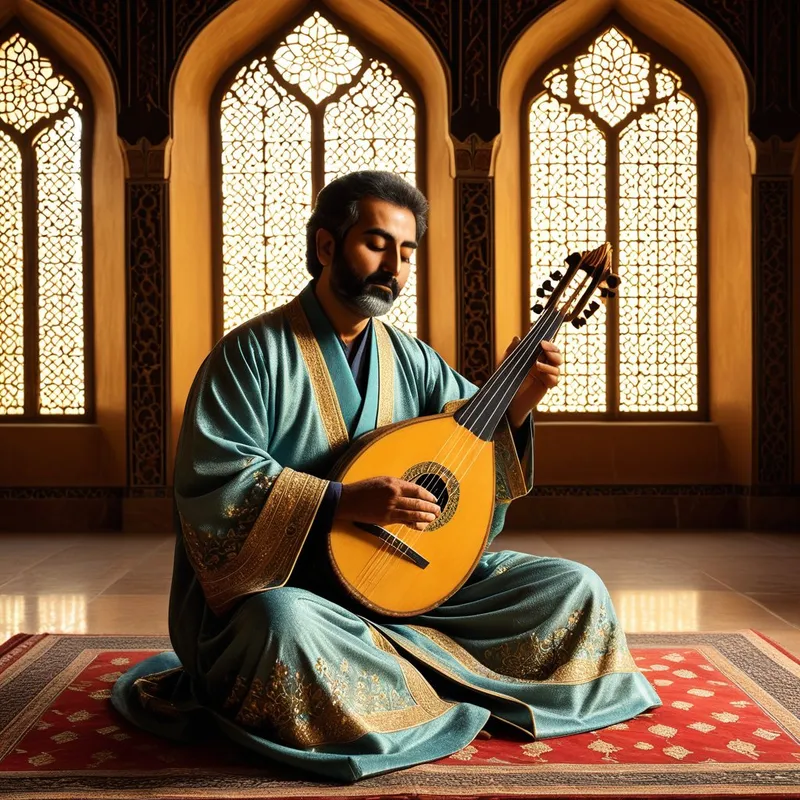
Barbad Myth Meaning & Symbolism
The myth of the musician Barbad, whose profound artistry healed a king's soul and commanded the very forces of nature through the power of sound.
The Tale of Barbad
Listen, and let the silence between the notes speak. In the age of splendor, when Ctesiphon’s arches touched the clouds and the Tigris ran with stories, there sat a king whose soul was a barren desert. Khosrow II Parviz, they called him, the Ever-Triumphant. Yet his greatest battle was fought within the walls of his own palace, a silent war against a melancholy so profound it turned wine to vinegar and silk to chains. The court physicians whispered; the astrologers charted futile courses in the stars. The king was imprisoned in a winter of his own spirit, and the kingdom held its breath, frozen in sympathy.
Into this petrified court came a man whose wealth was not in gold, but in the spaces between sounds. His name was Barbad. He carried not an army, but a barbat—an instrument of polished wood and taut gut, a captured piece of the forest’s soul. He was denied audience, blocked by the envy of the king’s previous musician, Sarkash. But true music cannot be barred by gates.
One evening, as the king sat shrouded in his customary gloom in the Ayvan-e Khosrow, a new servant, humble and cloaked, entered to tend the fire. This was Barbad, in disguise. As the shadows danced on the vast walls, he did not speak. Instead, from the folds of his garment, he drew his barbat. His fingers, calloused by devotion, touched the strings.
The first note was a single drop of rain on parched earth. Then came a melody—not one of joyous celebration, but of profound recognition. It was the Dastan-e Bahar, the Story of Spring. The music did not assault the king’s sorrow; it gently encircled it. It painted in sound the cracking of ice, the stubborn push of a green shoot through frozen ground, the hesitant song of the first returning bird. It spoke of a thaw the king had forgotten was possible.
King Khosrow did not move, but a single tear traced a path through the dust of his despair. The melody wove through the hall, and as it reached its crescendo, a miracle was said to have occurred: blossoms unfurled from the stone pillars; the very air grew warm and sweet. The music did not just describe spring; it invoked it. The king’s winter broke. He looked up, truly seeing for the first time in seasons, and said, “Who has brought back my soul?”
Barbad cast off his disguise, and in that moment, he was no longer a supplicant, but a physician of the unseen. He had healed the unhealable wound. His subsequent songs, the Khosrovani, became the celestial map of the empire’s spirit, governing not only moods but, legends say, the very turning of the celestial spheres. He played the Hormozd Khosravi to announce the king’s glory, and the Kin-e Iraj to mourn fallen heroes. His art was a direct conduit to the order of the world.
Cultural Origins & Context
The story of Barbad is rooted in the Sassanian period, a golden age of Persian culture that fiercely celebrated music, poetry, and learning. It is preserved not in a single, sacred text, but in the rich tapestry of later Persian literature—most notably in Ferdowsi’s Shahnameh, and in the historical chronicles of scholars like Al-Biruni.
This transmission is key. Barbad is not a god, but a human artist elevated to mythic status by the culture that revered him. He represents the pinnacle of the khorasani tradition. The myth served multiple societal functions: it was a foundational story for Persian classical music (Dastgah), attributing its systematic modes to a divine-human genius. It was a political allegory about the wise king who recognizes true merit over flattery. Most importantly, it was a cultural manifesto on the power of art. In a society where the spoken word and the melodic phrase were sacred, Barbad’s tale codified the belief that true artistry is a cosmic force, capable of restoring balance to the human soul and, by extension, to the kingdom itself.
Symbolic Architecture
At its heart, the myth of Barbad is an archetypal drama of the creative spirit confronting the frozen, stagnant psyche. The king’s melancholy is not mere sadness; it is the paralysis of the ruling principle, the ego that has become rigid, isolated, and cut off from the wellsprings of life (the unconscious). Sarkash, the jealous predecessor, symbolizes the outdated, inferior function—the old way of being that is all technique and no soul, seeking to maintain control through exclusion.
Barbad represents the transcendent function—the emergent third thing that arises from the tension between conscious stagnation and the unconscious urge toward life. He does not fight the king’s winter; he plays it into spring.
His disguise is crucial. The creative solution does not announce itself with fanfare; it enters humbly, through the back door of perception, in a form the defended ego will not recognize as a threat. The barbat is the instrument of this psychopomp, a tool that translates the invisible patterns of the soul into audible, felt vibration. The legendary effects—the blossoming stone, the change in season—are not literal magic but a profound metaphor for the somatic reality of psychological transformation. When the deep, frozen affect is finally resonated with, the entire “kingdom” of the body-mind feels it as a physical unlocking, a warming, a return of vitality.
The Dreamer's Resonance
When this myth stirs in the modern unconscious, it often manifests in dreams of profound, resonant sound or music in moments of stalemate or depression. One might dream of finding a forgotten instrument in an attic and, upon playing a single note, seeing cracks of light appear in a dark wall. Or of hearing a specific melody that causes a withered plant to suddenly bloom. The somatic experience is one of a deep, vibrational unlocking—a thaw in the chest, a release of breath held for too long.
Psychologically, this signals the dreamer is in a “King Khosrow” phase: a state of intelligent but isolated despair, where logical solutions have failed. The psyche is now sending up the “Barbad” image—the archetype of the inner creator or healer. This figure does not argue with the depression; it communicates in the language of the right brain and the body: through image, metaphor, and felt sense. The dream is an announcement that a transformative, non-linear intelligence is at work beneath the surface of conscious suffering, preparing to play the soul back into alignment.
Alchemical Translation
The individuation process modeled here is the solutio followed by the coagulatio, all mediated through the creative act. The king’s frozen state (the nigredo, or blackening) is not bypassed but is the essential raw material. Barbad’s music is the aqua permanens, the divine water that dissolves the rigid structures of the ego, allowing the trapped libido (life energy) to flow again.
The modern individual’s task is not to “fix” their melancholy with willpower, but to find their unique “barbat”—the creative medium through which the frozen complex can be sounded, heard, and thus transformed.
This is the alchemy of art-as-therapy in its deepest sense. It is not about producing a masterpiece for the outer world, but about engaging in a sincere, devotional dialogue with the inner king. The jealous “Sarkash” within—the inner critic, the voice of practicality that devalues this process—must be diplomatically bypassed. One must don the “disguise” of play, of non-serious experimentation, to allow the healing melody to enter. The resulting “Khosrovani” are the newly integrated psychic modes—the more complex, nuanced, and resonant ways of being that emerge when the creative function is given sovereignty. One becomes both the musician and the healed king, the artist and the realm, conducting the seasons of one’s own soul.
Associated Symbols
Explore related symbols from the CaleaDream lexicon: