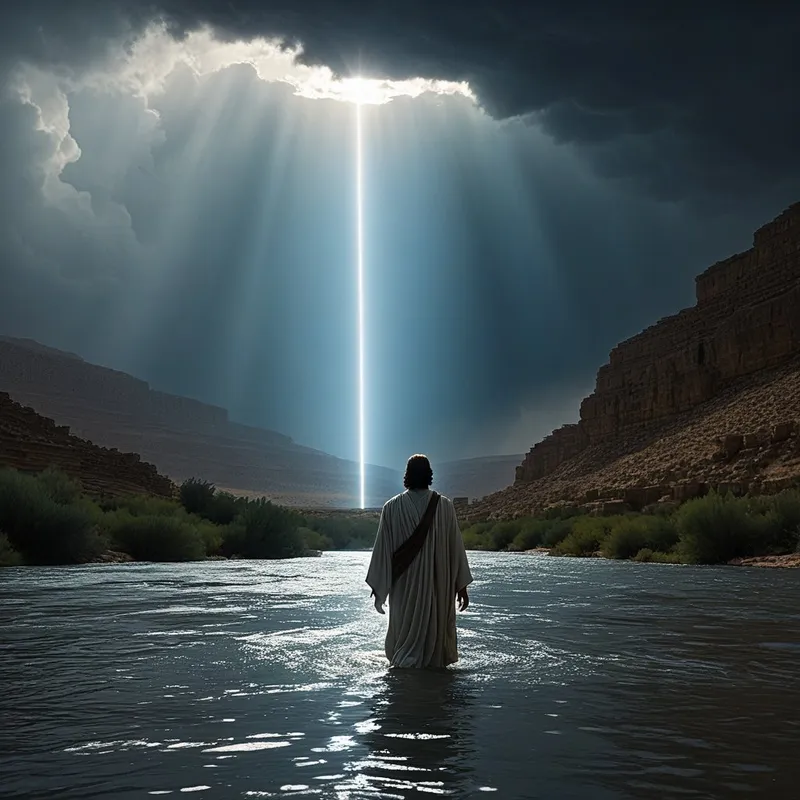
Baptism of Jesus Myth Meaning & Symbolism
A prophet in the wilderness baptizes a carpenter, and the heavens tear open, revealing a divine identity and a sacred mission.
The Tale of Baptism of Jesus
The wilderness was a throat, parched and crying out. It was a place of stones and scorpions, of heat that shimmered like a mirage of forgotten seas. And to this place of raw edges came the people, a river of longing flowing down to the banks of the Jordan. They came for the voice.
The voice belonged to a man clothed in camel’s hair, his skin tanned to leather by the sun, his diet the bitter locust and wild honey. He was John, and his words were a fire, scorching away pretense. “Repent!” he thundered, and the word meant to turn, to change your mind, to feel the weight of your life and choose a different path. The waters of the Jordan, he said, could wash that weight away. It was a baptism, a drowning of the old self, a desperate gasp for a new beginning. The people confessed, wept, and were submerged, emerging sputtering into the harsh, clean air of hope.
One day, among the crowd, came a man from Nazareth. No fanfare preceded him, no entourage. He was a carpenter, his hands familiar with grain and knot, his bearing quiet. He joined the line of sinners and seekers and stood before John.
And John knew. The fire in his voice banked to a whisper of awe. He saw not a sinner, but the one he had been proclaiming—the one whose sandals he felt unworthy to untie. “I need to be baptized by you,” John protested, his certainty crumbling, “and do you come to me?”
But the man from Nazareth looked at him, and his gaze held the depth of a willing descent. “Let it be so now,” he said, his voice calm, a still point in the churning ritual. “It is proper for us to fulfill all righteousness.” It was a mystery wrapped in humility. The sinless one stepped into the line of the sinful. The source of cleansing asked to be cleansed.
John consented, his hands trembling. He guided the man into the cool, brown current of the Jordan. The water rose, embracing the carpenter’s shoulders. For a moment, there was only the sound of the river and the held breath of creation. Then John lowered him, a ritual burial in the liquid earth.
As he rose, breaking the surface, the world tore.
It was not a metaphor. The very fabric of the heavens was rent asunder, like a veil sliced from top to bottom. And from that opening poured not judgment, but a presence—the Spirit of God—descending not as a whirlwind, but as a dove. Gentle, yet undeniable, it alighted upon him, a living anointing.
Then the Voice. It did not boom from the mountain but spoke from the heart of the torn-open sky, a sound of pure affirmation that vibrated in the stones and in the bones of every witness. “This is my Son, the Beloved; with him I am well pleased.”
The water dripped from his hair. The dove rested. The voice echoed into silence. The carpenter from Nazareth stood in the river, now revealed. The hidden years were over. The mission had begun, not with a crown, but with a blessing born from descent.

Cultural Origins & Context
This story is foundational, recorded in all four canonical Gospels. It emerges from the volatile spiritual landscape of 1st-century Judea, a time of Roman occupation and fervent Jewish apocalyptic expectation. Ritual washing (mikva’ot) was common, but John’s baptism was unique: a one-time, prophetic act of moral preparation for the imminent judgment of God.
The early Christian communities told and retold this story not as a mere biography point, but as the inaugural event of Jesus’s public ministry. It served multiple crucial functions. It validated John the Baptist’s role as the prophesied forerunner. It publicly identified Jesus as the Messiah, not as a political revolutionary, but as the Spirit-anointed “Servant” from the prophecies of Isaiah. Most importantly, it established the template of the Trinity—Father’s voice, Son in the water, Spirit as dove—in one dramatic theophany. It was the story that answered the question: “When and how was Jesus revealed?”
Symbolic Architecture
The baptism is a dense nexus of symbols, a psychic map of transformation. The Jordan is not just water; it is the boundary river, the threshold between the wilderness of preparation and the promised land of mission. To enter it is to cross into a liminal space where identities are dissolved and reconstituted.
The descent into the waters is always a descent into the collective, into the chaos of what is shared and unresolved. To emerge is to be individuated from it.
Jesus’s act is one of profound solidarity. He sanctifies the human condition by fully entering it—the water meant for repentance becomes the medium of divine affirmation. His baptism is not for his own sin, but for the sins of the world he embodies. The dove symbolizes the gentle, creative, and peace-bringing spirit of God, a stark contrast to violent messianic expectations. It is an anointing for a ministry of healing, not conquest.
The torn heavens signify the end of separation. The Greek word schizō is violent and permanent. The barrier between divine and human, erected in mythic falls, is ripped open from God’s side. The Voice that follows is the core symbol: the archetypal affirmation of identity. Before any action, any miracle, any teaching, there is the declaration of belovedness. It is the foundational psychic reality upon which all authentic life and work must be built.

The Dreamer’s Resonance
When this mythic pattern stirs in the modern dreamer, it signals a profound crisis and opportunity of identity. Dreaming of a ritual washing or immersion often coincides with life transitions—the end of a career, a relationship, a long-held self-image. The water in the dream may be murky, cold, or surprisingly warm.
The somatic experience is key: the feeling of being submerged, of breath held, of pressure, and then of breaking through to air. This is the psyche enacting a death-rebirth sequence. The dreamer is the one being baptized, undergoing a necessary dissolution. The figure administering the baptism (a known person, a stranger, or a shadowy guide) represents the part of the psyche that calls for accountability and change—the inner John.
A dream of a voice from above, or of a bird alighting, points to the emergence of a new, authentic identity from this dissolution. It is the unconscious affirming a core Self that exists beyond roles and achievements. The conflict in such dreams is between the ego’s fear of annihilation in the water and the soul’s longing for the voice that says, “This is who you truly are.”

Alchemical Translation
Psychologically, the baptism myth models the indispensable first stage of individuation: the confrontation with the shadow and the discovery of the Self.
The journey to the Jordan is the conscious decision to engage in deep self-work, often prompted by a feeling of existential dryness (the wilderness). Submitting to baptism is the courageous act of descending into one’s own unconscious material—the repressed memories, shame, and unacknowledged faults (the “sin” he solidarity with). This is the nigredo, the darkening, the dissolution.
The alchemical secret is that the gold—the authentic Self—is not found by avoiding the leaden waters of the psyche, but by being submerged in them.
Emerging from the water is the beginning of albedo, the whitening. The “dove” symbolizes the reconciling function of the psyche, the transcendent function that brings a new, peaceful order from the chaos. But the culmination is the “Voice.” This is the experience of inner authority, the realization of one’s own unique value and calling that comes not from external validation (family, culture, status), but from the deepest center of one’s being. It is the ego’s alignment with the Self.
For the modern individual, the ritual is internal. We are both John and Jesus. We must develop the inner prophet that calls for honest repentance—a turning and re-evaluation of our life’s direction. And we must also have the humility to step into the river of our own shared humanity and shadow, trusting that on the other side of that descent awaits not condemnation, but the most profound affirmation we will ever know: the discovery of our own belovedness, the solid ground from which a genuine life can be built.
Associated Symbols
Explore related symbols from the CaleaDream lexicon: