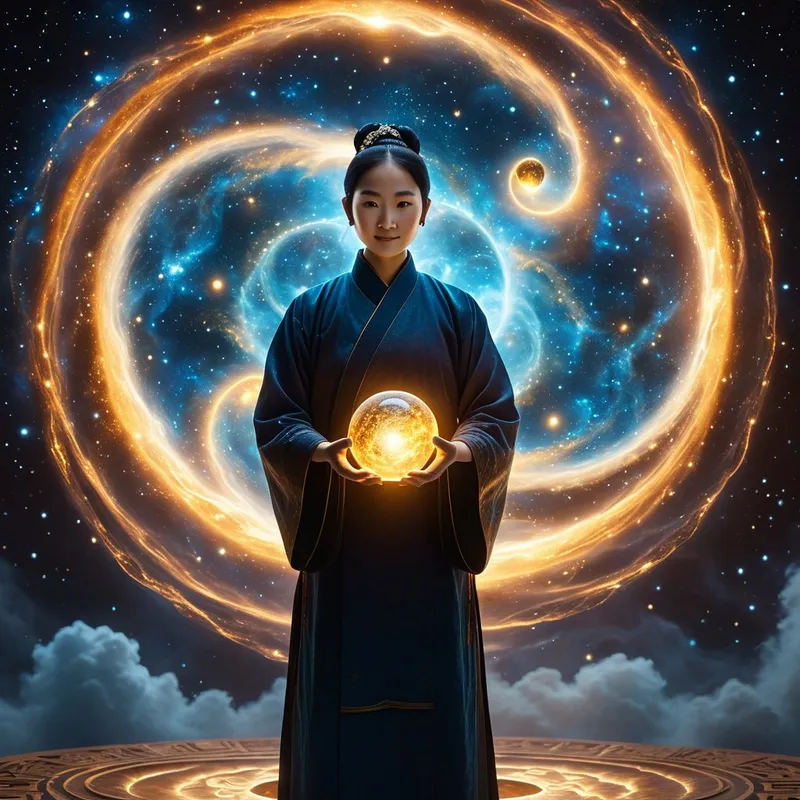
Baoding Balls Myth Meaning & Symbolism
A celestial artisan forges two perfect spheres from chaos, embodying the eternal dance of yin and yang to bring harmony to the human heart and cosmos.
The Tale of Baoding Balls
Before the world knew its name, in the silent breath between the parting of Hundun and the solidifying of the earth, there was a sound. It was not a roar, nor a whisper, but a hum—a deep, resonant frequency that vibrated in the marrow of the nascent universe. This was the song of potential, and it was heard by a solitary figure who dwelled in the Tian, the heavenly domain. He was known as the Celestial Artisan, a being whose essence was the marriage of intent and form.
He observed the newborn world below. The mountains rose, but they were jagged and hostile. The rivers flowed, but their courses were violent and erratic. In the hearts of the first people, a mirror of this discord thrived: thoughts clashed like storm clouds, the Qi was stagnant, and hands, made for creation, trembled with unresolved tension. The world was a masterpiece half-finished, a melody missing its counterpoint.
The Artisan descended to a place where the earth’s metal veins sang loudest, a sacred mountain whose core was iron born from stellar fire. He did not gather ore with tools, but with his will. From the chaos of the mountain’s heart, he called forth the essence of density, of strength, of enduring form. The molten metal did not splash; it coalesced, drawn by his focused silence. For forty-nine days and nights, he stood unmoving, his consciousness a crucible. He poured into the cooling metal not just heat, but the principle of Yin—the quiet moon, the yielding valley, the deep well of rest.
When the first sphere was born, dark and cool as a night without stars, he began again. This time, from the very air and the first light of dawn, he spun the principle of Yang—the ardent sun, the ascending peak, the spark of action. He forged the second sphere, and within it, he captured the hum that had begun all things.
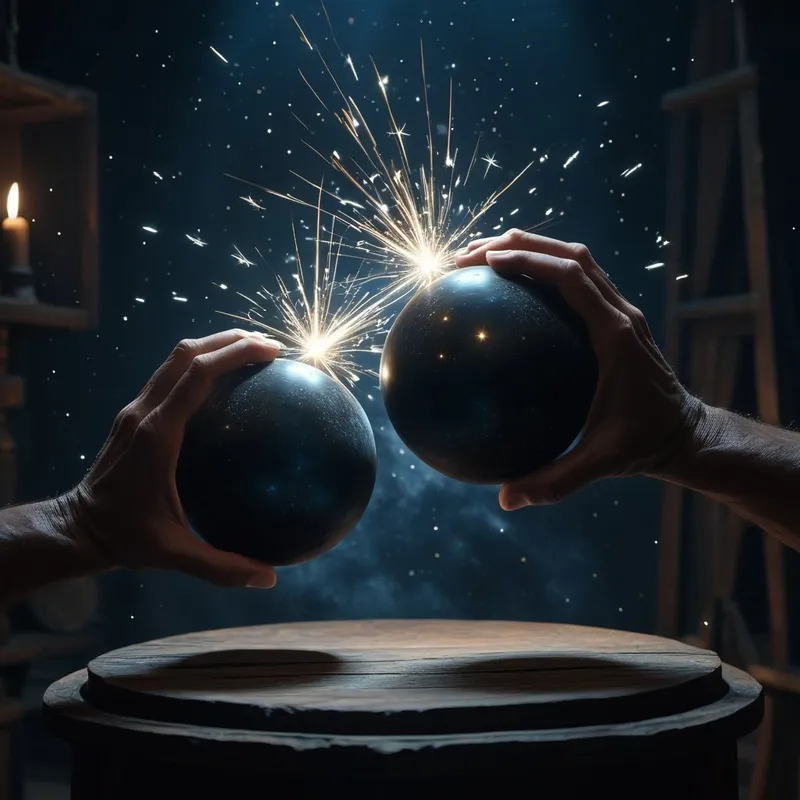
He placed the dark Yin sphere and the bright Yang sphere in the palm of his hand. They were separate, complete unto themselves. Then, he set them in motion. With a subtle rotation of his wrist, the spheres began to orbit one another. Click… click… click… A sound emerged, rhythmic, soothing, profound. It was the sound of the cosmos breathing. It was the friction of opposites generating not discord, but a third, transcendent thing: Harmony.
Where the resonant hum passed, the jagged mountains softened into majestic slopes. The wild rivers found their graceful, meandering paths. And the Artisan, walking among the people, placed a pair of these spheres into the hands of a weary elder. As the elder’s anxious fingers began, clumsily at first, to rotate the spheres, the clicking song entered his blood. The clash in his mind stilled; the knotted Qi in his chest began to flow. The conflict was not erased, but mastered, transformed into a dynamic, living balance. The Artisan smiled, for his creation was complete. He had not given them a tool, but a universe in miniature—a portable cosmos for the soul.
Cultural Origins & Context
While the specific, personified myth of the Celestial Artisan is a tapestry woven from broader Taoist and cosmological principles, the artifact of the Baoding Ball is deeply rooted in Chinese material and medical history. Emerging from the Ming Dynasty, these spheres, also called "Iron Balls" or "Health Balls," were practical objects from Baoding City in Hebei Province. Their initial function was likely physical: to strengthen the hand, improve dexterity, and stimulate the acupuncture points and meridians of the palm, which in traditional Chinese medicine are seen as microcosmic maps of the entire body.
The mythologizing of the object occurred through oral tradition and its integration into Taoist and Feng Shui practices. Elders and healers would speak of the balls not merely as exercise devices, but as vessels of principle. Their passing from master to student, from grandparent to grandchild, was often accompanied by folk wisdom and parables that attributed their origin to divine or sage intervention. This narrative layer served a crucial societal function: it transformed a daily practice into a ritual of philosophical alignment. Rotating the balls became a somatic meditation, a way to physically enact and internalize the central tenet of Taoist thought—the dynamic, interdependent balance of Yin and Yang. The myth provided a story that the body could believe, turning exercise into a form of reverence and self-cultivation.
Symbolic Architecture
At its core, the myth of the Baoding Balls is a parable of containment and dynamic tension. The two spheres are the archetypal pair, the fundamental binary that underpins reality: light and dark, active and passive, thought and instinct, conscious and unconscious.
The true harmony is not the absence of conflict, but the sacred rotation where opposition generates music.
The Celestial Artisan represents the conscious Self—the organizing principle that can descend into the chaos of the unconscious (the mountain’s molten core) and retrieve its contents. He does not destroy the raw, metallic nature of primal energy; he refines it, gives it perfect form. The act of forging them separately, then setting them in perpetual motion, symbolizes the psychological achievement of holding opposites in tension without forcing a premature or false synthesis. The resonant click is the sound of integration, the moment where friction becomes rhythm, and conflict becomes creative energy.
The hand that holds them is the locus of this alchemy. In palmistry and acupuncture, the hand is a microcosm. Thus, to hold this revolving cosmos in one’s palm is the ultimate symbol of agency—the universe and its laws are not out there, but here, within your grasp, to be set in balance through your own will and action.
The Dreamer's Resonance
When the motif of the Baoding Balls appears in a modern dream, it seldom manifests as literal iron spheres. Instead, the dreamer may find themselves holding two contrasting objects—a hot coal and an ice crystal, a glowing gem and a dark stone, or even two conflicting ideas made physical. The dream often centers on the attempt, sometimes frantic, sometimes focused, to keep these two objects in simultaneous motion without dropping them.
This is a somatic portrait of the psyche attempting to reconcile a profound inner dichotomy. It may point to a tension between career and family (action and rest), logic and emotion (Yang and Yin), or a cherished ideal and a shadowy, rejected impulse. The clicking sound in the dream, if present, is a profound sign: it indicates the unconscious is working towards a resolution, that the friction itself is beginning to generate a new, stabilizing rhythm. A dream where the spheres move silently and smoothly suggests a state of achieved, if nascent, inner balance. One where they clang violently or fall speaks to a felt loss of control over life’s opposing demands. The dream is an invitation to consciously take up the practice of holding space for both sides of the conflict, to rotate them in the light of awareness until their contact creates music, not noise.
Alchemical Translation
The individuation process, the journey toward psychic wholeness, is perfectly modeled in this myth. We all begin in a state of internal Hundun—our potentials, conflicts, and energies are a formless, often distressing, chaos. The first step is the descent of the "Celestial Artisan"—the awakening of conscious intention and self-reflection—into this turbulent inner landscape.
The alchemy occurs not when one sphere conquers the other, but when their eternal dance becomes the engine of the soul.
The forging of the two separate spheres is the difficult work of differentiation. We must extract our "Yin" from the murk—our capacity for rest, receptivity, and introspection—and give it solid, respected form. Likewise, we must consciously shape our "Yang"—our drive, ambition, and expressive power. This often feels like creating two separate, competing selves. The crucial alchemical act is the rotation. This is the ongoing practice of life: allowing the attentive, nurturing self (caregiver) to engage with the assertive, boundary-setting self (ruler). It is letting creative frenzy (creator) be followed by periods of quiet incubation (sage).
The modern individual performs this "rotation" through mindfulness, therapy, artistic expression, or simply through the conscious navigation of daily life. The goal is not to become a single, homogenous thing, but to become the skilled hand that holds the revolving duality. The resonant harmony that results is what Jung called the transcendent function—the birth of a new attitude from the tension of opposites. The Baoding Balls myth tells us that our wholeness is a dynamic, moving balance, a universe in miniature, forever turning in the palm of our own awareness.
Associated Symbols
Explore related symbols from the CaleaDream lexicon: