
Banshee Myth Meaning & Symbolism
A spectral woman whose mournful wail heralds death, the Banshee is a profound Celtic archetype of ancestral grief and the liminal voice of fate.
The Tale of Banshee
Listen, and let the peat-fire’s glow grow dim. The wind has dropped in the Sídhe; a silence deeper than the bog pools settles over the land. It is in this hollow quiet that she arrives—not with a clap of thunder, but with the sigh of a closing door between worlds.
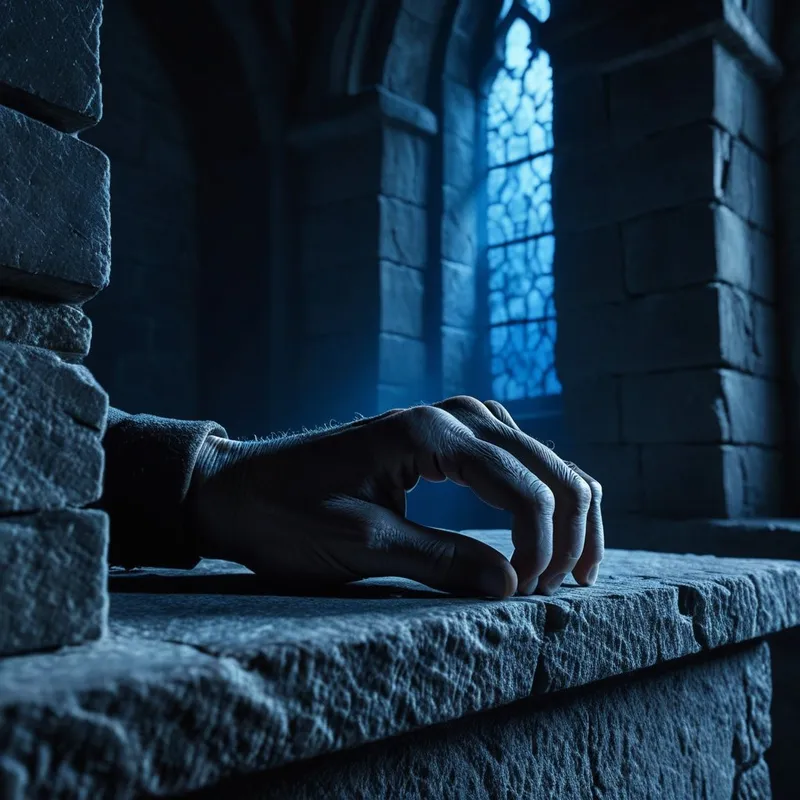
You would feel her before you hear her. A chill, not of winter, but of absence, would creep up the stone of your hearth. The embers would blue and dim. Then, from beyond the blackthorn hedge, down by the old fairy fort, it would begin. A low keening, a sound like a knife drawn slowly across the soul. It is the voice of the Bean Sídhe—the Woman of the Sídhe.
Some say she appears as a youthful maiden, her gown the colour of grave-mist, her hair a waterfall of pale silver catching a moon that is not there. Others tell of a stooped hag, her face a map of ancient sorrows, her eyes pools reflecting only the final star. She might be seen washing blood from a shroud in a swift-running stream, the water crying out as it passes over her hands. Or she may be only a presence, a gathering of shadows at the edge of the field where the family’s bile stands sentinel.
Her song is the story. It begins as a whisper, a name caught on the wind. It swells into a lament, a raw, wordless articulation of loss that predates language. It is the sound of a thousand generations of women weeping for their dead. It winds through the glen, slips under the door, and coils around the hearts of those within. It does not threaten; it announces. It is the voice of the land itself, singing the dirge for one of its noble children. The conflict is not hers to wage; it is the immutable conflict of life against death, and she is its herald. The rising action is the crescendo of her wail, a sound so filled with terrible love and cosmic grief that it strips all pretense from the world, leaving only raw, sacred truth. The resolution is the silence that follows—a silence now heavy with meaning, a space hollowed out for the coming change. And then, she is gone. Only the memory of the sound remains, echoing in the stones, a confirmation from the Otherworld that a thread in the great tapestry is being cut, and a soul is preparing to cross the final threshold.
Cultural Origins & Context
The Banshee is not a singular, standardized monster from a Celtic bible. She is a folk-belief, emergent and organic, rooted deeply in the pre-Christian Gaelic world. Her origins lie in the complex veneration of the Sídhe, the people of the mounds, often understood as the diminished gods and goddesses of the old Tuatha Dé Danann. The Banshee, as a Bean Sídhe, is intrinsically linked to specific, ancient Gaelic families or clans—the Ó Briains, the Ó Conchobhairs, the Ó Néills. She is a familial spirit, a guardian of bloodlines, whose duty is not to cause death, but to keen for it.
This tradition was passed down orally, by the fireside, in the whispered stories of seanchaí. Her function was profoundly societal and psychological. In a culture with a cyclical view of time and a thin veil between worlds, death was a transition, not an end. The Banshee’s wail served as a sacred alert. It allowed the family and community to begin the psychological and ritual process of mourning before the physical death occurred. She ritualized the shock, giving it a form, a sound, and a supernatural sanction. She was the embodiment of the community’s collective grief, externalized and given a face—or a voice—so that the living were not alone in their sorrow. She affirmed the importance of the individual within the clan and connected their passing to the eternal rhythms of the ancestral and spiritual world.
Symbolic Architecture
The Banshee is a master symbol of the liminal, the in-between. She exists at the threshold of life and death, the human and the Otherworld, sound and silence, prophecy and fulfillment.
She is the embodied sound of the inevitable, the music of fate that we spend our lives trying to drown out with noise.
Psychologically, she represents the aspect of the unconscious that knows our deepest, most unavoidable truths—particularly those concerning loss, mortality, and the endings necessary for transformation. Her feminine form is critical; she is not the grim reaper, an impersonal male skeleton, but a mourning woman. She connects death to the feminine principles of intuition, emotion, creation, and dissolution. Her wail is the sound of the psyche itself being torn by a coming change, the painful but necessary rupture of an old structure—be it an identity, a relationship, or a phase of life.
The comb she is sometimes described as holding or running through her hair is a potent symbol. It represents order and care (combing the hair) applied to the chaotic, tangled mess of grief and fate. Even in announcing chaos, she carries a tool for grooming, for making presentable. She prepares the soul for its journey. Her association with specific families speaks to the psychological concept of the ancestral layer of the unconscious—the inherited patterns, traumas, and destinies that flow in our blood, waiting for their moment to be heard.

The Dreamer's Resonance
To dream of the Banshee is to encounter the psyche’s own early-warning system. It is rarely a literal premonition of physical death. More commonly, it signals a profound psychological death—the end of an era of the self.
In the dreamscape, she may not appear as a spectral woman. Her presence may be transmuted: the sound of a distant, unbearable siren that only you hear; a figure perpetually weeping in the next room; a cold wind that whispers your name with unbearable sadness; or the overwhelming somatic sensation of being keened for. The dreamer is often a passive witness, frozen, forced to listen. This mirrors the psychological process of confronting a truth we have been avoiding—a relationship that has ended in spirit but not in fact, a career that is dying, an outmoded version of ourselves that must be shed. The Banshee’s wail in a dream is the sound of that inner knowing finally breaking through the ego’s defenses. It is a terrifying but ultimately integrative experience. The somatic resonance is key: a chill, a tightening in the chest, a feeling of hollow dread. This is the body recognizing the truth before the conscious mind can articulate it. The dream is an initiation into a necessary mourning.
Alchemical Translation
The alchemical journey, or individuation, is a series of deaths and rebirths. The Banshee myth provides a stark, beautiful model for the first, most crucial part of that cycle: the nigredo, the blackening, the descent into the dark night of the soul.
The work of transformation begins not with seeking the light, but with hearing the wail in the dark. The Banshee is the midwife of the soul’s dissolution.
For the modern individual, the “family” she keens for is not our literal clan, but our internalized structures—the persona, the ego-identifications, the complexes we mistake for our true selves. Her cry announces that these structures are mortally wounded and must be allowed to die. The alchemical translation is the act of sitting with the wail. It is the conscious, courageous decision to not numb the grief, fear, and emptiness that accompanies an ending, but to listen to it fully. This is the opus contra naturam—the work against our nature to flee pain.
By hearing her, we acknowledge the sovereignty of fate over our willful plans. We accept the dissolution. In that acceptance, the function of the Banshee transforms from a herald of terror to a guide. Her unbearable sound becomes a sacred song that washes away the inessential. The silence that follows her passing is not empty, but fertile—the tabula rasa upon which the new, more authentic self can be built. In psychological alchemy, to integrate the Banshee is to make peace with the necessary endings in our lives, to recognize grief not as a enemy, but as the deepest form of love and respect for what was, and the only honest ground from which what will be can grow. She teaches us that to be whole, we must first be hollowed.
Associated Symbols
Explore related symbols from the CaleaDream lexicon: