Banjo Origins Myth Meaning & Symbolism
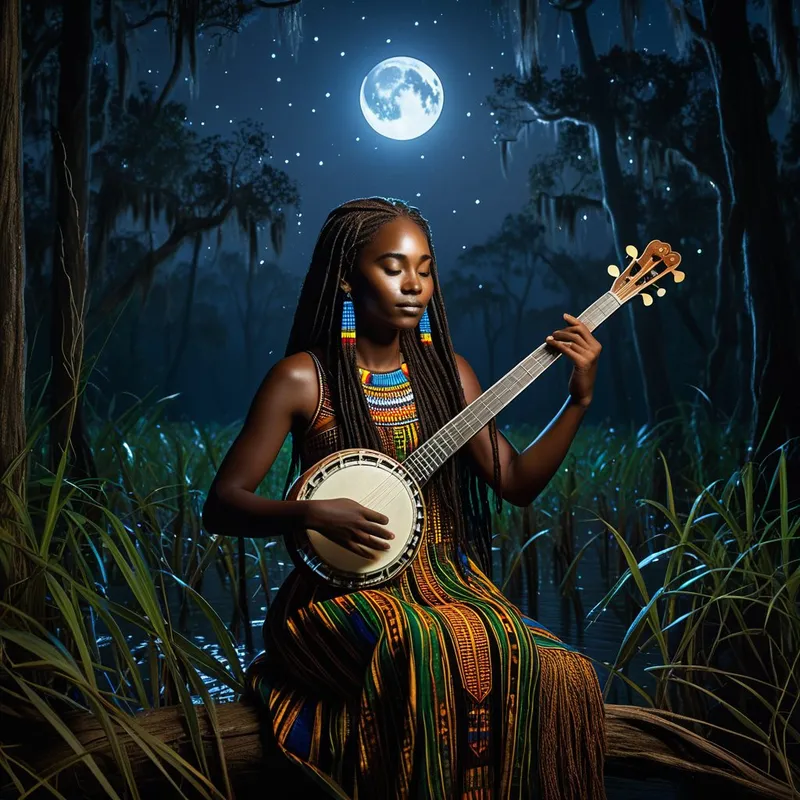
A spirit of memory, severed from home, weeps into a gourd. From her tears and the land's offerings, the first banjo is born, binding past to present.
The Tale of Banjo Origins
Listen. This is not a story of wood and wire. This is a story of a sound that had to be born.
Before the first pluck echoed in a Carolina pinewood, before a rhythm answered a work song in a Mississippi field, there was a silence. It was a deep silence, the kind that sits in the bone, heavier than the ocean. It was the silence of a memory cut in half—the shore left behind whispering to the shore arrived upon, with only the groaning sea in between.
From this silence, she emerged. They did not call her by a single name, for she was the breath of a thousand names left on the wind. She was the Nyama of memory itself, a spirit formed from the collective sigh of a people unmoored. Her skin held the dark of fertile river soil, her eyes were pools reflecting fires that no longer burned on homeland hearths. She walked the new, strange land—the damp humus of the swamp, the red clay of the hills, the sharp edges of the cane field—and everywhere she walked, the silence followed.
She came to the base of a great <abbr title="A bald cypress, a tree native to Southern US swamps, known for its resilience and "knees"">water cypress, its roots drinking deep from the black water. Here, her sorrow could no longer be contained. It did not come as a wail, but as a slow, steady weeping. Her tears, warm and saltless, fell upon the earth. Where they landed, they did not sink. They pooled and shimmered, holding in their liquid light the image of a ngoni, the shape of a broad ekonting, the memory of a voice.
The cypress felt her grief. A branch, long and straight, fell at her feet without a sound. The earth offered up a gourd, round and hollow, that had rolled from a forgotten garden. A possum, having lived its life and returned to the soil, left its taught, resilient hide upon the ground.
With hands that were not quite hands—more like the gathering of twilight—she took these offerings. She scooped the tear-pool, and it hardened into the gourd’s skin, stretched and fastened with thorns of resolve. She fused the cypress branch to the gourd, a neck to hold the tension of the past. From her own long, unraveling hair, she spun four strings. The first was spun from the memory of the river’s flow. The second, from the grit of the field at noon. The third, from the whisper of the grandmother’s story at dusk. The fourth, from the unspoken dream of a tomorrow not yet born.
She held the creature of her sorrow and her making to her chest. She did not strum it. She simply breathed upon the strings.
And the sound… it was not one thing. It was a percussive thumb, a melodic pluck, a drone of history. It was the laugh that survives. It was the coded cry. It was the river and the field and the story and the dream, all vibrating together. It was a sharp, joyful bark that cut the silence forever. It was the first banjo. And its song was not an end to grief, but its transformation. It was memory made audible, sorrow made danceable, a spirit given a voice that could be held in the hands.

Cultural Origins & Context
This myth, in its myriad local variations, is not found in a single sacred text but is woven into the oral traditions, songs, and tacit knowledge of the African Diaspora in the Americas, particularly within the Gullah Geechee and broader Creole cultures of the Southeastern United States and the Caribbean. It is a etiological myth for an instrument that is itself a diaspora—a fusion of West African lute prototypes (like the xalam, akonting, and ngoni) with the materials and necessities of a new world.
The story was passed down not by professional bards, but by the makers and players themselves—often in the liminal spaces after sundown, in the corners of praise houses, or during the secret gatherings where culture was preserved under threat. Its societal function was profound: to encode the trauma of displacement and enslavement into a narrative of active, creative survival. The myth asserts that the banjo is not merely an instrument adopted or adapted, but one conjured. It was a psychic technology for processing the unspeakable, transforming the raw materials of a brutal reality (the gourd, the hide, the local wood) and the intangible materials of profound loss (memory, tears) into an engine of community, identity, and resistance. The banjo, through this myth, becomes a sacred object of syncretism, a physical vessel for the soul of a scattered people.
Symbolic Architecture
The myth’s power lies in its stark, alchemical symbolism. Each element is a node of profound psychological meaning.
The Spirit of Memory is not a distant goddess but the embodied, collective psyche of a people. She represents the autonomous complex of cultural memory—wounded, wandering, yet inherently creative. Her tears are not weakness; they are the liquefied, potent essence of experience, the necessary solvent for transformation.
To create from sorrow is not to erase the sorrow, but to change its state of matter—from a weight that drowns to a vibration that connects.
The Gourd symbolizes containment and potential. Hollow, it represents the void left by rupture, the emptiness of exile. Yet, its very hollowness is what makes it resonant, capable of amplifying a whisper into a statement. The Cypress Neck is the spine of resilience, a tree that thrives in drowning waters, connecting the deep, muddy roots (the unconscious past) to the place where the strings are pressed (conscious action). The Four Strings are the tethers of identity: Connection to Origin, Endurance in Struggle, the Narrative Thread, and the Forward-Looking Aspiration.
The act of creation itself is the core symbol. The banjo is not found; it is assembled from what is at hand, both materially and spiritually. It is the ultimate symbol of making a way out of no way. The resulting sound—percussive, melodic, complex, and biting—is the sound of the integrated psyche, where pain and joy, memory and innovation, are not in opposition but in conversation.
The Dreamer's Resonance
When this mythic pattern surfaces in modern dreams, it signals a profound somatic and psychological process: the confrontation with a foundational grief or dislocation and the unconscious urge to instrumentalize it.
A dreamer might find themselves in a featureless landscape, holding disparate, unconnected objects that feel charged with emotion. They may be trying, fruitlessly, to speak or cry, but only a silent vibration emerges. This is the "silence" phase of the myth. The dream ego is the wandering spirit, carrying unprocessed Nyama.
The transformative moment comes when the dream shifts to an act of focused making: desperately tying strings to a found object, hearing a resonant hum from an empty vessel, or finally producing a sound—often jarring or surprisingly beautiful—from an assembled instrument. This is the psyche working to build a structure (a "banjo") to hold and express a previously inchoate and burdensome emotional history. The dream is modeling the birth of a personal "voice" or creative capacity directly from the raw material of one's wounds. It is the somatic feeling of tension (the stretched hide) giving way to resonance (the plucked string).

Alchemical Translation
For the modern individual navigating any form of diaspora—be it cultural, psychological, or spiritual—the Banjo Origins myth is a masterclass in the alchemy of individuation. It maps the process of psychic transmutation from the massa confusa of suffering to the lapis philosophorum of authentic expression.
The first stage, Nigredo, is the black silence, the wandering grief—the confrontation with the shadow of loss, displacement, or fractured identity. This is the spirit’s tears. The Albedo is the gathering of the "offerings": the conscious and unconscious resources. The gourd is the accepting of one’s own emptiness as a vessel. The cypress is connecting to one’s core resilience. The hide is the willingness to be vulnerable and stretched.
The individuated self is not a found treasure, but an instrument built from the wreckage of the ship and the maps of the drowned.
The Citrinitas, the yellowing, is the act of assembly itself—the often messy, trial-and-error work of therapy, art, journaling, or community building where we try to fuse memory (the past) with action (the present). Finally, Rubedo, the reddening, is the first breath upon the strings. It is not a final, perfect note, but the initial, shocking vibration of a newly integrated voice. It is the moment a personal history of pain is translated into a unique perspective, a creative act, or a mode of connection that is authentically one’s own.
The banjo, in the end, is the symbol of the complexio oppositorum—the complex union of opposites. Its sound holds the major and the minor, the punch and the caress, the old world and the new. To heed this myth is to understand that our most authentic voice is often forged in the crucible of our deepest silences, and that what we create from our tears can become the very thing that makes the world dance.
Associated Symbols
Explore related symbols from the CaleaDream lexicon: