Bamboo as Scholar's Friend Myth Meaning & Symbolism
A myth where the bamboo plant offers its body to become the scholar's brush, embodying the alchemy of knowledge, resilience, and artistic expression.
The Tale of Bamboo as Scholar's Friend
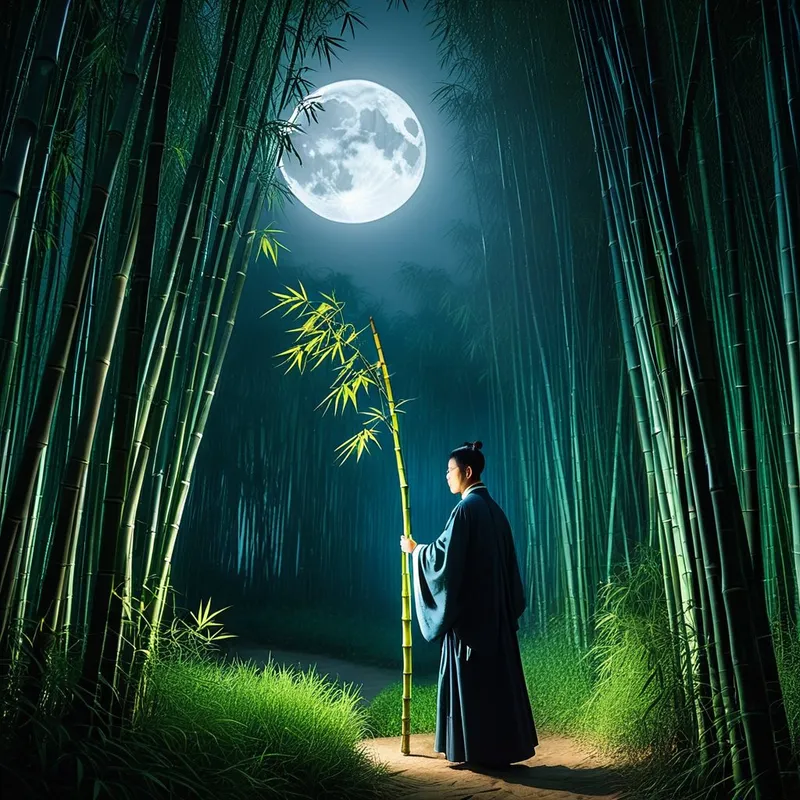
Listen, and hear the whisper in the grove. It was a time when the world was younger, and the boundary between the human heart and the green world was thin as rice paper. In the deep mountains, where mist clung to the peaks like memory, there lived a scholar named Li Ming. His days were a silent dialogue with the classics, his nights a vigil under the cold stars, seeking not just to read wisdom, but to become it. Yet, his brush—a thing of wood and wolf hair—felt clumsy, a barrier. It could trace characters, but it could not breathe the spirit into them. His scrolls remained silent.
The conflict was not of dragons or demons, but of a profound inner drought. The well of his inspiration was dust. One evening, in despair, he wandered into a bamboo grove sacred to the Shen of the mountain. The bamboo here was not ordinary. It stood in a perfect circle, each stalk straight and true, its joints like the measured beats of a poem. As the moon rose, silvering the leaves, a voice sighed on the wind, not in words, but in a feeling of resonant emptiness.
"Scholar," the grove seemed to say, "you seek a vessel for the void. You look outward for a tool, when the vessel must be born of the same substance as the intent."
Li Ming knelt, placing his palm against the cool, smooth skin of the eldest stalk. He felt not plant, but presence. A consciousness, old and patient, that knew the weight of seasons and the strength found in yielding. In that touch, a pact was understood, a silent offering more sacred than any spoken vow.
At dawn, he returned with a heart both heavy and light. With a blade of pure intent, he selected a single, perfect stalk. This was the rising action—not a battle, but a ceremony. As he cut, there was no scream of wood, but a release, a sigh of purpose fulfilled. He hollowed the segment, its inner chamber a conduit waiting. He gathered the finest hairs from the winter coat of a white rabbit, an animal of the moon, and bound them with silk thread to the bamboo shaft.
In that moment of resolution, the alchemy was complete. The first time his new brush touched the inkstone, it was not Li Ming who moved it. It was the mountain's resilience, the grove's quiet fortitude, the bamboo's hollow wisdom flowing through his hand. Characters danced onto the paper, alive with wind and grace. The bamboo had not died; it had translated itself. It became the scholar's friend, the literal extension of his will, transforming silent knowledge into resonant art. The myth ends not with an end, but with a beginning: the first true line of a poem that is still being written.

Cultural Origins & Context
This myth, less a single story and more a pervasive cultural motif, finds its roots in the deep intertwining of literati culture (Shi Dafu) and the natural world in ancient China. It was passed down not as a formal epic, but through the very practice it sanctified: in the quiet instructions of a master calligrapher to his pupil, in the poems that praised the "virtues of bamboo," and in the countless paintings that depicted scholars in bamboo groves. Its tellers were the scholars and artists themselves, for whom the bamboo brush was the primary instrument of civilization, the tool that recorded history, philosophy, and beauty.
Societally, the myth functioned as a sacred justification for the scholar's way of life. It elevated the act of writing from a craft to a cosmological principle, connecting the human pursuit of order and meaning (Wen) directly to the orderly, resilient patterns of nature. The myth taught that true knowledge was not extracted, but received through a relationship of respect and symbiotic exchange. It reinforced the Confucian ideal of the scholar as a cultivated plant himself—upright, resilient, useful—and the Daoist principle of Wu Wei, action through yielding and natural cooperation.
Symbolic Architecture
The myth's power lies in its elegant symbolic architecture, where every element is a mirror to the psyche.
The Bamboo is the central archetype. Its hollow stem symbolizes the receptive mind, the empty vessel that must be cleared of ego to receive inspiration and truth. Its segmented joints represent integrity, moral fortitude, and the structured growth of character and knowledge. It bends in the storm but does not break, embodying resilience rooted in flexibility—a crucial psychological stance.
The Scholar (Li Ming) represents the conscious ego in search of depth. His initial frustration is the crisis of the intellectual who possesses information but lacks wisdom, who has language but not poetry. He is the part of us that seeks to articulate the ineffable.
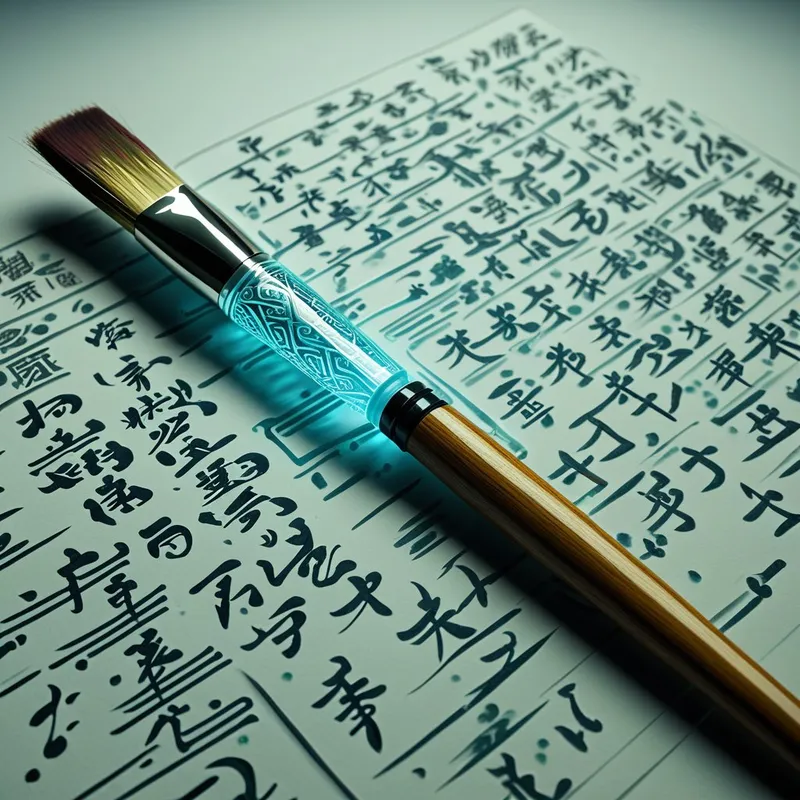
The Brush is the synthesized symbol, the coniunctio or sacred marriage. It is no longer merely plant or tool, but a psychopomp—a bridge between the inner world of feeling and thought and the outer world of tangible expression.
The hollow bamboo does not weaken the brush; it becomes the channel that allows the spirit of the mountain to flow into the word.
The act of Creation (Writing) becomes a ritual of communion. The ink is the pooled shadow of experience, the paper is the receptive field of consciousness, and the brush-stroke is the moment of integration, where inner reality is made manifest.
The Dreamer's Resonance
When this myth pattern stirs in the modern unconscious, it often surfaces in dreams of searching for or crafting the "right tool." One might dream of frantically trying to write with broken pencils, of finding a beautifully crafted but unusable instrument, or of being in a forest selecting materials for an unknown purpose. Somaticly, this can feel like a tension in the hands, the throat, or the chest—a pressure of something unexpressed.
Psychologically, this dream signals a process of re-sourcing one's voice. The dreamer is likely at a point where old modes of expression (the "clumsy brush")—be they logical analysis, habitual emotional responses, or outdated professional skills—are failing to convey the complexity of their current inner experience. The psyche is pointing toward the need for a new vessel, one born of authenticity (the bamboo's integrity) and receptive emptiness (the hollow core). The dream is an invitation to identify what in one's life represents the "bamboo grove"—that source of natural, resilient, and deeply rooted truth that can be ethically "harvested" to serve a higher purpose of articulation.

Alchemical Translation
The myth models the individuation process—the journey toward psychic wholeness—with stunning clarity. The scholar's initial state is one of alienation: mind separated from nature, intellect from soul, intention from effective action. This is the nigredo, the dark night of the soul where one's tools feel useless.
The journey to the grove is the beginning of the albedo, the whitening. It is a turning inward and downward, away from the constructed world of study and toward the instinctual, vegetative layer of the psyche (the bamboo grove). The pact with the bamboo represents a critical negotiation with the Self, the larger psychic totality. The ego (scholar) does not conquer the unconscious (nature); it petitions it, forming an alliance.
The crafting of the brush is the coniunctio, the sacred marriage. The conscious mind (the craftsman's skill) and the raw material of the unconscious (the bamboo's symbolic virtues) are joined to create a new, transcendent function: the authentic voice. This is the birth of the Lapis Philosophorum, the philosopher's stone, which in this context is the capacity for true expression.
The transformation is not in the bamboo becoming a tool, but in the scholar becoming a conduit. The brush writes the man as much as the man writes the brush.
Finally, the act of writing with the new brush is the rubedo, the reddening or manifestation. The integrated psychic energy, now symbolized by the brush, is made real in the world. It produces something of lasting value and beauty—not just words, but embodied wisdom. The cycle completes as the individual, like the mythic scholar, finds that their deepest struggles (the hollow core, the flexible strength) have become the very channels through which their unique contribution to the world can flow. The friend was not found; it was forged in the silent agreement between seeking and yielding.
Associated Symbols
Explore related symbols from the CaleaDream lexicon: