Bamboo Annals Myth Meaning & Symbolism
A myth of a lost chronicle, buried and forgotten, speaking to the soul's struggle to preserve truth against the erasures of time and power.
The Tale of Bamboo Annals
Listen, and hear the whisper from the hollow stalk. It does not begin with thunder, but with a silence so deep it swallowed dynasties.
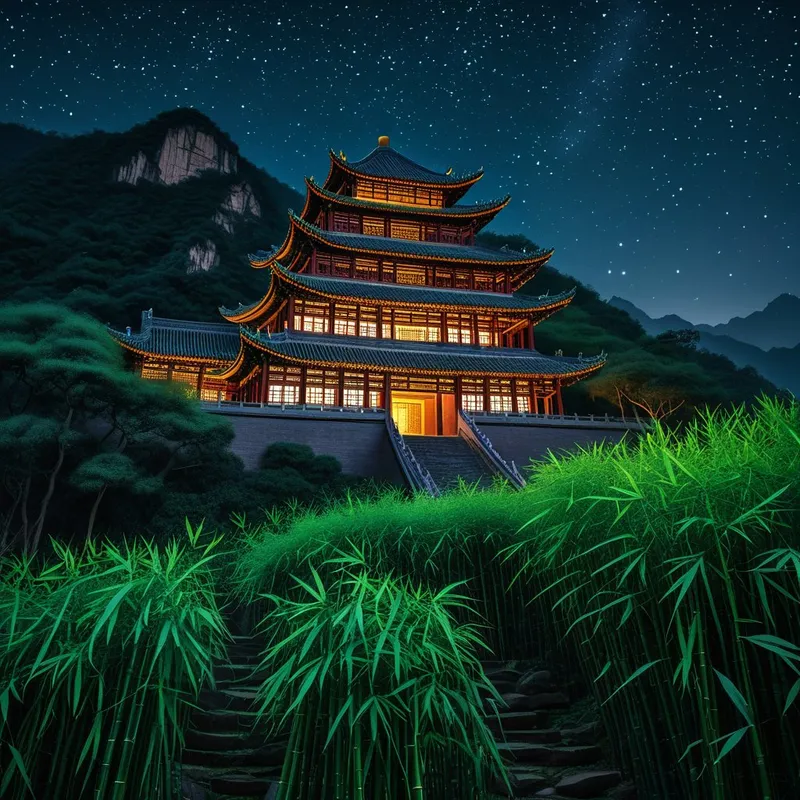
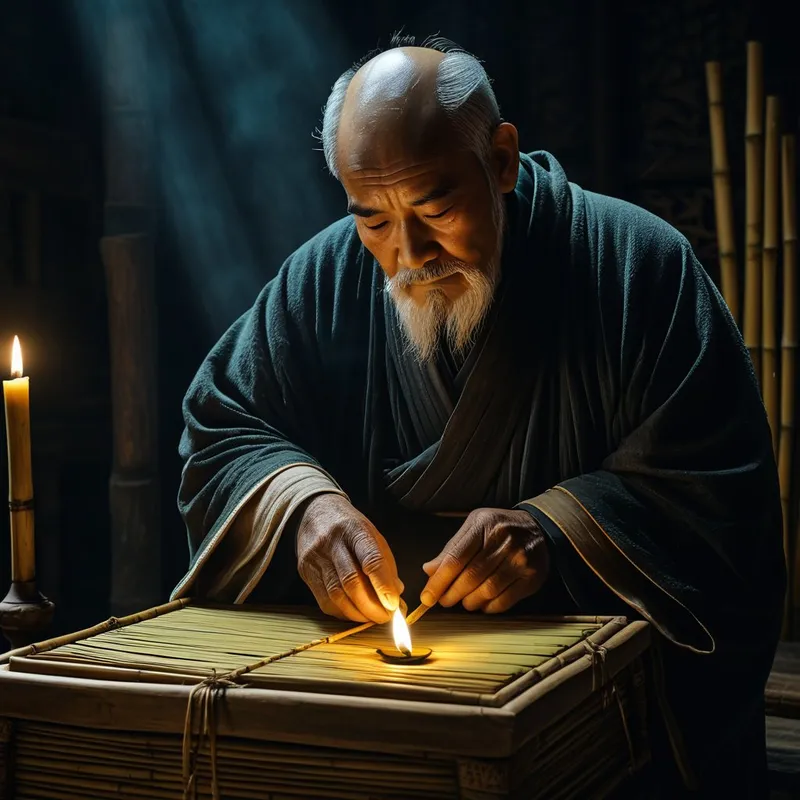
In the time after the great burning, when the First Emperor sought to unify all under heaven by consigning the past to flame, the air itself tasted of ash and fear. The old songs were choked in throats; the chronicles of a hundred states crackled and turned to smoke. But in the heart of the land of Wei, a different kind of seed was planted. Not in earth, but in memory. The sages and scribes, their hands still trembling from the heat of the pyres, performed a desperate alchemy. They took the forbidden histories—the rise and fall of kings, the omens of heaven, the true names of the Xia and Shang—and etched them, character by precious character, onto slips of green bamboo. This was not an act of rebellion, but of burial. A sacred internment.
With the solemnity of a funeral rite, they carried the bundled annals to a forgotten place, a tomb not for a body, but for time itself. They sealed the bamboo slips within a stone casket and lowered it into the cool, dark belly of the earth, beneath the roots of an ancient stand of bamboo. No marker was raised. No song was sung. The guardians of this truth took the secret with them to their own graves, leaving the chronicle to the patient silence of stone and root. The empire marched on; new dynasties rose, writing their own stories over the scorched earth.
Centuries flowed like the Yellow River. The Han ruled, and scholars yearned for the lost past, for a thread to connect them to the authentic origins. Then, in the reign of Emperor Wu, the earth itself spoke. A tomb, cracked open by time or by chance, yielded its ghost. The stone casket was found, and within it, the bamboo slips, their ink still stark against the aged green. They were lifted into the light of a new age, a voice from the grave of history. For a fleeting moment, the truth breathed again. The annals were transcribed, studied, debated—a recovered memory for the empire.
But the story does not end in revelation. The recovered text was itself a ghost, fragile and contested. It spoke of timelines that challenged the orthodox, of kings omitted from the sanctioned records. It was inconvenient. And so, in the way of all things that disturb the comfortable order, it began to fade. Copies were lost. Passages were deemed spurious. The physical slips, that tangible bridge to the buried past, vanished once more—not into earth, but into the labyrinth of neglect and scholarly dismissal. The Bamboo Annals became a phantom in the library of history, a tantalizing shadow of a truth that was found, only to be lost again in a different, more profound way.
Cultural Origins & Context
The Bamboo Annals is a unique figure in Chinese mythology—not a myth of gods, but a myth of history itself. Its origins are inextricably linked to the most traumatic intellectual event in early Chinese history: the Burning of the Books in 213 BCE. This was not merely censorship; it was an attempted psychicide, a severing of the collective soul from its ancestral memory. The myth arises from the profound cultural anxiety that followed: What if the past is truly lost? What if the foundation of our identity is ash?
The tale was passed down not by village bards, but by historians and bibliophiles. It functioned as a foundational parable for the scholar-official class, embodying their deepest professional dread and their highest sacred duty: the preservation of truth against the erosive forces of political power, time, and forgetfulness. The myth validates the historian as a heroic, if tragic, figure—the guardian at the tomb of memory. It also reflects the Chinese philosophical tension between the <abbr title="The "Mandate of Heaven," the divine right to rule">Tianming as recorded in true history versus the <abbr title="The "Mandate of Heaven," the divine right to rule">Tianming as constructed by the victorious dynasty. The Annals represented the terrifying and thrilling possibility of an uncorrupted source, a direct line to a past before the political rewrite.
Symbolic Architecture
The myth’s power lies in its stark, resonant symbols. The Bamboo is the central pillar. It is hollow, suggesting a vessel for spirit or truth. It is resilient, bending but not breaking, symbolizing the endurance of memory even under oppression. Its segmented growth mirrors the chronological slips of the annals themselves, a natural technology for recording linear time.
The tomb is not a place of death, but a womb of latency. What is buried is not ended, but placed in a state of potential, awaiting the necessary conditions for its rebirth.
The Stone Casket represents the unconscious—both personal and cultural. It is the hard, protective shell of repression, where traumatic or inconvenient truths are sealed away for safekeeping, beyond the reach of the conscious ego (the ruling authority). The Burial and Exhumation cycle is the core psychic motion. It is the process of repression and the eventual, often shocking, return of the repressed. The truth does not stay buried forever; the psyche, like the earth, eventually yields its secrets, often at a moment of cultural crisis or reorientation.
Finally, the Second Loss—the disappearance of the Annals after their recovery—is the most psychologically profound element. It speaks to the fragility of integrated truth. Even when a traumatic memory surfaces, the conscious mind may reject it, distort it, or lose it again because its full integration is too destabilizing. The truth is not a solid object to be possessed, but a fleeting relationship to be maintained.
The Dreamer's Resonance
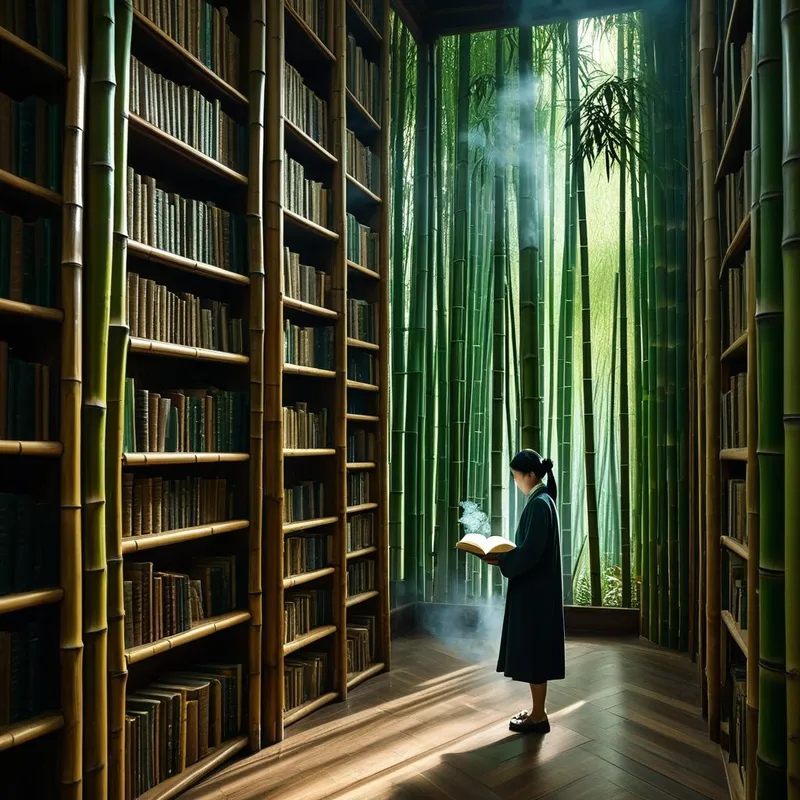
When this myth stirs in the modern dreamer, it signals a profound process of archaeological excavation within the psyche. To dream of searching for a lost book, a hidden room, or a buried box containing writings is to dream the Bamboo Annals. The somatic sensation is one of urgent, frustrating digging—a sense that a vital piece of one’s own history, a foundational narrative about who you are, is missing or has been deliberately hidden.
This often corresponds to a period of life review or crisis, where the stories one has told oneself (the "official history") no longer hold up, creating a sense of falsity or emptiness. The dreamer is encountering their own personal "book burning"—perhaps a childhood trauma, a disowned talent, or a family secret that was erased from the family narrative. The dream is the psyche’s attempt to recover the original text, the unedited version of the self, from the tomb of forgetfulness or repression. The anxiety in the dream mirrors the cultural anxiety of the myth: the terror of having no authentic past to stand upon.
Alchemical Translation
The individuation journey modeled by the Bamboo Annals is not one of heroic conquest, but of scholarly, patient re-membering. The first stage is The Burning—the ego’s necessary, often brutal, consolidation of power, which involves suppressing contradictory elements of the self (complexes, shadow aspects) to create a coherent identity. This is the Qin Emperor stage.
The second is The Burial—the wise, instinctual act of the Self (the total psyche) to protect these suppressed truths by encapsulating them in the unconscious (the stone casket). They are not destroyed, but preserved in potentia. This is an act of love, not fear.
The third is The Excavation—the mid-life or crisis-driven moment when these buried contents demand attention. They emerge, often in fragmentary, confusing, or challenging forms (like the disputed chronicle). The ego’s task is not to instantly accept them as the whole truth, but to transcribe them. To give them conscious attention and language.
The final and most difficult alchemy is to hold the chronicle lightly, knowing it too is but one version, yet allowing it to alter the landscape of the self.
The final stage is The Integration of Loss—understanding that the recovered truth will not provide a perfect, complete new identity. It will be contested internally. Parts will be lost again to denial. The triumph is not in possessing a perfect history, but in engaging in the eternal, sacred work of the scribe: the continual, humble attempt to record, correlate, and honor the multiple, often conflicting, texts of one’s own being. The Self is not a finished chronicle, but the living, breathing, and sometimes hollow stalk through which the winds of memory and truth forever whisper.
Associated Symbols
Explore related symbols from the CaleaDream lexicon: