Baldr's Return Myth Meaning & Symbolism
A prophecy of the beloved god Baldr returning from the dead after Ragnarök, heralding a world reborn from the ashes of the old.
The Tale of Baldr's Return
The world held its breath. The great winter, the Fimbulwinter, had scoured the land for three years without respite. Then came the thunder of the final march, the clangor of doomed shields, and the silence that follows the last cry. Ragnarök had come and passed. The sun was swallowed, the stars vanished, and the earth itself sank beneath the boiling sea.
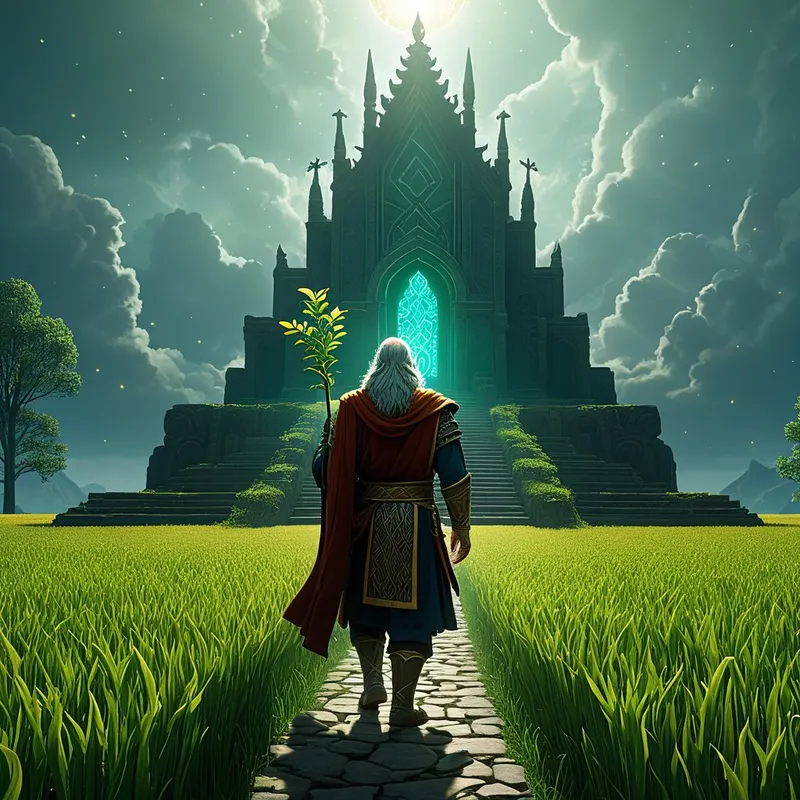
In that absolute silence, in the abyss where the Yggdrasil once stood, a new sound began. Not a roar, but a whisper. The whisper of water receding from newborn shores. The sigh of soil, warm and fertile, pushing up through the ash. A green so tender it hurt to behold spread across the land. The sun, daughter of the old, rose in a sky cleansed of smoke.
And in this reborn world, from the shining halls of Gimlé, they came walking. Few, so few, survivors of the old order. Thor's sons, carrying their father's mighty hammer. Vidar, the silent avenger. The sons of the gods, and two human beings, Líf and Lífþrasir, who had hidden deep within the wood of Hoddmímis holt. They gathered on the Idavollr, now a field of lush grass, and in their hearts was a mingling of profound loss and dawning wonder.
Then, a light appeared that was not the sun. It walked towards them from a direction beyond direction. It was Baldr. He who had been slain by the blind god Höðr and the treachery of Loki. He who had descended to the cold halls of Hel, and for whom all creation had wept, save one. He had been held there, a hostage of fate.
Now he returned. Not as a ghost, but whole. The radiance that had once made him beloved was now tempered, deepened by the knowledge of the dark. With him came his brother Höðr, reconciled, the old blindness washed clean in the waters of dissolution. They brought with them no weapons, no claims of kingship. They brought only their presence, a living promise. The prophecy was fulfilled. The world had died, and from its bones, a new one was born, with Baldr returned to dwell in it. The golden chess pieces of the gods, found in the grass, gleamed anew, waiting for hands to move them in a game whose rules were yet unwritten.
Cultural Origins & Context
This profound coda to the Norse cosmic cycle comes to us primarily from the Prose Edda of Snorri Sturluson, specifically in the Gylfaginning. It is a myth preserved not in the heat of pagan belief, but in the scholarly ink of a Christian Icelander looking back at a fading tradition. This context is crucial; Snorri was both a preserver and an interpreter, framing the myths within a pseudo-historical and euhemeristic lens. Yet, the stark, uncompromising beauty of the imagery—the rebirth of the world, the return of the innocent god—feels older, echoing in earlier poetic fragments.
The myth functioned as more than just an eschatological footnote. In a culture that viewed the cosmos as fundamentally cyclical and temporary, governed by fate (ørlög), the promise of Baldr's return after the cataclysm provided a narrative of hope that was not sentimental, but hard-won. It acknowledged the inevitability of loss, betrayal, and destruction (the core of the Baldr tragedy), but refused to let that be the final word. It was a story told in longhouses during the depth of winter, a spiritual counterpoint to the physical struggle for survival, asserting that even after the worst has transpired, a form of renewal is woven into the fabric of reality itself.
Symbolic Architecture
Baldr is the symbol of pure, conscious goodness, the integrated self untouched by shadow. His invulnerability, granted by the oaths of all things, represents a state of psychic integrity where the conscious ego believes itself immune to the unconscious. His death by the one unsworn thing, the mistletoe, is the inevitable piercing of this illusion by the repressed, the overlooked, the "blind" spot in our psyche (Höðr) manipulated by the chaotic trickster (Loki).
The death of the innocent is the birth of consciousness; we only know what light is by its absence in the dark.
His descent to Hel is not an end, but a necessary incubation. The myth posits that wholeness cannot exist in a state of naive perfection; it must first be broken and journey through the underworld of the personal and collective unconscious. His return after Ragnarök symbolizes the ultimate triumph: the redeemed archetype of the innocent, no longer naive but informed by experience, becomes the cornerstone of a new psychic order. The old world—the outdated structures of the psyche, the rigid hierarchies of complexes—must undergo a total apocalyptic dissolution (Ragnarök) for this renewed self to be established. Baldr and Höðr returning together signify the reconciliation of opposites, light and dark, conscious and unconscious, now integrated.

The Dreamer's Resonance
When this myth stirs in the modern dreamer, it often manifests not as a literal narrative, but as a profound emotional and somatic pattern. One may dream of a cherished place from childhood, now in ruins, yet with unmistakable signs of new, resilient growth pushing through the cracks. Or of a beloved figure long gone, returning not as a ghost, but as a calm, solid presence in a serene, unfamiliar landscape.
Psychologically, this signals a process emerging from the depths of a major life dissolution—the end of a foundational relationship, the collapse of a career identity, a shattering loss. The dreamer is in the post-apocalyptic space. The old "world" of their self-concept has fallen. The initial dreams may be of the battle itself (Ragnarök): chaos, conflict, and terror. The dreams of Baldr's return come later, in the quiet aftermath. They are the psyche's assurance that the process has a purpose. The feeling upon waking is not joy, but a deep, quiet peace and a sense of profound, unshakeable hope. It is the somatic knowledge that the core of one's being—the innocent, essential self—has not been destroyed, but has been tempered and will reform the personality from a more authentic, integrated center.
Alchemical Translation
The alchemical journey mirrored here is the opus of individuation, culminating in the creation of the lapis philosophorum or the Self. The first stage is the nigredo: the death of Baldr, the plunge into despair, guilt, and mourning—the blackening. This is followed by the chaotic battle of opposites, the separatio and coniunctio of Ragnarök, where all psychic structures are torn asunder.
The rebirth of the world is the albedo, the whitening: the emergence of a new, purified perspective from the ashes. But the final stage, the rubedo (reddening), is Baldr's return itself.
The ultimate transmutation is not the creation of something new, but the return of what was always essential, now indestructible because it has consciously embraced its own history of fracture.
For the modern individual, this myth models the path through profound psychological death. We must allow our inner "Baldr"—our ideal self, our innocence, our purest values—to be "killed" by life's inevitable betrayals and our own blind spots. We must let it descend into the underworld of depression, analysis, and shadow-work. The apocalyptic "battle" is the painful restructuring of our entire personality. Only after this total dissolution can the essential core return, not as a naive ideal, but as the governing principle of a reborn psyche. We do not go back to who we were. We move forward, carrying the redeemed essence of who we always were at our core, now fit to inhabit a world we have helped to rebuild from the ground up. The prophecy of return is the promise of the Self, awaiting us on the far side of our personal Ragnarök.
Associated Symbols
Explore related symbols from the CaleaDream lexicon: