Baldr's Funeral Myth Meaning & Symbolism
The radiant god Baldr is slain, and all creation mourns. His funeral pyre becomes a vessel of cosmic grief and a seed of future renewal.
The Tale of Baldr's Funeral
The world held its breath. A shadow had fallen across the golden halls of Asgard, a chill that seeped into the roots of Yggdrasil itself. Baldr the Beautiful was dead. Slain by a dart of mistletoe, guided by the blind hand of Höðr, a pawn in Loki's cruel game. The light of the gods was extinguished.
A silence, thick and suffocating, settled over the gathered Æsir. Then, a sound began—a low, shuddering moan that was not a sound at all, but the very fabric of the world grieving. It was the first sob of Frigg, Baldr's mother, and it tore through the stillness. One by one, the gods and goddesses were overcome. Thor, the thunderer, stood with head bowed, his hammer Mjölnir hanging limp. Odin, the All-Father, felt the weight of prophecy settle upon his shoulders, a knowledge more bitter than the mead of Valhalla. The death was not just a loss; it was a rent in the order of things, a promise broken.
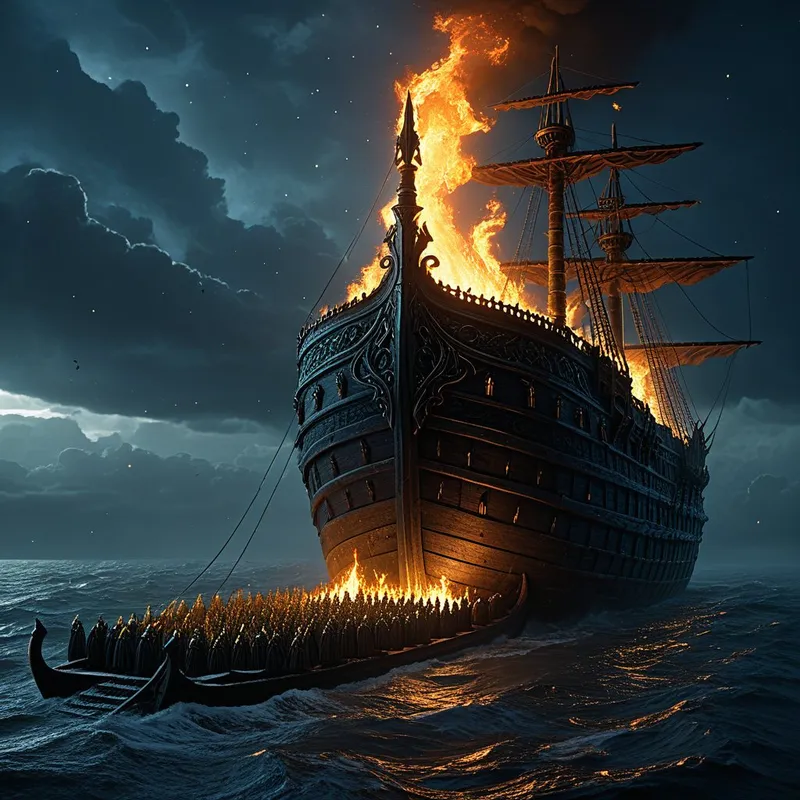
They could not leave him where he fell. A funeral befitting a god was required, a pyre to carry his light back to the cosmos. They brought his body to the sea. His great ship, Hringhorni, rested on the strand, a vessel meant for glory now a bier. But the ship was so immense, so heavy with fate, that not even the combined strength of the Æsir could send it to the deep.
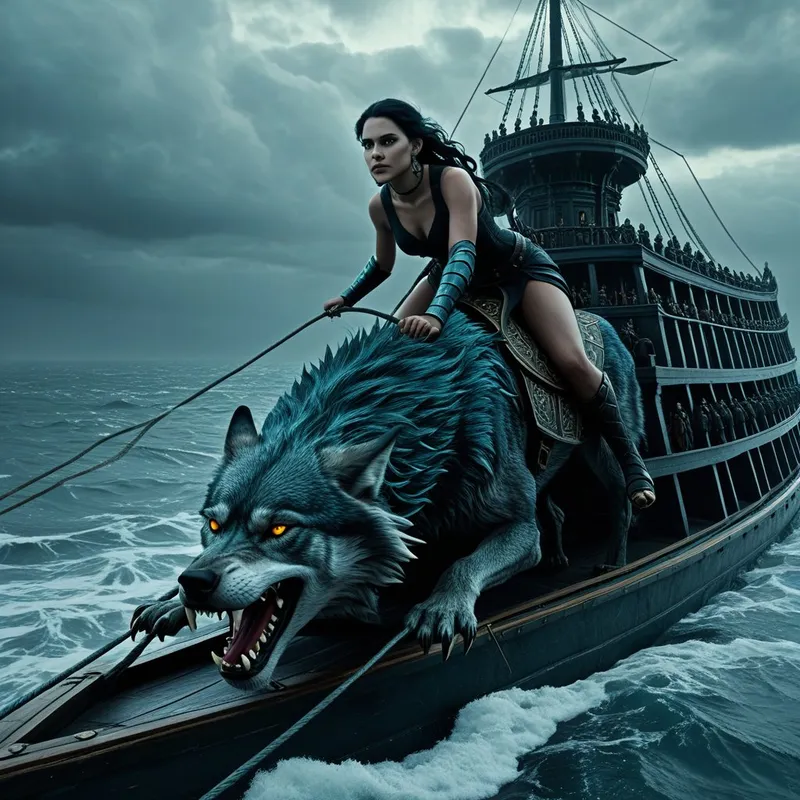
From the iron woods of Jötunheim came the answer: the giantess Hyrrokkin. She arrived riding a wolf with vipers for reins, a force of untamed wildness. With a single, mighty push, she launched the ship with such force that the earth shook and fire sparked from the rollers. The gods, humbled and awed, placed Baldr upon the deck. They heaped about him treasures, his horse, his weapons—all the accouterments of his shining life. Nanna, his wife, heart broken, laid herself down beside him, and her spirit fled to join his in the misty halls of Hel.
Then came Thor. With sacred violence, he consecrated the pyre, raising Mjölnir to bless the vessel. But the dwarf Lit, scurrying before him, was caught in the ritual and kicked into the flames, a final, accidental sacrifice to the hunger of the fire. Odin stepped forward. Into the blaze he laid his ring, Draupnir, a symbol of endless cycles, of wealth that begets wealth. A final gift, a father's hope cast into the consuming dark.
The fire was lit. Hringhorni burned, a second sun upon the water, its light reflected in a thousand tears. The smoke carried the essence of the beloved god upward, a bitter incense. And as the ship drifted into the gloom, consumed by flame and wave, every being in the nine worlds wept. Stones wept. Trees wept. Metals shed their cold, hard tears. All creation joined the dirge for the lost innocence, for the light that had made the world gentle. The funeral was not an end, but a great, collective sigh—the universe acknowledging a wound that would never fully heal.
Cultural Origins & Context
This central myth comes to us primarily through the Poetic Edda and Snorri Sturluson's Prose Edda. These texts, penned in 13th-century Iceland, are our fragile window into a much older, oral tradition. The story of Baldr's death and funeral was not mere entertainment; it was a sacred narrative explaining the fundamental fragility of a cosmos poised between order and chaos.
In the harsh, sublime landscape of the Norse world, where winter's darkness could mean death and summer's light was life itself, Baldr represented the latter's pure, vulnerable form. His funeral served a critical societal function: it was a ritual container for collective grief and existential dread. By hearing of the gods' own profound sorrow, a community facing famine, battle, and loss could validate its own suffering. The myth taught that even the divine order is not immune to tragedy, and that the proper response is not silent stoicism, but a grand, ceremonial expression of mourning that involves the entire community—and, symbolically, the entire world. It modeled how to honor what is lost, and how to continue in a world permanently dimmed.
Symbolic Architecture
Baldr is the archetype of the Solar Consciousness—the untarnished ego, the principle of purity, harmony, and connectedness. He is the part of the psyche that believes in goodness, that feels inherently safe and loved. His invulnerability, sworn by oath from all things, represents the illusion of perfect security the conscious mind constructs.
The death of the solar hero is the necessary shattering of the persona, the inevitable encounter with a reality that does not swear fealty to our innocence.
The mistletoe is the critical symbol. Small, overlooked, "too young" to swear the oath, it represents the unconscious shadow element that is excluded from the ego's tidy agreements. It is the repressed resentment, the hidden flaw, the unacknowledged weakness that the conscious self (Baldr) cannot see and therefore cannot defend against. Loki, the shape-shifting trickster, is the catalyst who knows of this exclusion and weaponizes it. He is the disruptive insight, the psychic function that dismantles naive wholeness to force a confrontation with complexity.
The funeral pyre on the ship is a profound image of alchemical release. The ship, a vessel for journeying, becomes a vessel for dissolution. The ego, with all its treasures and attachments (his horse, his wife, Odin's ring), is offered up to the transformative elements of fire and water. It is not destroyed, but transmuted—its essence released from fixed form.
The Dreamer's Resonance
When this myth stirs in the modern dreamer, it often signals a profound process of disillusionment and necessary mourning. One may dream of a radiant, perfect home burning down; of a cherished, unbreakable heirloom shattering; or of attending the funeral of a youthful, idealized version of oneself.
The somatic experience is one of a deep, hollow ache in the chest—the "heartbreak" that is literally the breaking of an old psychic structure. There is a feeling of cosmic loneliness, of being adrift on a dark sea (the funeral ship). This is the psyche's ritual. It is not a pathology, but a sacred process. The dream is the internalized Hringhorni, carrying the dead ideal to its necessary end. To resist this grief, to try to "fix" the radiant dream-object, is to refuse the funeral rites. The dream insists we must let the pyre burn, must feel the collective weep of our own inner world, to make room for what comes after.
Alchemical Translation
The individuation process modeled here is the death of naive wholeness and the birth of a more conscious, resilient selfhood. We all begin with a Baldr-like innocence, a self-concept we believe is invulnerable. Life, inevitably, throws its Loki-guided mistletoe dart.
The first alchemical stage is Mortificatio: the killing of the old king, the bright god. This is the devastating loss, the failure, the betrayal that shatters our world-view. The funeral is the crucial next stage: Separatio and Sublimatio. We must consciously separate from the identification with that lost innocence. We place it on the ship, honor it with our tears (the weeping of all things), and commit it to the transformative flames. Odin's gift of Draupnir is key.
The ring that multiplies itself in the fire is the promise that from this conscious dissolution, new psychic wealth will be generated. The cycle continues, but now with awareness of the shadow.
The myth does not end with Baldr's return in the bright new world after Ragnarök. But that promise is implicit in the funeral's completion. By fully undergoing the rites of grief—by not bypassing the darkness of Hel—we perform the alchemy. The pure, brittle gold of the innocent ego is alloyed with the dark iron of experience in the forge of grief. What emerges is not the same radiant Baldr, but a being tempered by the underworld, capable of holding both light and darkness. We build our soul not from invulnerability, but from the sacred ashes of what we have loved and lost.
Associated Symbols
Explore related symbols from the CaleaDream lexicon: