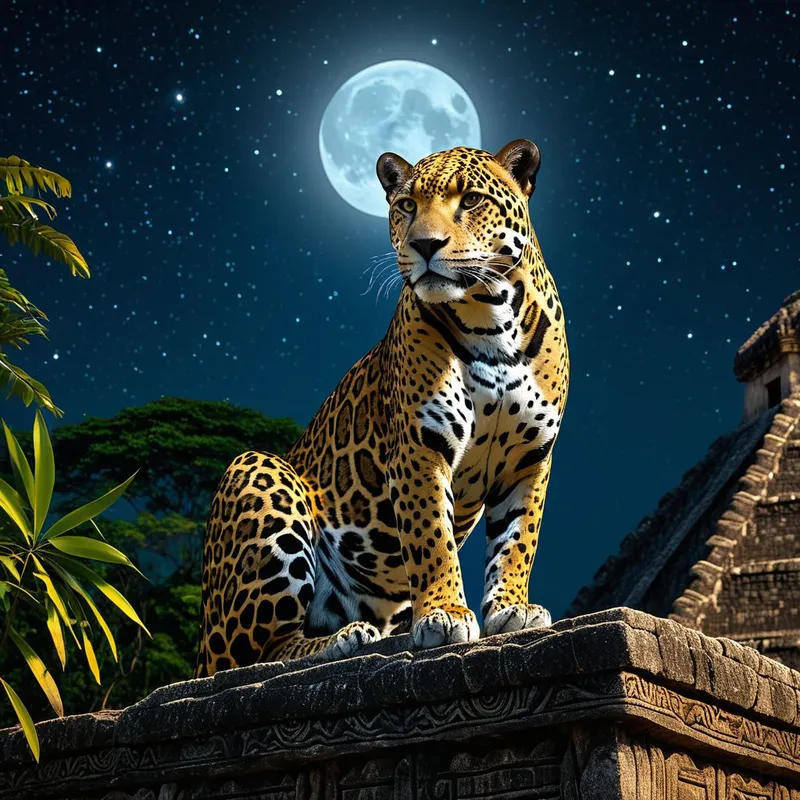
Balam Myth Meaning & Symbolism
The myth of the Balam, the Jaguar protector who guards the village threshold, embodying the sacred pact between humanity, the wild, and the spirit world.
The Tale of Balam
Listen. When the world was young and the shadows beneath the Ceiba were deep enough to swallow stars, the people lived in a trembling balance. By day, they shaped corn from the earth and raised stones to the sky. But when the sun, Kinich Ahau, plunged into the Xibalba, the true rulers of the night awoke.
This was the time of the whispering leaves, the time when the boundary between the village and the wild, between the hearth and the hungry dark, grew thin as a spider’s silk. Monstrous beings, the wayob, slithered from the roots of the world, seeking to steal the breath from children, to sour the milk of mothers, to unravel the very dreams that held the community together.
The people cried out to the K'uh. They offered blood and smoke, tears and honey. And the gods, who dwell in the green heart of the world and the black vault above it, heard. But they did not send a warrior with a spear of lightning. They did not send a plumed serpent to coil around the village. Their answer was more subtle, more terrible, and more intimate.
They called upon the lords of the emerald gloom—the Jaguars. Not the beasts of flesh and bone that stalked the tapir, but their elder brothers, the way of the Jaguar. These were spirits woven from the same essence as the starry night, the sudden thunder, and the silence before the kill.
A pact was forged in the scent of ozone and damp earth. The Jaguar spirits would become the unseen guardians. They would be given a place at the very threshold—not to enter, but to stand watch. Each village, each lineage, would have its protector: a Balam.
And so, as dusk bled into indigo, the people would make their small offerings: a pinch of ground maize at the corner of the house, a silent prayer spoken to the gathering shadows. And from those shadows, a form would coalesce. A presence felt as a low vibration in the chest, a scent of wet stone and orchids. Great, luminous eyes, like polished obsidian mirrors, would open where there was only darkness. The Balam had taken its post. It did not purr. It did not move. It was a wall of vigilant spirit. The wayob would come, sensing fear, but at the village edge they would halt, confronted by a gaze that held the patience of mountains and the finality of a closing jaw. They would hiss and retreat, back into the formless chaos.
The people slept. The children dreamed safe dreams. And the Balam, the eternal watcher, kept its covenant with the night, a sacred paradox: the most dangerous creature of the wild, become the surest shield of the home.

Cultural Origins & Context
The Balam is not a singular character from one epic narrative, but a pervasive and deeply rooted concept within the Maya worldview, primarily preserved in colonial-era texts like the Popol Vuh and in the rich oral traditions that survived the conquest. In the Popol Vuh, the Balam-Quitzé, Balam-Acab, Mahucutah, and Iqui-Balam are the forefathers of the Maya lineages, whose names signify their jaguar-nature.
This mythic framework elevated the jaguar from a powerful animal to a foundational ancestor and spiritual guardian. The Balam was a communal entity, a protective genius loci for a village or a clan. Its lore was transmitted by daykeepers and shamans (Aj Q'ij), who understood the protocols for maintaining this sacred relationship. The myth functioned as both a cosmological explanation and a social technology. It explained why the jungle, for all its dangers, was not purely hostile—it was also the source of their protectors. It enforced ecological respect and prescribed ritual behavior (offerings, prayers) that reinforced community cohesion and boundaries, both physical and spiritual.
Symbolic Architecture
The Balam is the ultimate symbol of the liminal guardian. It exists entirely at the threshold: between jungle and village, wild and domestic, night and day, danger and safety. It is the embodied paradox of protection that comes not from taming the wild, but from allying with its most potent, untamable aspect.
The guardian is not a wall that denies the wild, but the wild itself, persuaded to face outward.
Psychologically, the Balam represents the transformed aspect of our own primal, instinctual nature—the raw power of the unconscious, the "beast" within. Untransformed, this energy is the wayob: chaotic, predatory, and destructive to the conscious order of the "village" (the ego). But through a sacred pact—through acknowledgment, respect, and directed intention (the "offering")—this same fierce energy is converted into a protective force. The Balam is the archetype of the shadow made sentinel. It is the part of ourselves we fear most, stationed at the border of our psyche to guard against lesser, more fragmented terrors.
The Dreamer's Resonance
When the pattern of the Balam stirs in the modern dreamer, it often manifests as dreams of powerful, watchful animals at the periphery of the dream scene—a panther on a garden wall, a wolf sitting calmly at the foot of the bed. There is tension, but not immediate threat. The feeling is one of being observed by a profound intelligence.
This dream signals a somatic and psychological process of boundary fortification. The dreamer may be undergoing a period of vulnerability, psychic intrusion (from toxic relationships, overwhelming demands, or internal chaos), or a dissolution of personal borders. The emerging Balam represents the psyche’s instinctive move to recruit its own deepest, most autonomous resources for defense. It is the Self organizing a response from the depths, proposing a pact: "I will use my raw power, not to destroy you, but to secure the space in which you can exist." The dream is an invitation to consciously recognize and honor this inner guardian, to make the symbolic "offering" of attention and respect to one's own instinctual core.
Alchemical Translation
The alchemical journey modeled by the Balam myth is the transmutation of prima materia—the leaden, feared, and chaotic shadow—into the lapis philosophorum—the golden, protective guardian of the psychic totality. The modern individual’s "village" is the fragile constellation of identity, relationships, and conscious values. The "night" is the onslaught of unconscious contents, neuroses, and external pressures.
The process begins with the honest confession: "I cannot defend this space with conscious will alone." This humility is the call to the gods. The "pact" is the courageous act of turning toward one's own inner wildness—the repressed anger, the untamed creativity, the fierce independence—not to fight it, but to negotiate. The "offering" is the regular practice of acknowledging this power through journaling, active imagination, or respectful engagement with one's instincts and body.
Individuation requires a sentinel at the gate of the Self, one fashioned from what we once banished to the outer dark.
The triumph is not the eradication of the wild, but its integration into a new function. The Balam does not come to live in the hearth; it remains at the threshold. Similarly, the integrated shadow does not become the ego; it becomes its vigilant protector, allowing the individual to dwell in relative peace, their inner "children" (vulnerable potentials) safe to dream and grow, because the most formidable power they possess is now aligned with the preservation of their wholeness. One becomes, in essence, guarded by one's own depth.
Associated Symbols
Explore related symbols from the CaleaDream lexicon: