Bahram the Warrior King Myth Meaning & Symbolism
A warrior king's mythic journey to claim his throne, confronting destiny, divine will, and the shadow of his own royal lineage.
The Tale of Bahram the Warrior King
Listen, and let the sands of time whisper a tale of destiny written in starlight and sealed with royal blood. In the golden age of the Sasanian Empire, a prophecy was born with a prince. They named him Bahram Gur, for it was foretold he would possess the strength and spirit of the onager, the untamed beast of the desert. But fate is a fickle weaver. While Bahram was but a child, dark clouds gathered. A usurper’s ambition cast a long shadow over the Peacock Throne, forcing the true heir into exile for his own safety.
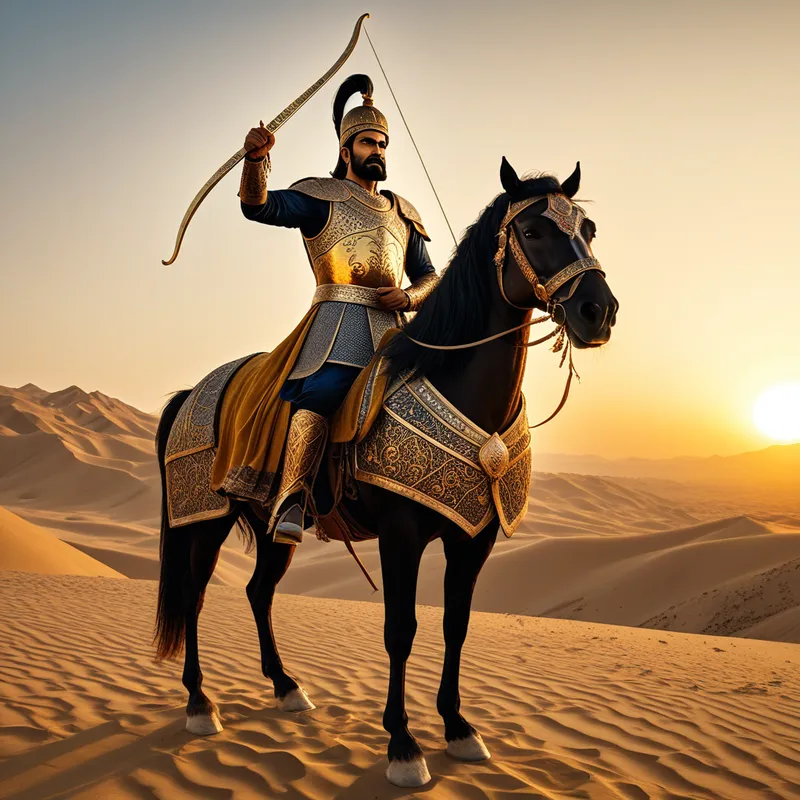
The young prince was sent far to the south, to the luminous court of al-Nu'man in al-Hira. There, under foreign skies, Bahram grew. He did not grow soft in palace gardens, but hard and keen on the arid plains. He became a living weapon—a master of the bow, his arrows singing with unerring truth; a rider whose union with his horse was a single, flowing thought; a hunter whose prowess echoed the wild Gur of his name. Yet, in the quiet hours, the desert wind seemed to carry a lament, a hollow echo where the weight of a crown should have rested on his brow.
Years flowed like the Tigris. Then, a message, stark as a dagger: the usurper was dead. The throne of Iran stood empty, a silent scream across the mountains. But a throne does not welcome; it tests. The mighty nobles and Mobads scoffed at this "desert Arab," this stranger shaped by foreign sands. "Let him prove his divine right," they murmured. "Let him perform the impossible."
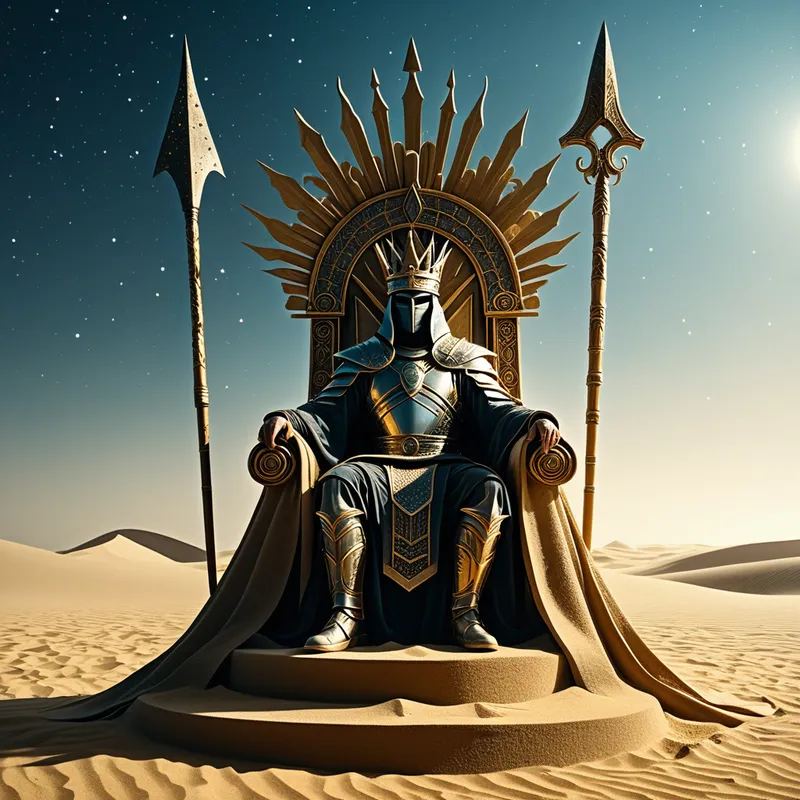
The challenge was set in the hall of mysteries: a room with two identical, magnificent thrones. Upon one sat a bejeweled crown. Upon the other, sat a lioness, majestic and deadly, her eyes pools of amber fire. "Choose," the assembly hissed. "Choose the throne that is yours by fate." The air grew thick with incense and tension. Bahram stood at the threshold, the scent of the lion, of musk and power, filling his nostrils. He did not look at the glittering crown. He looked into the eyes of the beast. He saw not a monster, but a sovereign. With a calm that stilled the very dust in the sunbeams, he walked not away from danger, but toward it. He sat upon the throne of the lioness.
And a miracle woven by the divine Ahura Mazda unfolded. The lioness did not tear. She bowed her great head, laying it gently upon the king's lap. In that moment, the beast recognized its master; nature acknowledged its rightful ruler. The crown upon the empty throne gleamed, but the true crown was placed upon Bahram’s head by the silent assent of the wild. The Warrior King had come home, not by conquest of arms alone, but by the conquest of fate itself.
Cultural Origins & Context
The legend of Bahram Gur is embedded in the rich tapestry of post-Achaemenid Persian literature, most famously in Ferdowsi's monumental 10th-century epic, the Shahnameh. While Bahram V was a historical Sasanian king (r. 420–438 CE) known for his love of hunting and patronage of the arts, the mythic figure is a grand archetypal elaboration. The stories were honed and passed down through generations of naqqals, who would perform the verses in coffeehouses and courts, their voices weaving history into destiny.
The myth served a crucial societal function: it modeled the ideal of Farr, the luminous royal glory that signified a ruler's legitimate, heaven-sanctioned right to rule. In a culture deeply influenced by Zoroastrian cosmology, the king was not just a political leader but a cosmic actor, responsible for maintaining Asha against the forces of Druj. Bahram’s story reassured the people that true sovereignty is not merely inherited or seized, but recognized and affirmed by the very order of the world, often through a supreme, symbolic test.
Symbolic Architecture
At its core, the myth of Bahram is not about a man claiming a political office, but about the Self claiming its innate, sovereign authority. The exile represents the necessary period of alienation and development, where the conscious identity (the prince) is separated from its destined wholeness (the throne). He is forged in the "foreign" realm of the unconscious—the desert, the hunt, the skills that operate on instinct and precision.
The throne is not a seat of comfort, but an altar of integration where one must sit with one's own untamed power.
The lioness is the quintessential symbol of this untamed power—the raw, instinctual, potentially destructive force of the psyche, often related to the Shadow and the fierce, protective energy of the Great Mother. The empty, crowned throne represents the sterile, hollow form of authority without substance—the persona of kingship. Bahram’s choice to sit with the lioness is the ultimate act of psychological courage: he chooses to integrate his wild, instinctual nature rather than repress it or be destroyed by it. His sovereignty is born from this reconciliation. The act is a divine judgment because it aligns his individual will with the archetypal pattern of rightful order.
The Dreamer's Resonance
When this mythic pattern stirs in the modern dreamtime, it often manifests as a profound crossroads. The dreamer may find themselves in a vast, empty hall or desert, confronted with a test or a choice between two daunting paths. One path may appear safe, glittering, and socially approved (the empty throne with the crown). The other is fraught with perceived danger, inhabited by a powerful animal or a formidable, shadowy figure (the lioness).
The somatic experience is key: a gripping in the stomach, a racing heart—not just from fear, but from the awe of confronting something immense within oneself. This is the psyche presenting the threshold of individuation. The dream is asking, "Are you ready to claim your authentic authority, which requires you to acknowledge and befriend the powerful, wild, and instinctual parts of yourself you have been exiled from?" The "throne" is the dreamer's unique place of psychological wholeness and responsibility. The dream signals that the period of preparation (exile) is over; the call to integrate and rule one's inner kingdom has arrived.
Alchemical Translation
The alchemical process mirrored in Bahram’s journey is that of Rubedo—the reddening, the final stage where the differentiated elements are unified into a new, enduring substance. The prima materia is the exiled prince, the unformed Self. The long nigredo (blackening) is his exile and forging in the desert—the dissolution of his inherited identity. The albedo (whitening) is his conscious development of skill and virtue.
The supreme test before the two thrones is the coniunctio oppositorum—the sacred marriage of opposites. The conscious, civilized, rightful heir (the prince) must unite with the unconscious, wild, fearsome feminine (the lioness).
The gold of the alchemist is not the crown on the empty throne, but the tranquil, integrated power that allows the king to sit with the lion.
This is the creation of the Lapis Philosophorum—the sovereign, individuated Self. For the modern individual, this translates to the moment we stop seeking external validation (the empty crown) and instead turn inward to confront and integrate our deepest passions, rages, and instincts (the lioness). Our true authority, our "right to rule" our own lives, is born from this act of fearless self-reckoning. We become the warrior-king not by dominating our inner world, but by earning its loyalty through courageous recognition.
Associated Symbols
Explore related symbols from the CaleaDream lexicon:
- King — The archetype of sovereign authority and rightful order, representing the integrated Self that Bahram must become to claim his destiny.
- Throne — The seat of power and psychological wholeness, which is empty until the inner conflict between civilized identity and wild instinct is resolved.
- Lion — The fierce, untamed instinctual power and royal courage that Bahram must integrate, symbolized by the lioness on the throne.
- Journey — The essential exile and wandering through the "desert" of the unconscious, which is a necessary forging ground for the future sovereign.
- Destiny — The inescapable, divinely-ordained pattern or fate that calls the individual to their true purpose and station, as foretold for Bahram.
- Crown — The symbol of legitimate authority and glory (Farr), which is only truly earned through the integration of one's shadow, not merely inherited.
- Shadow — The unconscious, feared aspects of the self, represented by the wild lioness, which must be confronted and integrated to achieve wholeness.
- Horse — The symbol of instinct, power, and journey, reflecting Bahram's famed prowess as a rider and his connection to the vital, animal energy of life.
- Desert — The liminal space of exile, testing, and purification where the old identity is stripped away and the essential self is forged.
- Arrow — The focused will, precision, and directed purpose that Bahram develops during his exile, necessary to hit the mark of his destiny.
- Test — The crucial, symbolic ordeal that separates the rightful sovereign from the pretender, proving alignment with a deeper, archetypal order.
- Fate — The overarching, often personified force that guides the mythic narrative, challenging the hero to rise to his pre-ordained role.