Bacchus's Chariot Myth Meaning & Symbolism
The god of ecstasy returns from conquest, his chariot drawn by wild beasts, heralding a revolution of spirit that dissolves rigid order.
The Tale of Bacchus's Chariot
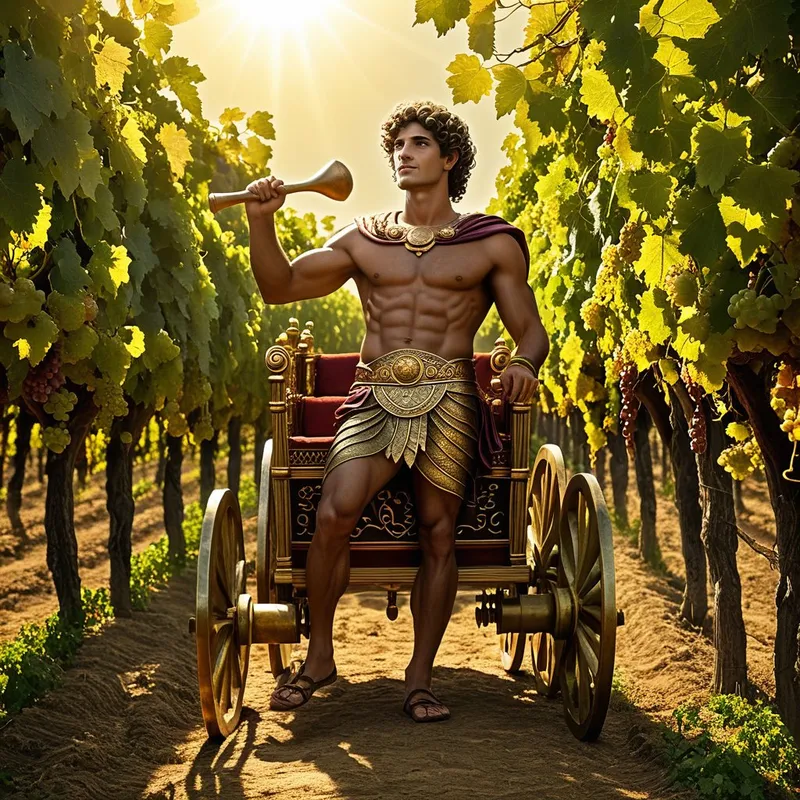
Hear now the tale of the returning king, not of war, but of the vine. The air in the streets of Rome is thick with the scent of incense and order, a perfume of stone and law. But a new scent rides the wind from the east—a perfume of crushed grapes, damp earth, and wild honey. It is the herald of Bacchus.
He comes not on foot, nor on a steed bred for battle. He arrives in a chariot that seems wrought from the heart of the forest itself, wood alive with creeping ivy and studded with amethyst. And before this chariot are no docile horses. They are the great cats of the eastern mountains: tigers, their stripes like shadows in a jungle; leopards, spotted like the dappled light beneath a canopy. Their eyes burn with a green fire, and from their muzzles hang strands of foam, not from the bit, but from the raw, ecstatic power of the god who holds their reins. He is young, this god, his brow crowned not with laurel, but with a wreath of vine leaves and bursting purple clusters. In one hand, the thyrsus, a wand that is both weapon and blessing. His gaze is distant, seeing not the cobblestones, but the pulsing, singing heart of the world.
The sound precedes him—a cacophony that is also a symphony. The deep-throated roars of the great cats. The wild, skirling music of flutes and drums, played by a throng that streams in his wake: Maenads with hair unbound, their feet bare and bloody from the dance, their eyes rolled back in holy rapture. Satyrs caper and leap, their goat-legs pounding the earth in rhythm with the god's own pulse. They carry wineskins that never empty, and where their wine spills, the very ground sprouts tendrils and flowers.
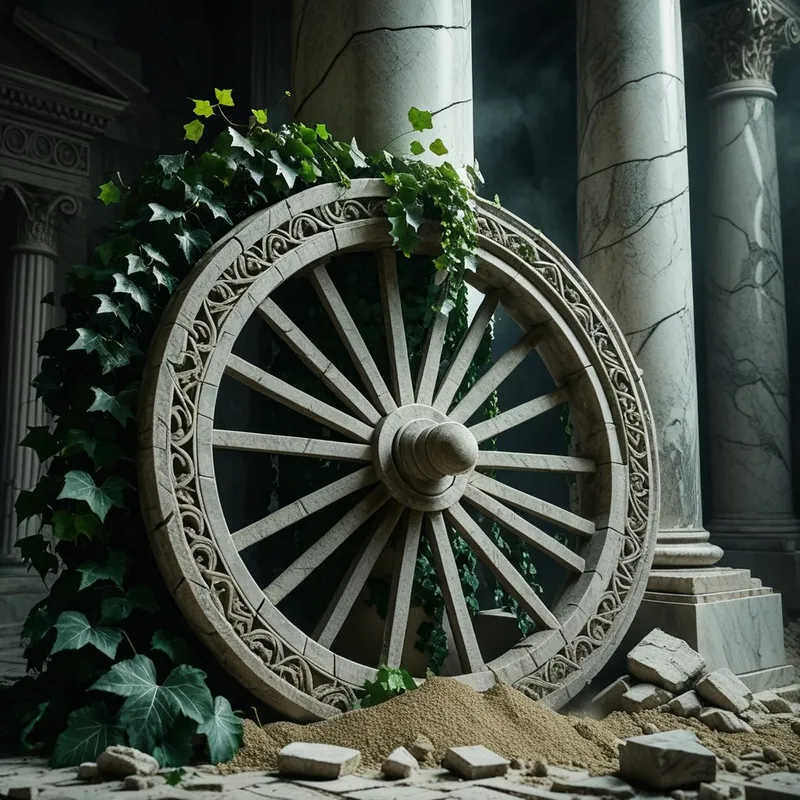
The ordered world trembles. Senators clutch their togas, feeling the strict lines of their lives begin to blur. Matrons peer from behind shutters, a forbidden longing stirring in their breasts. The chariot does not follow the straight road. It winds, it spirals, the tigers pulling it over manicured hedges and through public squares where business halts. Where the chariot passes, stone cracks and from the cracks, vines erupt. Wine flows in the fountains. Laughter, raw and unbidden, breaks from lips long sealed by propriety. It is not destruction, but a dissolution. The rigid mask of civilization is softened, melted, by a warmth that comes from within the earth and within the soul. He does not conquer with sword, but with sap; not with decree, but with delirium. His is the triumph of the wild juice over the dry law, the return of all that had been prudently buried. And as the procession fades into the twilight, leaving a city forever altered, the scent of grapes hangs in the air, a promise and a threat: nothing that is rigid can withstand the rising sap.
Cultural Origins & Context
This vivid imagery of Bacchus's triumphant return, often called his Triumph, is a distinctly Roman elaboration on the Greek myths of Dionysus. The Romans, masters of administration and martial order, encountered the cult of Bacchus not as mere story, but as a potent and potentially subversive foreign religion. By the 2nd century BCE, the Senatus Consultum de Bacchanalibus was issued, brutally suppressing the god's worship for its threat to social hierarchy and traditional Pax Deorum.
The myth of the chariot, therefore, represents a cultural negotiation. It domesticates the terrifying, anarchic power of the god by framing it within a familiar Roman ritual—the military Triumph. Yet, the subversion remains in the details: the conqueror is a god of madness, his captives are the citizens' own repressed instincts, and his chariot is drawn by beasts, not disciplined steeds. The myth was passed down through poets like Ovid, who captured its paradoxical nature. Societally, it functioned as a controlled release valve—a narrative that acknowledged the terrifying, transformative power of ecstasy (ekstasis) while attempting to symbolically integrate it into the Roman worldview. It was a warning and an invitation, a tale of what happens when the structured self meets the untamed god.
Symbolic Architecture
At its core, the chariot of Bacchus is a symbol of the vehicle of consciousness—the psyche or the ego—being taken over by a force far greater than itself. The chariot, a human construct of control and direction, is now pulled by instinctual, feline powers. This is the central psychic drama.
The ego does not drive the chariot of the soul; it is merely the passenger who must learn to trust the tigers.
The beasts represent the raw, untamed libido—not merely sexual, but the full spectrum of creative and destructive life force. They are beautiful, powerful, and deadly. The Bacchus figure represents the archetypal spirit of this force, the numen of transformation that can shatter the petrified structures of the personality. The Maenads and Satyrs are the personified contents of the unconscious, erupting into daylight once the god arrives. The crushing of stone and the sprouting of vines symbolize the alchemical process: the solve (dissolution) of rigid, outworn attitudes (lapis, the stone), to make way for the coagula (coagulation) of new, organic, and fertile life patterns.
The Dreamer's Resonance
When this myth stirs in the modern dreamer, it often manifests as dreams of vehicles out of control—a car with a mind of its own, a train hurtling off its tracks, or a bicycle careening down a wild hillside. The somatic experience is one of thrilling terror and surrender. Alternatively, one might dream of being in a formal, rigid setting (a boardroom, a school) when wild animals suddenly burst in, or when vines and flowers begin aggressively growing through the walls.
Psychologically, this signals a profound uprising of the instinctual self against an ego-structure that has become too constrained, too "civilized" at the expense of vitality. The dreamer is going through a process where long-buried passions, creative urges, or authentic emotions are demanding recognition and integration. It is a crisis of liberation. The fear is real—the tigers can devour. But the myth suggests that the alternative, a life of unyielding stone, is a kind of living death. The dream is an invitation to acknowledge the driver in the chariot, to make a relationship with the wild god within, lest one be simply dragged by it.

Alchemical Translation
The journey of Bacchus's Chariot is a perfect map for the individuation process. It begins with the nigredo, the blackening: the sterile, rigid state of the over-controlled personality, the "Roman" within us that values only order and repression. The arrival of the god and his beasts is the shocking, often chaotic influx of the unconscious—the prima materia of transformation.
The goal is not to kill the tigers, but to cease being their prisoner and become their priest.
The subsequent chaos, the dissolution of old forms (the cracking columns), is the necessary solutio. The ego must surrender its illusion of total control. This is not annihilation, but a humbling. The key alchemical stage here is coniunctio oppositorum—the marriage of opposites. The rational chariot and the irrational beasts, civilization and wildness, spirit and instinct, are yoked together. Bacchus, the divine mediator, holds the reins. He represents the emerging Self, a totality that includes both light and dark, order and chaos.
The triumph is the state of rubedo, the reddening or culmination. It is not a return to old order, but the establishment of a new, more vibrant order based on integrated wholeness. The vines growing from the cracks are the new life, the creativity and authentic connection that can only flourish when the rigid persona has been broken open. For the modern individual, the myth teaches that true strength lies not in suppression, but in the sacred, terrifying, and ultimately liberating act of allowing the wild, creative, ecstatic depths to take the reins and guide one home to a more complete humanity.
Associated Symbols
Explore related symbols from the CaleaDream lexicon: