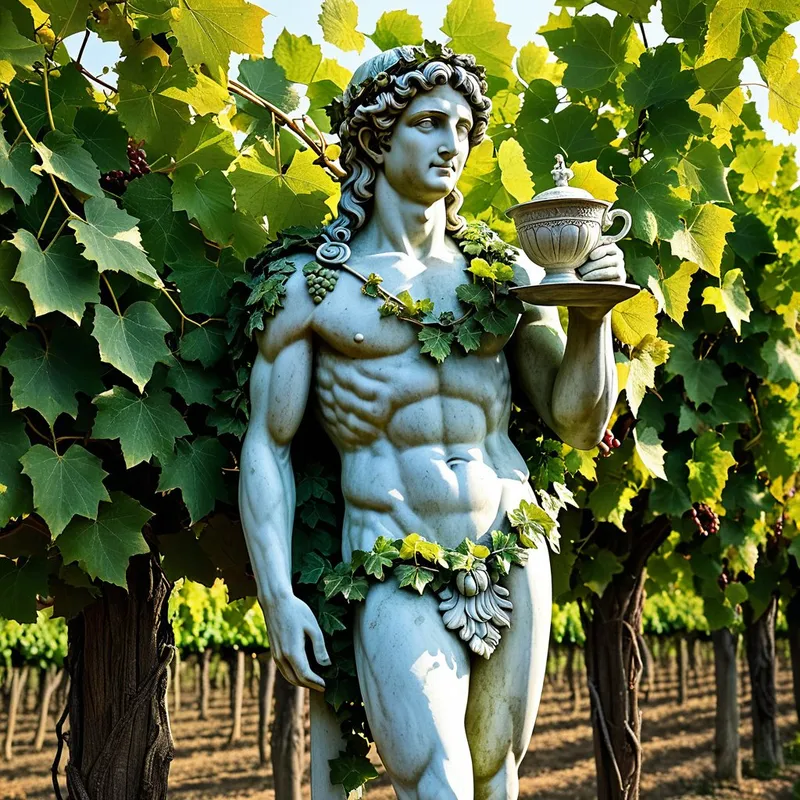
Bacchus/Dionysus Myth Meaning & Symbolism
The god of wine, madness, and liberation, born from fire and twice-born from a mortal womb, who shatters rigid order to reveal the raw, creative life force.
The Tale of Bacchus/Dionysus
Listen, and hear the tale of the god who arrives not with a decree, but with a vine. In the time before memory, a great fire burned in the heavens. The lord of lightning, Jupiter, loved a mortal princess, Semele. Consumed by a jealous rage, the goddess Juno tricked the girl into a fatal request: to see her divine lover in his full, unshielded glory. Semele asked, and Jupiter, bound by oath, complied. His divine radiance, a fire no mortal vessel could contain, incinerated her where she stood.
But from the ashes, Jupiter snatched the unborn child. With a swift stroke, he sewed the infant into his own thigh, a living womb of flesh and godhead. In time, the god was born again, emerging from the side of the sky-father. This was Bacchus, the twice-born.
He grew not in the ordered halls of Olympus, but in the wild, secret places of the earth, nursed by nymphs and taught the mysteries of the vine by old Silenus. Wherever he walked, the earth softened. Grape clusters swelled from barren soil. Springs of water and wine burst forth. He wandered the world, followed by a throng of ecstatic women, the Bacchantes, who danced with serpents and tore living beasts apart with their bare hands, their laughter echoing the god's own mad joy.
But the world of men, built on law and boundary, feared him. In the city of Thebes, his own cousin, King Pentheus, sought to chain this chaos. He called the god a fraud, a corrupter of women, a threat to the state's rigid order. He had Bacchus bound and imprisoned. Yet the chains fell away, the prison doors sprang open of their own accord. Vines cracked the stone foundations of the palace.
Driven by a fury he mistook for reason, Pentheus disguised himself to spy on the secret rites of the Bacchantes in the forest. Hidden in a pine tree, he watched the sacred, terrifying dance. But the god pointed, and the women saw. Led by Pentheus's own mother, Agave, in her divine madness, they mistook the king for a mountain lion. With a collective scream that was both horror and ecstasy, they descended. They pulled him from the tree. There, under the cold moonlight, in a frenzy of liberation that knew no law, the women of Thebes, including his mother, tore the king limb from limb. Agave returned to the city triumphant, bearing her son's head upon a thyrsus, only to awaken from the god's spell to the ultimate, devastating recognition.
Bacchus did not gloat. He stood as the implacable force of nature itself, having revealed a simple, terrible truth: that which you deny and chain within yourself will return, not as a guest, but as a conqueror, and it will dismantle you from the inside out.

Cultural Origins & Context
To the Romans, Bacchus was a deeply complex import. The myth arrived from Greece (Dionysus) and was assimilated into the Roman pantheon, but not without profound tension. His worship was initially private, often secretive, conducted in mystery cults that promised initiates liberation and a blessed afterlife. The Roman state, a paragon of disciplina and order, viewed these ecstatic, boundary-dissolving rites with intense suspicion. The infamous "Bacchanalia Affair" of 186 BCE saw the Senate brutally suppress the cult, fearing it undermined social hierarchy and masculine authority.
Yet, they could not eradicate him. Bacchus was woven into the fabric of life itself. He presided over the vineyard and the harvest, the literal transformation of grape into wine—a daily, domestic miracle. His public festivals, like the Liberalia, celebrated not just wine, but liber (freedom), particularly for adolescents coming of age. The myth was passed down not only by poets like Ovid in his Metamorphoses but also in the very rituals of the household and the theater, where his essence was both celebrated and cautiously contained. His societal function was dual: he was the necessary, dangerous pressure valve for a rigid society, and the divine embodiment of the life force that no law could ultimately control.
Symbolic Architecture
Bacchus is not merely the god of wine; he is the god of the unspeakable potency within the grape, the spirit trapped in matter. His myth is a symbolic map of the psyche's deepest, most volatile layers.
The god of ecstasy is also the god of madness, for they are born from the same spring: the overthrow of the tyrannical ego.
His "twice-born" nature signifies a fundamental duality and the process of transformation through destruction. The first, fiery birth from Semele’s ashes is the spark of raw, divine potential. The second, surgical birth from Jupiter’s thigh represents the difficult, often painful, integration of that wild potential into a structured identity (the "father's" realm of order). He is the thyrsus: a wooden spear (phallic, penetrating) wound with ivy (binding, connective) and topped with a pine cone (fertile, seeding chaos). He is the unity of opposites: male and female, young and old, civilized and savage, creator and destroyer.
The tragedy of Pentheus is the central psychological lesson. Pentheus represents the rigid, hyper-rational ego that denies the existence of the irrational, instinctual, and emotional depths (the Bacchic within). His spying from the tree is the ego's attempt to observe and control the unconscious from a safe, detached distance. The dismemberment is the inevitable, catastrophic collapse of that ego-structure when the repressed contents erupt. It is not a punishment, but a brutal, involuntary initiation.
The Dreamer's Resonance
When this myth stirs in the modern dreamer, it signals a profound somatic and psychological upheaval. To dream of wild vines cracking through the walls of one's house, of a party that spirals into chaotic frenzy, or of a forbidden, intoxicating drink, is to feel the Bacchic pressure building beneath the surface of a too-ordered life.
The dreamer may find themselves in a familiar office or home that is suddenly, inexplicably, overgrown with lush, uncontrollable vegetation. This is the instinctual, creative, or emotional life demanding space. Dreaming of being in a ecstatic dance or a mob, feeling both terror and irresistible liberation, points to the dissolution of persona—the social mask—and contact with the raw, collective energy of the unconscious. A dream of being torn apart, while terrifying, can symbolically mirror the Pentheus experience: the necessary deconstruction of an outdated self-image that has become a prison. The somatic process is one of liquefaction: solid, frozen structures (habits, beliefs, identities) are being dissolved by a surging, emotional, and vital force.

Alchemical Translation
The myth of Bacchus is a perfect allegory for the alchemical process of individuation—the psychic transmutation of the base self into a more whole, integrated being. The grape represents the unrefined, primal matter of the psyche, full of potential but unformed. The crushing and fermentation are the necessary sufferings, conflicts, and periods of darkness (nigredo) that break down the ego's defenses.
The wine is not made in the sunlight of reason, but in the dark, anaerobic vat of the soul.
Pentheus represents the ego that refuses this process, clinging to its "kingdom" of control. His fate is the fate of one who bypasses the work. The true initiate—the modern individual on the path—must consciously become both the crushed grape and the vintner. One must allow the rigid self to be softened and broken apart by life's fermenting experiences (loss, passion, failure, creativity) to release the trapped spirit.
The goal is not to become a perpetually frenzied Bacchante, but to become like Bacchus himself: the one who holds the cup (kantharos) that contains the potent, transformative liquid. This is the symbol of the integrated Self, capable of containing ecstasy and despair, order and chaos, without being destroyed by either. The god's serene, knowing smile in his statues is the smile of one who has been dismembered and reconstituted, who has tasted the madness and returned, not to deny it, but to offer it as sacred wine. The triumph is the transformation of raw, annihilating impulse into a creative, life-affirming spirit—the grape become wine, the pain become meaning, the chaos become a deeper, more fluid order.
Associated Symbols
Explore related symbols from the CaleaDream lexicon: