Baba Yaga's Hut Myth Meaning & Symbolism
A tale of a hero's journey to a witch's animate hut, a liminal space of terror and wisdom, demanding courage and cunning to unlock profound transformation.
The Tale of Baba Yaga's Hut
Listen, and let the old pines whisper it. The tale does not begin with a king, but with a lack. A father gone, a mother ailing, a stepmother cruel as winter frost. For the maiden Vasilisa, the lack was light; the hearth-fire had died, and the jealous stepmother sent her into the deepest, hungriest part of the forest to fetch it from the one who dwells there.
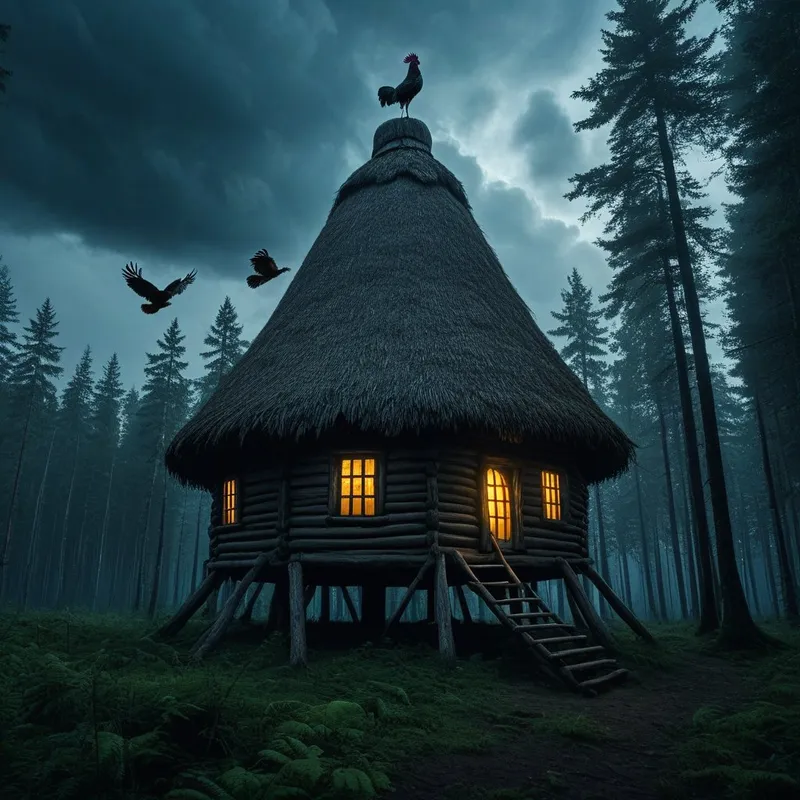
The forest is not just trees. It is a being that breathes, watches, and closes paths. The black trunks press close. The light fails. And then, the clearing. Not a sanctuary, but a revelation of dread. There it stands: a hut. But this is no peasant’s home. It is perched atop two gigantic, scaly chicken legs, squatting and twitching like a resting bird of prey. It turns, slowly, ceaselessly, its back door groaning to face the path, its front door, with a single glowing skull mounted above it, staring into the impenetrable woods. This is the dwelling of Baba Yaga.
To approach is to risk being ground between the hut’s restless feet. Vasilisa remembers the old words, the charm of politeness taught by a doll from her true mother. “Izbushka, Izbushka,” she calls, her voice thin against the wind. “Turn your back to the forest and your front to me!” The creaking stops. The great legs bend, the hut rotates, and the door, now facing her, swings open with a sigh of rotten wood and old spices.
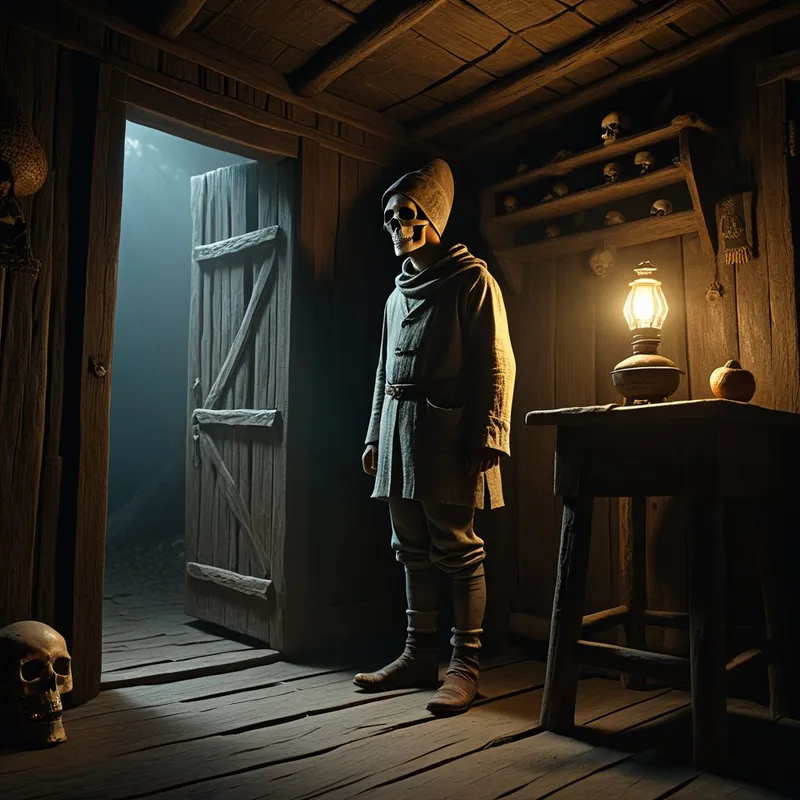
Inside, the air is thick and still. Bones adorn the walls. A giant mortar and pestle rest by the hearth. And there, stretched on a bench that spans the entire hut, is the mistress herself. Baba Yaga: nose hooked enough to scrape the ceiling, iron teeth, legs of bone. Her breath is the wind before a storm. “I smell Russian flesh,” she booms. She demands to know why Vasilisa has come, and the girl, trembling, speaks truthfully of her need for fire.
Baba Yaga sets impossible tasks: sort a mountain of mildewed grain from poppy seeds, clean the hut, prepare a feast. Failure means being eaten. But Vasilisa is not alone; she has her mother’s blessing in the form of a little doll in her pocket, which comes alive in the night to complete the labors with silent, swift magic. Each dawn, Baba Yaga finds the work done, and her scrutiny deepens from hunger to something like curiosity.
On the third day, she gives the girl a final question, a riddle that is also a gift: “How did you do this?” Vasilisa, again, speaks the simplest truth: “By my mother’s blessing.” In that moment, the witch’s fury stills. She recognizes a power she cannot consume—the power of inherited love and honest speech. She gives Vasilisa a skull from her fence, its eye sockets blazing with the needed fire. “Take it. Go.”
The girl carries the blazing skull through the dark wood. It burns her stepmother’s house to ash, purifying the corruption, and leaves Vasilisa standing in the light, ready to weave her own destiny. The hut, and its mistress, turn away, waiting in their liminal clearing for the next soul brave or desperate enough to call it to order.
Cultural Origins & Context
This myth is woven from the dense fabric of East Slavic, primarily Russian, folklore. It was not written in books for centuries but lived in the oral tradition, told by skaziteli around hearths during the long, dark winters. Baba Yaga is not a singular invention but a cumulative archetype, a figure who likely absorbed attributes of pre-Christian Slavic goddesses of fate, death, and the wild, later demonized by Christian influence into a cannibalistic witch.
The hut itself is a profound piece of folk imagination, reflecting a worldview where the boundary between the domestic and the utterly wild is fluid and perilous. Its primary societal function was initiatory. These tales, often told to children, were not mere entertainment but psychic maps. They taught that to navigate life’s profound crises—loss, injustice, the journey into adulthood—one must venture into the unknown (the forest), confront the terrifying, ambiguous power that dwells there (Baba Yaga), and, through cunning, politeness, and inner resource (the doll, the truth), extract the transformative spark needed to burn away the old life.
Symbolic Architecture
Baba Yaga’s hut is the ultimate symbol of the liminal, the threshold space where transformation is possible precisely because all normal rules are suspended. It is not a static home but a living, moving entity.
The hut on chicken legs is the psyche itself—unstable, perched on animal instincts, and forever turning between the conscious world (the path) and the deep unconscious (the forest).
Baba Yaga is the ultimate Shadow and Anima figure combined. She is the Wild Feminine in her most untamed form: destroyer and granter of wisdom, consumer and bestower of the fire of life. Her iron teeth speak to a devouring, assimilative quality of the unconscious, which consumes the unprepared but refines those who meet her tests.
The impossible tasks represent the ordeal of initiation. Sorting the mixed seeds is a demand for acute discrimination, separating the valuable from the worthless in one’s own life and character. The doll, a gift from the true mother (the innate, guiding Self), symbolizes the inner resource, the intuitive or spiritual aid that activates when the conscious ego is humble enough to accept help. The final gift of fire—contained in a skull, an object of death—is the alchemical prize: consciousness (light) forged from confronting mortality and the dark aspects of existence.
The Dreamer's Resonance
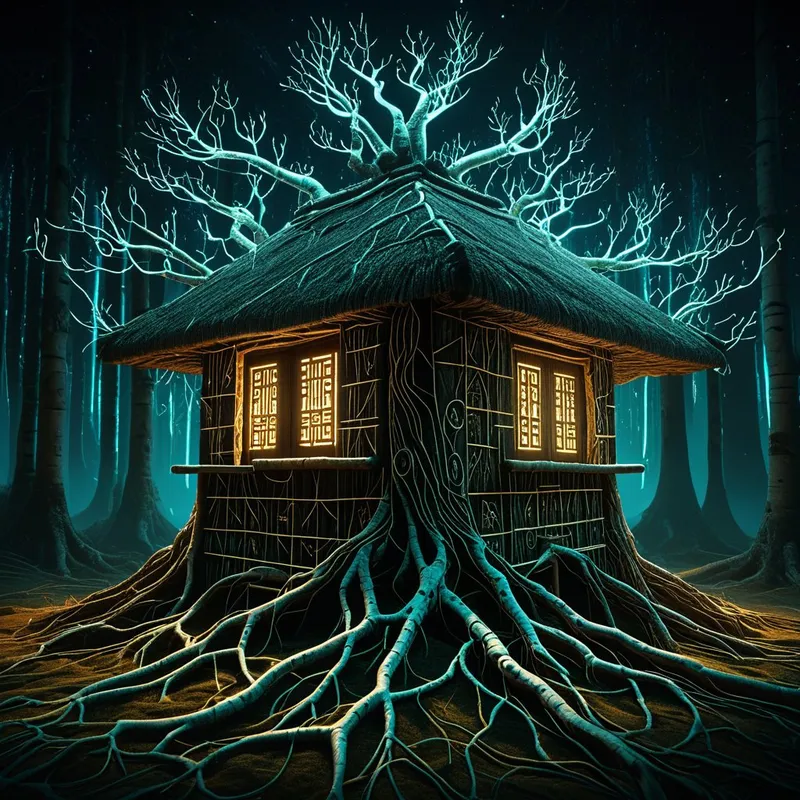
When this myth pattern appears in modern dreams, the dreamer is navigating a profound initiation in their waking life. The dream-forest is a state of confusion, loss, or being psychologically “lost.” The appearance of a strange, impossible dwelling—a house that breathes, a room that shouldn’t exist, a building on unstable legs—signals that the dreamer has reached a critical inner threshold.
The somatic experience is often one of dread mixed with fascination, a tightening in the chest alongside a pull to enter. This is the body registering the approach of the Shadow. To dream of being inside such a place, facing a terrifying yet compelling figure (who may not look like a classic witch), indicates the ordeal is underway. The dream-ego is being tested. Can it “sort the seeds”? Can it find the inner “doll”—that quiet, resilient part of the self that knows what to do? The resolution, if positive, is not a battle won, but a truth spoken or a humble acceptance of help, leading to the acquisition of an inner light or clarity (the fire) that was previously inaccessible.
Alchemical Translation
The journey to Baba Yaga’s hut is a perfect model for the Jungian process of individuation. The hero’s departure from the corrupted “kingdom” (the abusive home) is the ego’s necessary break from a persona that has become poisonous or inauthentic.
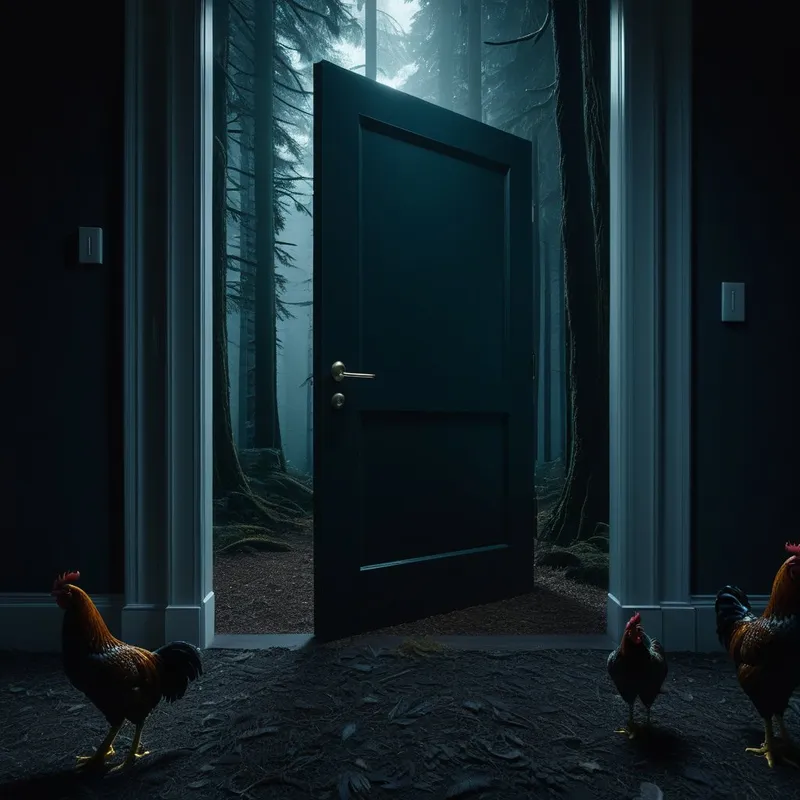
The forest is the descent into the unconscious. The hut is the vas hermeticum, the alchemical vessel where the great work occurs. It is a sealed, paradoxical space (turning yet stationary, a house yet alive) where the old self is broken down. Baba Yaga is the nigredo, the dark, chaotic, and terrifying first stage of transmutation. She represents the ruthless, natural law of the psyche that dismantles our pretensions.
The ordeal is the albedo—the purification. By performing the tasks, often with the help of the transcendent function (the doll), the ego learns discrimination, patience, and humility.
The final interaction—truth-telling—is the moment of integration. The ego does not defeat the Shadow but acknowledges its relationship to a greater, guiding principle (“my mother’s blessing,” the Self). This grants the rubedo: the fiery, living consciousness embodied in the skull. The hero returns not with a weapon, but with a transformative light that incinerates the old, stagnant structures of their life, allowing a new, more authentic existence to be built from the ashes. The hut remains, for the work of the deep psyche is never finished, only completed in cycles, awaiting the next courageous caller.
Associated Symbols
Explore related symbols from the CaleaDream lexicon: