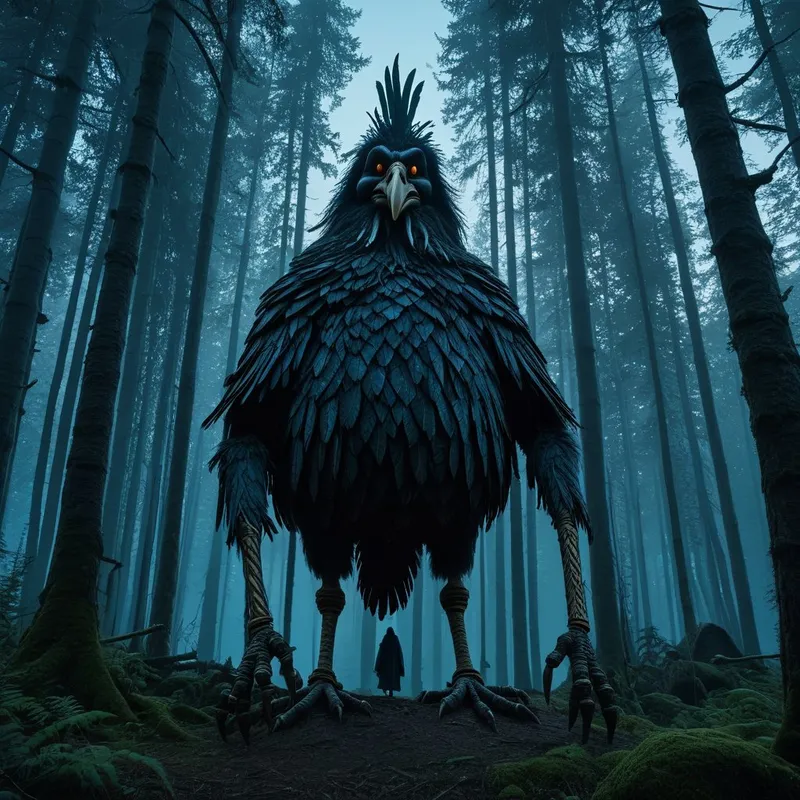
Baba Yaga Myth Meaning & Symbolism
A terrifying yet wise crone in a hut on chicken legs tests heroes in the deep forest, offering death or profound transformation to those who face her.
The Tale of Baba Yaga
Listen, and listen well. The story does not begin in a village, but in the space between breaths, in the hush that falls when the path runs out and the true forest begins. Here, the pines whisper secrets older than memory, and the air grows thick with the scent of damp earth and impending trial. It is to this borderland that a soul is driven—a maiden fleeing a wicked stepmother, a prince seeking a stolen bride, a simpleton sent on an impossible quest. Their feet, weary from the world of men, find the trail not marked on any map. It is a path felt in the bone, a pull towards the heart of the wild.
And in that heart, she waits.
Her house is the first sign you have crossed over. It stands not on earth, but on two gigantic chicken legs, squat and crooked, its walls made of rough-hewn logs and its windows like slitted, watchful eyes. It does not sit; it perches. And when it senses a visitor, it turns, groaning on its scaly limbs, to face them, its door presenting itself like a challenge or a mouth. Around it, a fence posts a grim warning: a palisade of human bones, topped with skulls whose hollow sockets glow with a faint, baleful light.
To enter, you must speak the old words: “Turn your back to the forest, your front to me, little house.” Only then will it settle. The door creaks open of its own accord, revealing the interior: cramped, dominated by a massive stove, and smelling of herbs, damp fur, and something metallic. And there, sprawled from corner to corner, is Baba Yaga herself. Her nose is of iron, hooked and terrible. Her teeth are of iron, clacking as she speaks. Her legs are bone, stretching from the stove to the threshold. She is not old as humans are old; she is old as stone and root.
“Fie, fie,” she rasps, the sound like wind through dry reeds. “I smell the blood of a Russian soul. What brings you here, of your own free will or against your will?”
This is the first test. The answer must be true, and it must acknowledge her power. To lie is to be devoured. To show cowardice is to be crushed in her mortar. But to stand, to state your need—this sparks a glint in her deep-set eyes. “Very well,” she might snarl. “You shall have what you seek… if you serve me. If you pass my tests.”
And the tests begin. They are never fair by the world’s logic. She may demand you wash her endless linens, or sort a mountain of grain from chaff in a single night, or fetch water in a sieve. Impossible tasks. Yet, help often comes from the forgotten and the small—a grateful mouse, a whispered secret from the cat, a gift from the trees themselves. The hero must be humble enough to accept it.
Success does not earn a smile. It earns a grunt, a clack of iron teeth, and a gift more perilous than any curse: a glowing skull on a stick, a ball of thread that rolls of its own will, a comb that becomes a forest, a towel that becomes a river. “Go,” she commands. “And do not look back.”
The flight from her domain is the final trial. Behind you, the forest roars. The earth shakes. She pursues, a storm of fury in her flying mortar, rowing the air with her pestle, sweeping away her trail with a broom of silver birch. Only by using her gifts exactly as instructed—throwing them behind to create insurmountable barriers—does the hero escape, stumbling back into the sunlit world, forever changed. The hut, and its mistress, sink back into the deep green silence, waiting for the next soul brave or desperate enough to seek the wisdom at the world’s ragged edge.

Cultural Origins & Context
Baba Yaga is not a deity of a formal pantheon, but a being of the hearth and the hedge, of the Navi—the spirits of the dead and the untamed wild. Her roots are pre-Christian, reaching into the animistic soil of the Slavic world, where every forest, stream, and household had its spirit. She is a complex amalgam: a vestige of a possible ancestral or death goddess, a personification of the terrifying yet generative force of nature, and a folkloric “boss monster” used to teach and terrify.
Her stories were not written in books but breathed into life by the firelight, told by grandparents during the long winter nights. She served a vital societal function. For children, she was the ultimate “beware of the woods” tale, a boundary-keeper between the safety of the village (mir) and the perilous wilderness (dikiy). For adolescents and adults, her narratives modeled a profound truth: that necessary wisdom and power often reside in the very place we fear most, and that confronting what terrifies us is the only path to maturation. The tellers of her tales understood that life’s most important lessons—courage, cunning, respect for the small and weak, and the acceptance of impossible tasks—are learned not in comfort, but at the border of the known world.
Symbolic Architecture
Baba Yaga is the ultimate shadow archetype made flesh, bone, and iron. She represents everything civilized society seeks to repress: wild nature, untamed feminine power, decay, death, and amoral, raw instinct. Her hut on chicken legs is a perfect symbol of the liminal psyche—it stands between earth and sky, forest and clearing, moving to face the seeker. It is the Self that is not fixed, but responsive.
The true initiation does not happen in the victory, but in the moment one stands before the terrifying, amoral guardian of the threshold and chooses to speak, not flee.
Her impossible tasks are the psyche’s way of forcing a breakdown of ordinary logic. Sorting grain from chaff is a metaphor for discernment; washing linens is purification; fetching water in a sieve is learning to work with, not against, one’s own perceived inadequacies. Failure means being consumed by the unconscious (devoured). Success, achieved often through humility and help from instinctual allies (the animals), means earning a piece of her power—a symbolic talent or insight (the magical gifts) necessary for the next stage of the journey.

The Dreamer's Resonance
When Baba Yaga stalks the dreamscape, the dreamer is at a profound psychic crossroads. This is not a simple anxiety dream. The somatic feeling is one of primal dread mixed with a strange, magnetic pull. Dreaming of her hut signifies encountering a part of the self that feels alien, ancient, and autonomous—a core complex or deep pattern that operates by its own rules. Dreaming of being given an impossible task by a fearsome figure points to a life situation where conventional solutions have failed, and the psyche is demanding a descent into “unreasonable” action or acceptance.
The flight from her in a dream, especially if one is using magical objects to create barriers, mirrors the psychological process of integrating a shadow insight and using its energy to separate from an old, consuming pattern. The dream-Baba Yaga does not appear to destroy, but to initiate. Her presence asks the dreamer: What old, bony, iron-clad truth are you finally brave enough to face? What nourishment can you only find in the psychological wilderness?

Alchemical Translation
The journey to Baba Yaga is a masterful map of individuation. The hero, representing the conscious ego, is forced out of the “kingdom” of familiar identity (by loss, quest, or expulsion). The deep forest is the unconscious. Baba Yaga herself is the embodiment of the prima materia—the chaotic, fearsome raw material of the Self.
The mortar in which she threatens to grind you is the same vessel of transformation; the pestle is the force of confrontation that breaks down the ego’s defenses to release its essence.
Serving her is the nigredo, the blackening—the humbling, confusing, and often despairing work of confronting one’s shadow. The help from creatures symbolizes tapping into instinctual wisdom. Surviving her tests is the albedo, the whitening—a purification and gaining of clarity. The magical gifts she bestows are the nascent symbols of the new, more complex personality (the lapis or philosopher’s stone in embryo). The final flight and integration of these gifts to secure one’s freedom is the rubedo, the reddening—the conscious embodiment of the transformation. One does not become Baba Yaga; one internalizes her paradoxical law: that true strength and wisdom are found not by conquering the wild, chaotic depths, but by facing them with respect, cunning, and the courage to be tested.
Associated Symbols
Explore related symbols from the CaleaDream lexicon: