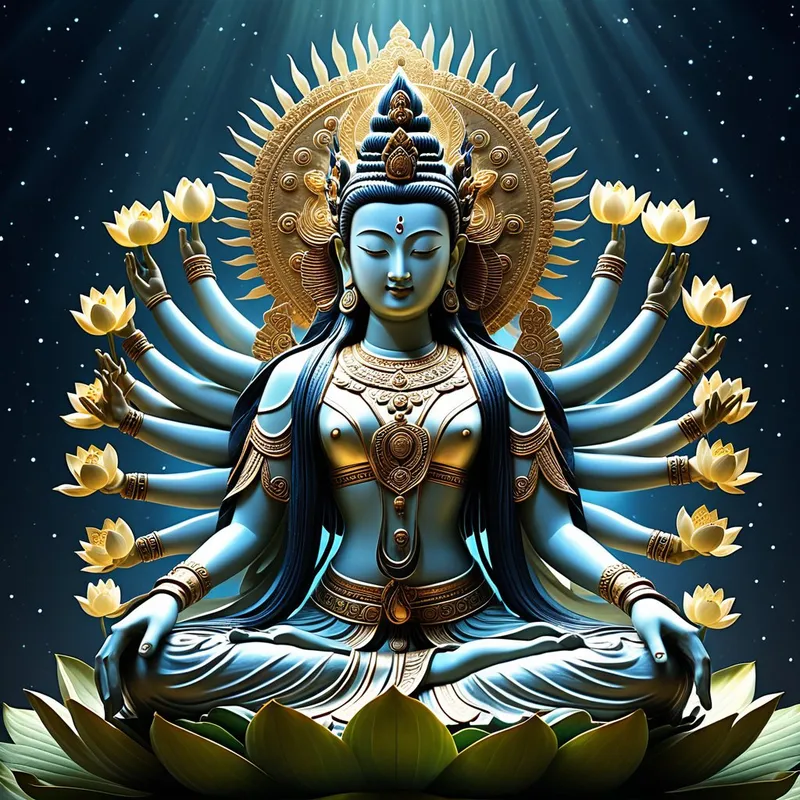
Avalokiteshvara Myth Meaning & Symbolism
The Bodhisattva who vowed to save all beings, shattering into a thousand pieces from the weight of suffering, only to be reformed with greater power.
The Tale of Avalokiteshvara
In the beginning, before time was counted in breaths, there was a vow that shook the foundations of reality. It was made in the presence of the Buddha Amitabha, in a pure land where light was the only substance. The being known as Avalokiteshvara—"The Lord Who Looks Down Upon the World"—stood before the infinite compassion of the Buddha and spoke a promise that echoed through all realms of existence: "I shall not attain final Nirvana until every single being, from the highest god to the lowest creature in the deepest hell, is freed from suffering."
And so, Avalokiteshvara descended. Not with thunder, but with a listening so profound it became a presence. The Bodhisattva entered the Samsara, the great wheel of suffering, of birth, sickness, old age, and death. With a thousand arms that grew from a heart of mercy, Avalokiteshvara reached out. A hand here to pull a soul from a chasm of despair, a hand there to offer cool water in the desert of craving, another to shield a child from fear, another to hold a sutra of wisdom. The eyes of compassion were everywhere, seeing the hidden pain in every corner of the universe.
For eons, this work continued. Yet, as Avalokiteshvara listened deeper, the sheer, cacophonous volume of the world's anguish began to press in. It was not a single cry, but a symphony of terror—the shriek of the dying animal, the silent sob of the betrayed, the gnawing hunger of the ghost, the confused rage of the warrior. The Bodhisattva heard the grinding of tectonic plates of grief and the whisper of loneliness in a crowded room. The vow, so pure in its inception, met the fractal, endless reality of pain.
Then came the moment of shattering. Gazing once more from the Sukhavati upon the writhing ocean of beings, Avalokiteshvara saw that for every soul lifted, a thousand more seemed to sink. The weight of this perception—the true, boundless depth of unliberated suffering—became unbearable. The luminous form, stretched across existence, could not hold. With a sound like a universe of crystal breaking, Avalokiteshvara fragmented. The body of compassion exploded into a thousand pieces.
But the story does not end in dissolution. From the silence that followed the shattering, a deeper power stirred. The Buddha Amitabha, the source of infinite light and life, arrived. From the shards of broken compassion, Amitabha reformed the Bodhisattva—not as before, but greater. Eleven heads now crowned the form, to see suffering in all directions of space and time. And from those heads, a thousand arms blossomed anew, each with an eye in its palm—the eye of wisdom in the hand of action. The shattered one was made whole, not by forgetting the breaking, but by integrating it. The compassion that had fractured under the weight of the world was now reconstituted with the unshakable strength of transcendent wisdom. The listening continued, now unbreakable.

Cultural Origins & Context
The myth of Avalokiteshvara finds its roots in the <abbr title="The "Great Vehicle" branch of Buddhism">Mahayana Buddhist traditions that flourished in India around the beginning of the Common Era. It was not a story told once, but one that evolved through sutras, devotional practices, and art, traveling along the Silk Road to transform into Guanyin in China and Kannon in Japan. The primary textual source is the Prajnaparamita Hridaya Sutra, but the narrative of the vow and the shattering is elaborated in later devotional literature and avadanas.
Societally, the myth functioned as the ultimate model of the Bodhisattva ideal. It moved Buddhism beyond a personal path of liberation to an ethic of radical, universal responsibility. It was told by monks to inspire compassion, depicted in temple art to offer a visual focus for devotion, and invoked in chant (most famously, the mantra Om Mani Padme Hum) as a direct call to the compassionate presence. The myth gave permission to feel overwhelmed by the suffering of others, while also providing a divine template for transforming that overwhelm into boundless, skillful capacity.
Symbolic Architecture
At its core, the myth is a profound map of the psychology of empathy. Avalokiteshvara represents the archetypal capacity for conscious, attentive listening—the "ear that hears the cries of the world." This is not passive sympathy, but an active, engaged consciousness that turns toward pain.
The first movement of the soul toward wholeness is not to fix, but to fully attend. Compassion begins as a vow to listen, even to that which threatens to break us.
The shattering is the critical symbolic turn. It represents the inevitable crisis of the empathetic ego. When we truly open to the suffering of the world—or even the totality of our own inner pain—our individual identity, our limited capacity to "hold it all together," cannot sustain the load. We fragment. This is not failure, but a necessary dissolution of the limited self that believed it could manage compassion from a place of separateness.
The reformation by Amitabha symbolizes the intervention of a transcendent principle—what in depth psychology we might call the Self, the central archetype of wholeness. Amitabha, meaning "Infinite Light," represents boundless awareness itself. The new form—with multiple heads and a thousand arms—is the psyche reconstituted at a higher order of complexity. The eye in each palm marries wisdom (seeing things as they are) with skillful action. The self is no longer a single point of consciousness trying to help, but has become a decentralized, multifaceted instrument of the whole.

The Dreamer's Resonance
When this mythic pattern stirs in the modern dreamer, it often manifests as dreams of overwhelming responsibility, fragmentation, or miraculous aid. You may dream of being in a disaster zone, trying to help countless people with only two hands, and feeling your body crack under the strain. You may dream of your reflection in a mirror splintering into multiple faces, each expressing a different anguish or need. Conversely, you may dream of a serene, multi-armed figure offering a specific tool that solves an impossible problem.
Somatically, this process correlates with what psychologists call "compassion fatigue" or vicarious trauma—the burnout of the caregiver. Psychologically, the dreamer is navigating the tension between the heart's boundless vow to care (for a parent, a partner, a cause, their own inner child) and the ego's realistic limits. The shattering in the dream is not a sign of weakness, but an unconscious enactment of the mythic truth: the old identity must break to make room for a more resilient, wiser structure of care. The dream is the psyche's way of processing the unbearable tension, moving it toward a potential reconstitution.

Alchemical Translation
The alchemical journey modeled by Avalokiteshvara is the transmutation of raw, identificatory empathy into wise, boundless compassion—what the Buddhists call Mahakaruna. For the modern individual, this is the path of the caregiver archetype moving from burnout to sustainable, enlightened service.
The initial vow (Nigredo: the blackening) is the conscious commitment to engage with life's pain, both personal and collective. The descent into Samsara is the messy, embodied work of caregiving, activism, therapy, or parenting. The shattering (Mortificatio: the mortification) is the essential crisis. This is the moment of breakdown, burnout, or profound disillusionment where one's strategies and self-concept fail. It feels like destruction.
The crucible of compassion is not forged in strength, but in the willingness to be shattered by the truth of suffering. Only in the fragments can the light of the Self enter.
The reformation by Amitabha (Albedo & Rubedo: the whitening and reddening) is the alchemical rebirth. This is not an automatic process, but requires surrender to a transpersonal source—whether called the Self, the unconscious, spirit, or wisdom. In psychological terms, it is the ego relinquishing its central role as "the one who helps" and instead becoming a vessel for a larger intelligence. The new "form" is a life reorganized around this central principle. The individual no longer has compassion as a tool; they operate as an organ of compassion. The thousand arms are the myriad skillful means—the right word, the silent presence, the boundary, the action—that now arise not from personal effort, but from the integrated wisdom of the whole being. The vow remains, but the one who vowed has been utterly transformed.
Associated Symbols
Explore related symbols from the CaleaDream lexicon: