Autumn Equinox Festival Myth Meaning & Symbolism
A myth of celestial archery and cosmic balance, where a hero confronts chaos to restore harmony between light and dark, heaven and earth.
The Tale of Autumn Equinox Festival
Hear now a tale of when the world hung in the balance, and the very breath of the seasons faltered. The sky, once a gentle dome of blue, became a furnace. Ten suns, the unruly children of the Di Jun, had abandoned their celestial schedule. They rose together, a blazing brotherhood of chaos, scorching the rivers to steam and the fields to dust. The earth cracked like a dried gourd; the people cried out, their voices lost in the roar of the heat.
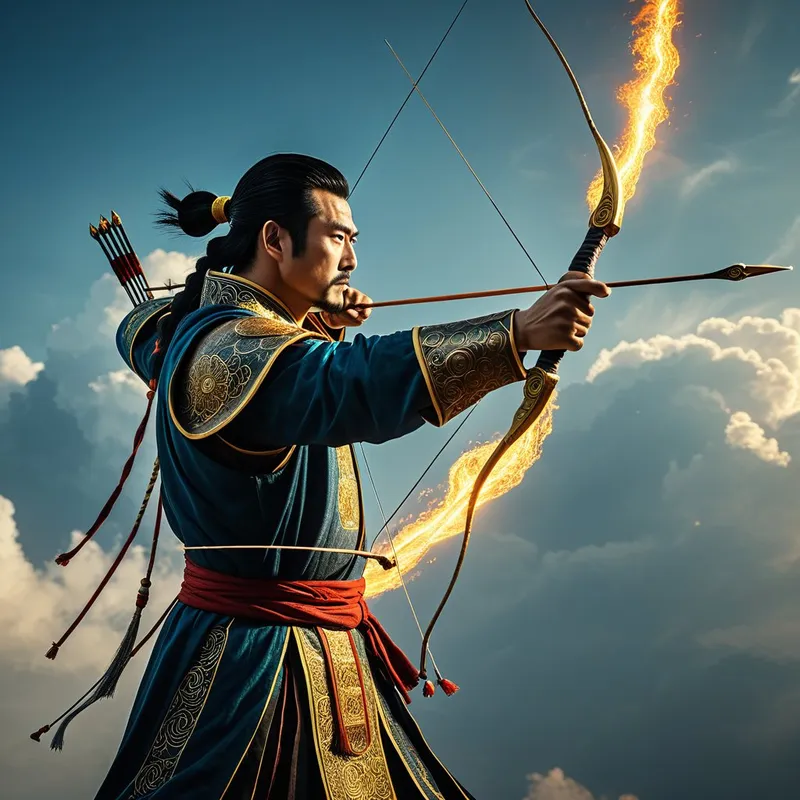
From this despair stepped a figure of resolve: Hou Yi. He was no mere man, but a lord of Dongyi, whose strength was matched only by his compassion. The Di Jun, witnessing the devastation, bestowed upon him a vermilion bow and white arrows, tools of divine correction. Hou Yi climbed the highest peak, the mountain groaning under the weight of the ten suns' gaze. The air shimmered, thick with the scent of burning pine. He did not act in anger, but with the heavy heart of a surgeon. One by one, his bowstring sang a song of terrible necessity. Nine suns fell from the sky, exploding into flocks of three-legged crows that plummeted to the earth, their fire extinguished.
Harmony was restored. The single remaining sun learned its path, rising and setting with obedient rhythm. For his service, Hou Yi was gifted the Pill of Immortality. Yet, this prize was a seed of new sorrow. He hid it, wishing to remain mortal with his beloved wife, the beautiful Chang'e. But fate is a sly current. While Hou Yi was away, a treacherous disciple, Peng Meng, came to steal the pill. To protect it from his grasp, Chang'e, in a moment of desperate resolve, swallowed it herself.
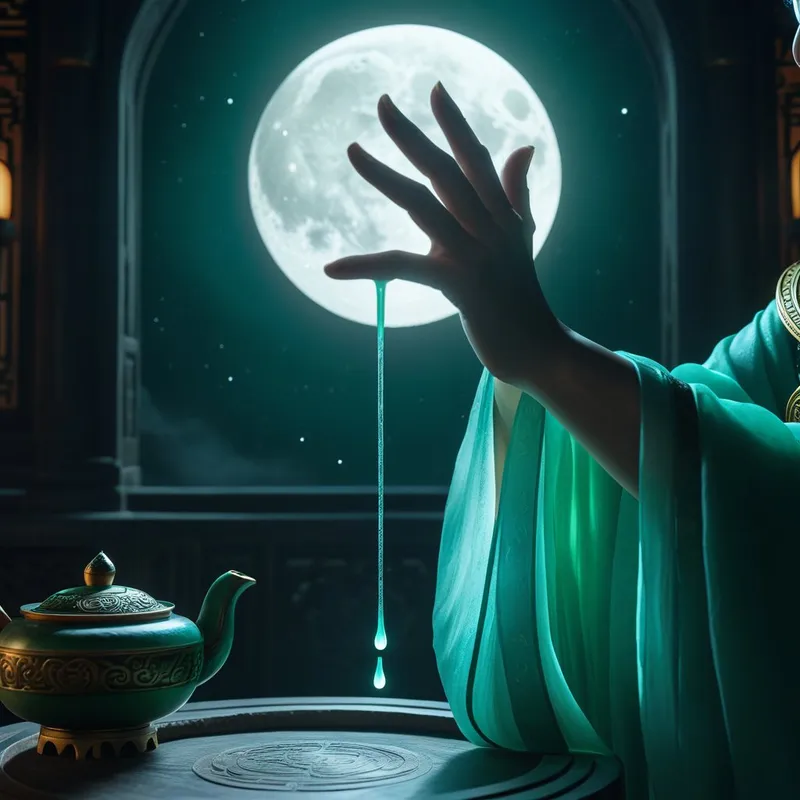
The elixir's power did not grant her joy, but exile. Her body grew light, lifting from the mortal clay, through the chilling void, to the cold, silent palace of the moon. There, she became its eternal guardian, a goddess of luminous solitude. Hou Yi, returning to an empty home, could only gaze at the silver disc in the night sky, his heart a hollow echo of his wife's name. In his grief, he offered sweet cakes and fruits to the moon, a ritual of longing across an uncrossable distance. And so, the heavens found their new balance: a single sun ruling the day, a solitary moon presiding over the night, and between them, the perfect, poignant equilibrium of the Autumn Equinox.
Cultural Origins & Context
This tapestry of myth is woven from threads of ancient Chinese astronomy, state ritual, and folk longing. The story of Hou Yi and Chang'e is not a single, canonical text but a living narrative that coalesced from various sources, including the Classic of Mountains and Seas (Shan Hai Jing) and later poetic elegies. It served multiple societal functions. On one level, it was an etiological myth, explaining the cosmic order—why there is one sun and one moon, and why the moon seems so lonely and bright.
On another, it was deeply integrated with agricultural and imperial cycles. The Autumn Equinox, or Qiufen, was a critical node in the lunar calendar, marking the point of perfect balance between day and night before the descent into yin dominance. Imperial ceremonies would be held to give thanks for the harvest and make offerings to the moon, mirroring Hou Yi's personal offerings. The myth thus provided a sacred narrative for a fundamental seasonal transition, transforming an astronomical event into a drama of sacrifice, order, and eternal remembrance. It was passed down not just by scholars, but through the intimate, family-centered Mid-Autumn Festival, where mooncakes eaten under the full moon kept the story alive on the lips of every generation.
Symbolic Architecture
At its core, this is a myth of the heroic imposition of necessary order upon primal chaos, and the profound, often personal, cost of that act.
The hero’s task is not to destroy the chaotic elements, but to differentiate them, to create the space where opposites can be held in tension.
The ten suns represent undifferentiated, destructive potency—a psychic state of manic inflation where all impulses blaze simultaneously, leading to burnout and sterility (the scorched earth). Hou Yi’s archery is an act of discernment. He does not obliterate the sun’s power; he reduces it to a single, manageable, life-giving source. This is the archetypal movement from chaos to cosmos, from a psyche ruled by unconscious, conflicting drives to one capable of focused consciousness and discipline.
Chang'e’s flight introduces the inevitable shadow of this heroic achievement: isolation. The elixir, the reward for restoring balance, becomes an agent of separation. Her ascent to the moon symbolizes the fate of that which must be sacrificed or repressed to maintain order—the intimate, the personal, the feminine, the realm of pure feeling. The moon becomes the container for all that is distant, beautiful, melancholic, and unconscious.
The moon is not the opposite of the sun, but its complement in exile. It holds the memory of what was lost to create the harmony we now inhabit.
The Autumn Equinox itself is the symbol of this achieved, yet bittersweet, equilibrium. It is not a static peace, but a fleeting, perfect moment of balance between the solar principle of action, clarity, and the masculine (yang) and the lunar principle of reflection, mystery, and the feminine (yin).
The Dreamer's Resonance
When this myth stirs in the modern dreamer, it signals a profound interior process of rebalancing. To dream of multiple suns scorching a landscape may reflect a psyche overwhelmed by ambition, responsibility, or the fiery demands of the ego. It is a somatic cry of systemic overload.
Dreaming of archery, especially with a sense of solemn duty, often coincides with a life phase requiring difficult but necessary discernment—cutting away projects, relationships, or identities that, while once part of the self, now cause collective (internal) devastation. The act feels like a betrayal of parts of oneself, akin to Hou Yi felling his celestial kin.
Chang'e’s presence—a figure floating away, residing in a beautiful but cold, isolated place—manifests as dreams of loneliness within success, of achieving a goal only to find oneself emotionally exiled. It may surface during life transitions (career pinnacles, empty nests) where one has "ascended" to a new station but feels severed from the warmth of former connections. The dreamer is processing the inherent sacrifice of individuation: to become who one is meant to be, other potential selves must be left behind, glowing with the ghost-light of memory on the moon's pale plains.
Alchemical Translation
The myth models the alchemical opus of individuation—the journey toward psychic wholeness. The initial state is the massa confusa, the chaotic "ten suns" of our unexamined life, where conflicting desires, roles, and potentials burn uncontrollably.
Hou Yi’s journey represents the conscious ego's daunting task. It must take up the bow of discrimination (the differentiated function of thinking or feeling) and make the painful, precise shots. This is the slaying of infantile omnipotence, the reduction of infinite possibilities to a single, sustainable path of authentic life. It is the development of a functioning persona that can operate effectively in the world.
The elixir is the promise of wholeness, but to grasp it directly with the ego is to invite inflation or theft. It must be integrated, not possessed.
Chang'e’s ingestion of the elixir and flight is the critical, often unconscious, next stage. The prize of conscious achievement (the integrated persona, the successful life) triggers a counter-movement in the soul. The anima (or animus), the contra-sexual soul-image, carries the undeveloped, mysterious, and feeling-laden parts of the psyche into the unconscious (the moon). This is not a failure, but a necessary relocation. The conscious ego cannot "have" wholeness; it can only relate to it.
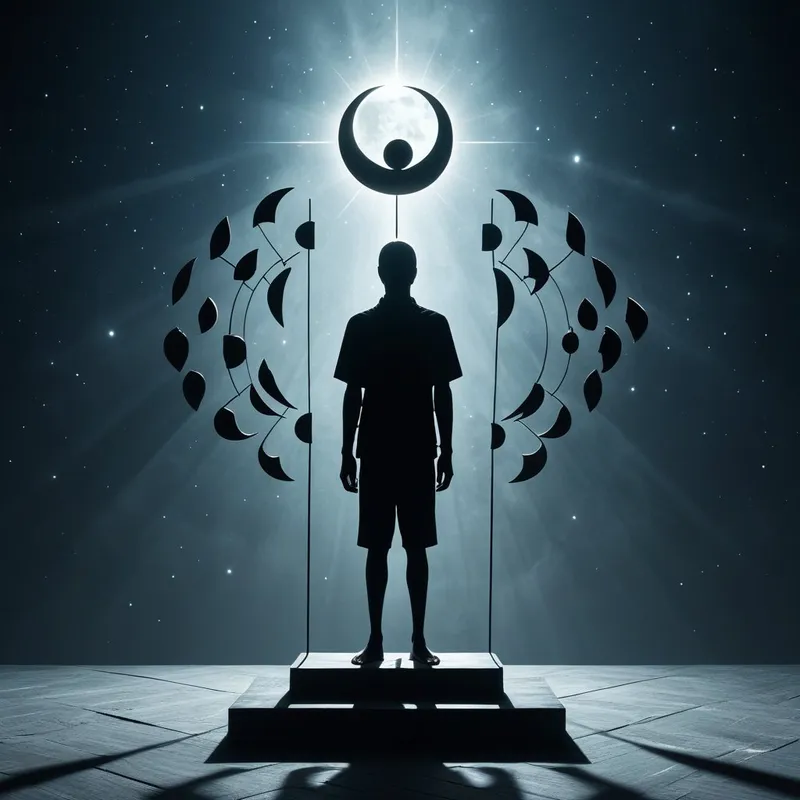
Thus, the mature individuation process mirrored in the Autumn Equinox is not a final victory, but the establishment of a conscious relationship between the solar ego (Hou Yi on earth, making his offerings) and the lunar unconscious (Chang'e in her distant palace). The festival, the ritual, the longing gaze—these symbolize the ongoing dialogue between the conscious and unconscious mind. True psychic equilibrium is not a state where darkness is vanquished, but where light and dark, action and reflection, knowing and mystery, are held in sacred, communicative balance, each acknowledging its need for the other across the vast and beautiful space of the self.
Associated Symbols
Explore related symbols from the CaleaDream lexicon: