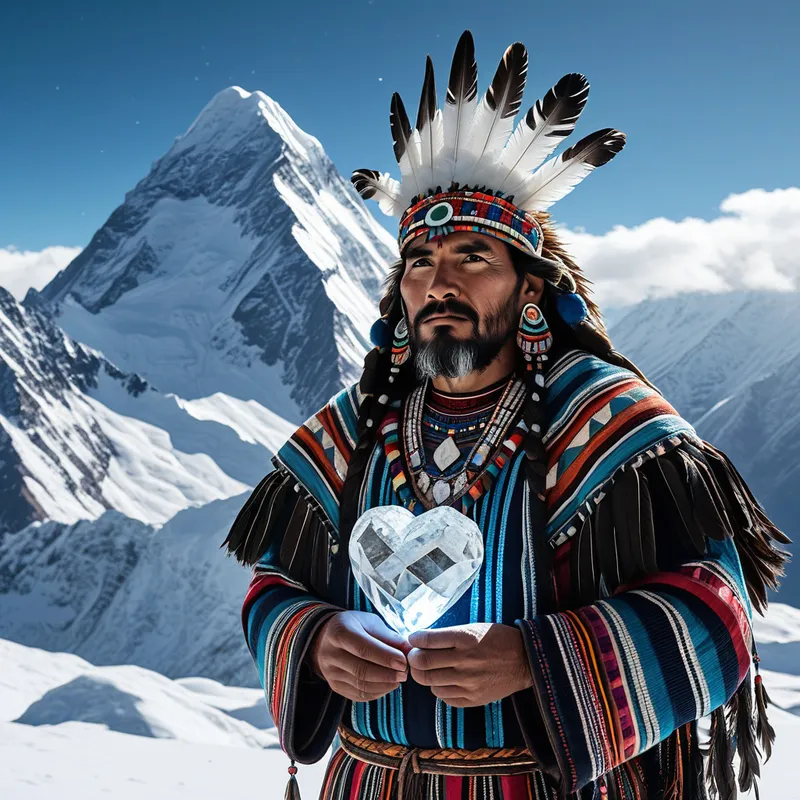
Ausangate Mountain God Myth Meaning & Symbolism
A myth of a mountain god who sacrificed his heart to bring water and life, embodying the sacred pact between humanity, the earth, and the cosmos.
The Tale of Ausangate Mountain God
Listen. Before the rivers knew their names, when the world was young and thirsty, there stood a colossus in the southern sky. His name was Ausangate, a being of living stone and ancient ice, his shoulders holding up the vault of stars, his roots deep in the womb of Pachamama. He was the axis of the world, the pillar of the four suyus. But his heart, they say, was not of stone, but of a crystal more precious than all the gold in Cusco.
A great silence fell upon the land. The sun, Inti, blazed with a fierce, unyielding eye. The springs dried to whispers. The terraces, once lush with maize, cracked like old pottery. The llamas grew thin, their plaintive cries echoing in the valleys. The people, the children of Inti, sent their prayers skyward on smoke that vanished into the thin air. They sent their most sacred runners, the Qhapaq Ñan, to the foot of the great mountain, to plead.
Ausangate felt their suffering as a tremor in his stone bones. He saw the life-force of Pachamama fading, the great web of ayni unraveling. The cosmic order, the Tinkuy, was broken. To be a pillar was not enough. To be a god was not enough. A deeper exchange was required.
There, on his wind-lashed summit, where only condors dared to fly, Ausangate made a choice. He reached into the very center of his being, where his divine essence pulsed with the rhythm of the cosmos. With a sound like a glacier calving, he tore his own heart from his chest. It was not a heart of flesh, but a colossal, multifaceted crystal, holding within it the captured light of the moon, Mama Killa, and the blue fire of the deepest ice.
He raised this luminous heart to the sky, an offering to Inti, to Pachamama, to the void itself. Then, with a final, earth-shaking sigh, he hurled it down the mountainside. Where the heart struck the earth, it did not shatter. It buried itself deep, and from its resting place, a miracle began. A spring of pure, ice-cold water bubbled forth. Then another, and another. The springs became streams, the streams became rivers—the lifeblood of the land returned. The Vilcanota River began to flow with renewed vigor, carrying the sacred essence of the mountain’s sacrifice to every field, every throat, every root.
Ausangate remained, silent and eternal, a silhouette against the dawn. He was now the source, the progenitor of waters, the Apu who gave not just his presence, but his very essence. The people, in awe and gratitude, knew the pact was sealed. The mountain had spoken not in avalanches, but in life-giving flow. The exchange was complete.
Cultural Origins & Context
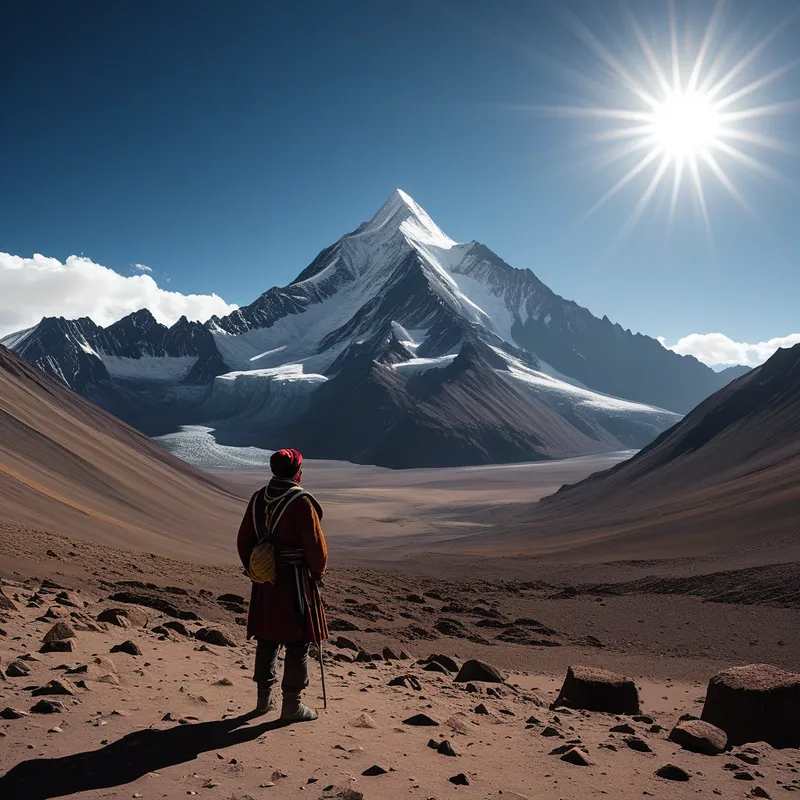
This myth originates from the heart of the Tawantinsuyu, the land of the four quarters, centered in the Cusco region of the Peruvian Andes. Ausangate is not merely a story but a living geographical and spiritual reality—one of the most revered Apus in the Andean world. The myth was not written but woven into the landscape itself, passed down orally through generations by Amautas and community elders.
Its function was multifaceted. Primarily, it served as a sacred charter explaining the origin of the vital watersheds flowing from the Cordillera Vilcanota. It established the principle of ayni on a cosmic scale: the mountain god gives water and protection; the people reciprocate with offerings (despachos), reverence, and right living. The myth reinforced social and cosmic Tinkuy, teaching that balance is maintained not by taking, but by sacred exchange, often requiring profound sacrifice from the most powerful entities. It was recounted during rituals, pilgrimages (peregrinación), and community gatherings, ensuring the relationship with the animate landscape remained vital and conscious.
Symbolic Architecture
At its core, the myth of Ausangate is a profound map of a sacred economy where the ultimate currency is essence, not possession. The mountain, the Apu, represents the archetypal Self in its most stable, eternal form—the immutable center of the psyche and the world. Yet, this stability becomes sterile if it does not engage in life-giving exchange.
The heart of stone must become a heart of water for life to begin. The highest sacrifice is not of something one has, but of something one is.
The crystalline heart symbolizes the concentrated, immortal essence of the Self—the incorruptible core of being. Its removal is not a diminishment but a transmutation. The act of offering it shatters the illusion of self-contained divinity, allowing the god’s essence to flow into the world. The resulting rivers represent the fertilizing, nourishing function of the Self when it is in right relationship with the psyche’s broader ecology—the personal and collective realms. The parched land is the psyche in a state of psychic drought, where the ego is isolated from the nourishing waters of the unconscious and the instinctual world of Pachamama.

The Dreamer's Resonance
When this myth stirs in the modern dreamer, it often signals a profound somatic and psychological process of essential sacrifice. One may dream of a towering, immovable figure (a parent, a boss, one’s own rigid identity) that must give up its central, treasured object. Or one dreams of a parched, desperate landscape within—a feeling of emotional or creative sterility.
The somatic sensation is often one of a deep, resonant crack or pull in the chest center, a symbolic echo of the heart’s removal. This is not a dream of violence, but of necessary, sacred surgery. The psyche is orchestrating the dissolution of a hardened, crystalline structure of the personality—a long-held belief, a defended identity, a source of pride that has become a prison. The dreamer is being prepared to let their deepest essence, which they have guarded as a static treasure, flow outward into relationship, creativity, or service. The process feels like a loss of a defining core, but the dream’s resolution—the appearance of flowing water, green growth, or communal relief—points to the healing that follows this alchemical offering.

Alchemical Translation
For the individual on the path of individuation</ab title="The Jungian process of integrating the conscious and unconscious to become a whole, individual self">uation, the Ausangate myth models the critical transition from being a monument of the Self to becoming a source for the Self. Early in development, we often construct a strong, mountain-like ego-structure—impressive, defended, and seemingly self-sufficient. This is necessary. But maturation requires this structure to participate in a deeper economy.
Individuation is not about building a higher peak, but about discovering the spring within the mountain and allowing it to water the entire valley of one’s being.
The “crystalline heart” represents those aspects we consider most intrinsic and non-negotiable: our core identity, our prized talent, our deepest wound we’ve calcified into a jewel. The alchemical work is to perform the sacred, inner despacho: to offer this heart up, to willingly let it be “shattered” from its static form and transformed into a flowing, life-giving function. This is the transmutation of pride into humility, of trauma into empathy, of isolated genius into generative wisdom. The ego-mountain does not crumble; it becomes a watershed. The individual ceases to merely stand for something and begins to nourish from what they are. This is the ultimate ayni—a reciprocal flow between the individual and the world, where one’s deepest sacrifice becomes the source of universal healing and connection.
Associated Symbols
Explore related symbols from the CaleaDream lexicon:
- Mountain — The immutable Self and the enduring structure of the psyche, which must become a source, not just a monument.
- Sacrifice — The essential, non-negotiable offering of one’s core identity or treasure required to restore flow and life to the parched soul.
- Water — The psychic energy, emotion, and creative life-force that flows from the sacrifice of a hardened essence, healing the inner landscape.
- Heart — The crystalline center of being, the concentrated Self that must be given away to become truly generative.
- Order — The Andean Tinkuy, the cosmic and psychic harmony restored through sacred exchange and right relationship.
- Healing — The restoration of the psyche’s ecology, where drought ends and vitality returns following the profound offering.
- River — The directed, life-sustaining flow of the Self’s essence into the world, carrying nourishment to all parts of one’s being and community.
- Stone — The initial, static form of divinity or identity, which contains within it the potential for fluid transformation.
- Journey — The pilgrimage of the soul to the foot of its own inner mountain, to acknowledge its drought and plead for the god’s intervention.
- Spirit — The animating principle of the Apu, the divine consciousness that chooses relationship and flow over isolated permanence.
- Root — The deep, ancient connection to Pachamama, the instinctual and earthly foundation that cries out for the mountain’s nourishing flow.
- Light — The captured essence of the celestial (Inti, Mama Killa) within the crystalline heart, symbolizing consciousness itself being offered for the good of the whole.