Audhumla Myth Meaning & Symbolism
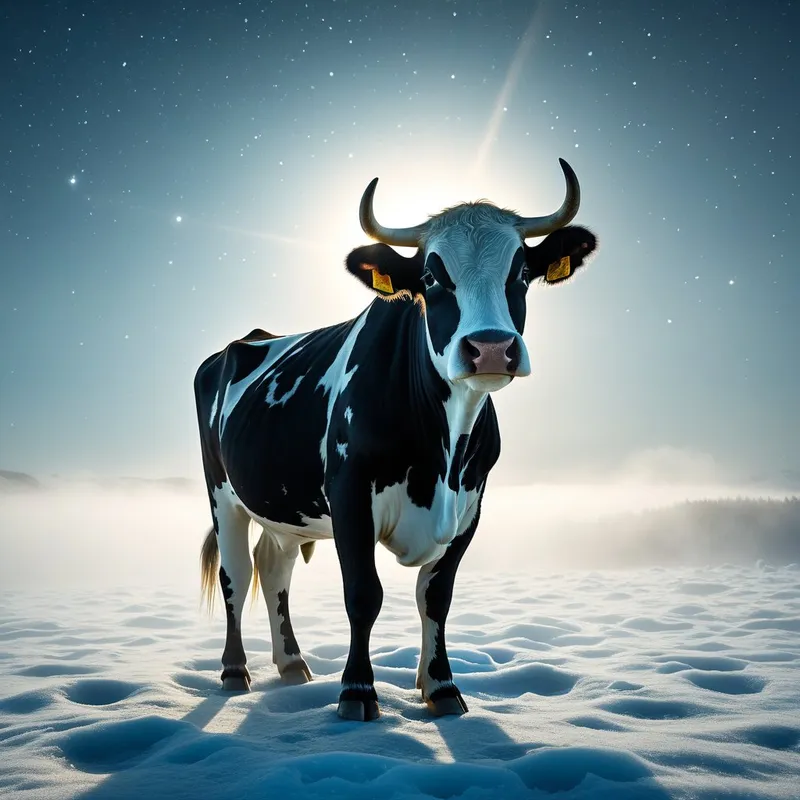
In the void before time, a cosmic cow licks the first god from primordial ice, nourishing the frost giant Ymir, birthing existence from the unconscious.
The Tale of Audhumla
In the beginning, there was no sand, no sea, no cool waves. There was only the yawning chasm, Ginnungagap. To the north lay the freezing, fog-cloaked realm of Niflheim; to the south, the fiery, sparking land of Muspelheim. Where their breaths met in the great emptiness, a rime formed—a hoar-frost that thickened and grew, layer upon layer, into a living, breathing mountain of ice.
And from that living ice, born of the meeting of fire and frost, two beings awoke. First came Ymir, the great giant, cruel and vast, whose sweat bred more giants from his sleeping flesh. And with him, from the melting drips of that same ice, came Audhumla.
She was no ordinary beast. She was a cow, but her size was that of worlds, her hide the color of a starless midnight sky dusted with the faint light of distant suns. She needed no pasture, for her nourishment flowed from the ice itself. Four great rivers of milk sprang from her udders, and these rivers were the sustenance of Ymir. He drank deeply, growing ever more powerful in his slumbering malice.
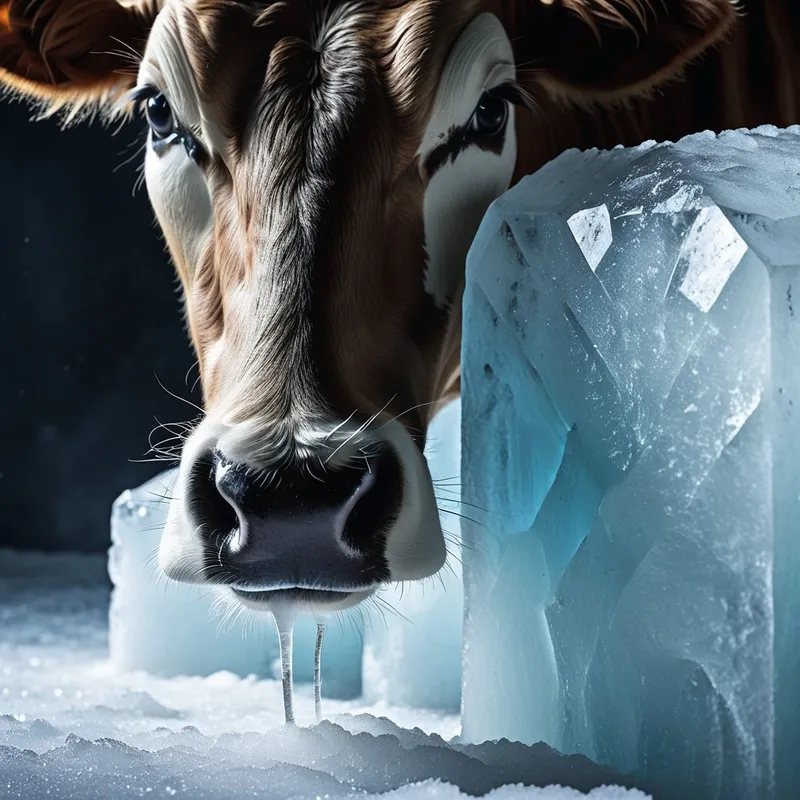
But Audhumla, patient and immense, sought her own sustenance. She bent her great head to the salty ice of Niflheim and began to lick. The sound was the first rhythm in the void: the slow, patient rasp of tongue on frost. For one entire day she licked, and as the ice melted, a being was revealed—not a giant, but the hair of a man, shining like burnished gold.
She did not stop. On the second day, she licked again, and a head emerged from the ice, a head with eyes that held the wisdom of the ages yet to come.
On the third day, her patient, nurturing work was complete. The whole man stepped forth from the ice, whole and powerful. This was Búri, the progenitor of the gods. He was beautiful and strong, and from him would spring Bor, and from Bor, the great gods Odin, Vili, and Vé.
Audhumla had done her work. She had nourished the chaos that was Ymir, and from the same source, with relentless, gentle patience, she had freed the order that was the divine. The stage was set. The cow, her rivers flowing, stood as the silent, foundational mother between the first giant and the first god, her breath a warm mist in the freezing dawn of all things.
Cultural Origins & Context
The myth of Audhumla comes to us primarily from the Prose Edda, written in the 13th century by the Icelandic scholar Snorri Sturluson. Snorri was compiling older, oral traditions that had been passed down through the skaldic poetry and storytelling of the Viking Age and earlier. This was not a scripture, but a living cosmology told by poets (skáld) around fires, used to explain the origins of a world that was often harsh and required immense resilience.
Audhumla’s story served a profound societal function. In a culture where cattle were literal wealth and survival—providing milk, meat, leather, and traction—the elevation of a cow to a cosmic, creative principle was a sacred acknowledgment of dependency. She represents the ultimate provider, the foundation upon which both the destructive (the giants) and the constructive (the gods) forces are built. Her myth roots the divine lineage not in a battle or a thought, but in a simple, somatic, nourishing act. It reminds the listener that before strategy, before war, before wisdom, there must be sustenance and patient, physical care.
Symbolic Architecture
Audhumla is the archetype of the primal ground of being. She is not the creator who speaks a world into existence, but the condition that makes creation possible. Her symbolism is deeply somatic and foundational.
The first act of consciousness is not thinking, but feeding. The ground of being is not an idea, but a nourishment.
She embodies the primal nourishment of the unconscious. The four rivers of milk that feed Ymir symbolize the abundant, life-sustaining energy that flows from the deepest layers of the psyche, even to feed our inner "giants"—our chaotic, primitive, and often troublesome instinctual energies. We must feed the monster to understand it, to live with it, before we can overcome it.
Her act of licking Búri from the ice is the quintessential symbol of emergence through attention. The ice is the frozen potential, the latent pattern, the unformed self. Her tongue—warm, persistent, and salty—represents a focused, caring, and repetitive application of consciousness. It is not a violent extraction, but a gentle revelation. The self is not built from nothing; it is discovered, uncovered, through patient, sustained engagement with our own frozen depths.
She is the unifying intermediary. She stands between fire and ice, giant and god, chaos and order. She does not take sides; she sustains the entire system. Psychologically, she represents the Self in its pre-personal, containing function—the psychic bedrock that holds all opposites in a tense, creative balance long before the ego takes a stand.
The Dreamer's Resonance
When the pattern of Audhumla stirs in the modern dreamer, it often signals a profound process of foundational nurturing or a call to uncover a latent identity. This is not the drama of the hero's battle, but the quiet, essential work of preparation.
You may dream of a vast, dark, warm space—a cave, a basement, a forgotten room. Within it, there is a patient, non-human presence (an animal, a slow machine, a deep well) that provides a constant, unconditional flow of something vital: water, light, warmth, or food. This dream speaks to a somatic need for deep rest and psychic replenishment at the most basic level. The psyche is saying, "Before you do anything else, you must be fed."
Alternatively, you might dream of a repetitive, almost monotonous action with profound results: polishing a stone to find a gem inside, brushing dirt from an ancient artifact, or, like Audhumla, licking or cleaning a surface to reveal a hidden image or figure. This is the dream of individuation in its earliest phase. The ego is engaged in the patient, often tedious work of attending to the unconscious, not to conquer it, but to gently liberate the latent form of the true self frozen within it. The affect is usually one of quiet awe and determination, not excitement or fear.
Alchemical Translation
The alchemical process mirrored in Audhumla’s myth is the prima materia—the first, chaotic matter—being simultaneously sustained and differentiated. For the modern individual, this translates to the initial, and often overlooked, stage of psychic work: creating the container and attending to the nourishment of the whole system.
The salt of the ice, the milk of the cow, the gold of the god—these are not separate substances, but different states of the same primal matter.
Our personal Ginnungagap is the void of potential that follows a crisis, a dissolution, or the simple exhaustion of an old way of being. The fire and ice are our conflicting impulses, passions, and numbness. From this tension, our "Ymir" is born: the chaotic, often overwhelming cluster of raw emotions, instincts, and unresolved patterns that now dominates our inner landscape. The alchemical instruction is counterintuitive: first, feed it. Do not attack the chaos. Instead, like Audhumla feeding Ymir, we must find a way to acknowledge and sustain this part of ourselves with the "milk" of attention and compassion, even as we find it monstrous.
Concurrently, we must begin our own "licking of the ice." This is the disciplined, daily practice of self-reflection, therapy, journaling, or meditation—the warm, persistent application of conscious attention to our frozen potentials and buried truths. We are not creating a new self from scratch; we are revealing the Búri-like essence that has been there all along, encased in the salt-ice of trauma, expectation, and neglect.
Audhumla’s process teaches that transformation begins not with a grand feat, but with a primal, patient nurture. The foundation of the soul must be fed, and the form of the soul must be gently uncovered, lick by patient lick, until the archetypal form within steps forth, ready to begin its own destiny.
Associated Symbols
Explore related symbols from the CaleaDream lexicon: