
Atman Myth Meaning & Symbolism
The journey inward to discover the immortal, universal Self that is the silent witness and true essence behind all transient experience.
The Tale of Atman
Listen. In the beginning, before the worlds were spun from thought, there was a silence so profound it was a sound. In that silence, the One breathed, alone, and knew Itself as Brahman. Yet within that boundless ocean of existence, a longing stirred—not for another, but to know Itself in multiplicity, to taste the sweetness of its own being through the play of form and name.
And so, from the heart of that silence, the worlds emerged: the fiery dance of stars, the cool embrace of oceans, the rustling green of forests. And within the heart of a creature called human, a spark was placed. This spark was not born of flesh, nor fed by breath. It was the silent guest, the inner ruler, the immortal witness. They named it Atman.
But a great forgetting fell upon the world. The human, enchanted by the dazzling play of the senses—the taste of ripe fruit, the warmth of the sun, the clasp of a hand—mistook the play for the player. It began to whisper to itself: "I am this body, fragile and fleeting. I am these thoughts, chaotic and passing. I am these desires, urgent and unfulfilled." It wrapped itself in layers of identity: son, warrior, mother, king, beggar. It wept at loss and clung to gain, a leaf tossed on the river of time, believing itself to be the leaf, never the river.
Yet, in the deepest cavern of the heart, beneath the thunder of thought and the tide of feeling, the Atman remained. Unmoved. Untouched. A flame that no wind could extinguish. It watched the drama of the personal self—the "I" that suffers, strives, and loves—with the serene detachment of the sky watching clouds form and dissolve.
From time to time, a strange discontent would arise in a person. In the midst of plenty, a hollow ache. In the height of success, a whisper of "Is this all?" This was the Atman, not calling, but simply being—its silent presence casting a shadow of truth upon the illusory. This discontent drove kings from their thrones and sages into forests. It posed the only question that matters: "Who am I, truly, behind all this?"
The seeker would sit, still the body, quiet the mind's endless chatter—the "I want," "I fear," "I remember." Layer by layer, like peeling an infinite onion, identities were discarded. "I am not the body... not the senses... not the mind..." Each negation was a step inward, a shedding of a costume. The journey was through a terrifying darkness, the void of the unknown self.
And then, in a moment beyond moments, the final veil would drop. Not with a fanfare, but with the quiet simplicity of a dawn. The seeker would see. There was no longer a seeker and a sought. The spark within the heart and the silence from which the worlds were born were not two. The wave realized it was the ocean. The personal "I" dissolved into the great "I AM." This was the recognition: Tat Tvam Asi. Thou art That. The story of separation was over. Only the storyless Being remained, playing in the forms of the world, forever free.

Cultural Origins & Context
The myth of the Atman is not a single narrative with characters and plot, but the foundational revelation of the Upanishads, the "secret teachings" composed between 800 and 200 BCE. These texts emerged from the forest academies of ancient India, where disciples gathered around a guru to engage in dialogue and contemplation, moving beyond the ritualistic focus of the earlier Vedas to direct inquiry into the nature of the self and reality.
Its societal function was revolutionary. In a culture structured by the varna system and the duties of ashrama, the teaching of Atman presented a profound equalizer. It declared that the essence of every being—from the priest to the laborer—was identical and divine. This knowledge was not for social reform but for liberation (moksha), the supreme goal of human life. It was passed down orally, from teacher to qualified student, emphasizing direct experience over mere belief, making it an esoteric psychology of the highest order.
Symbolic Architecture
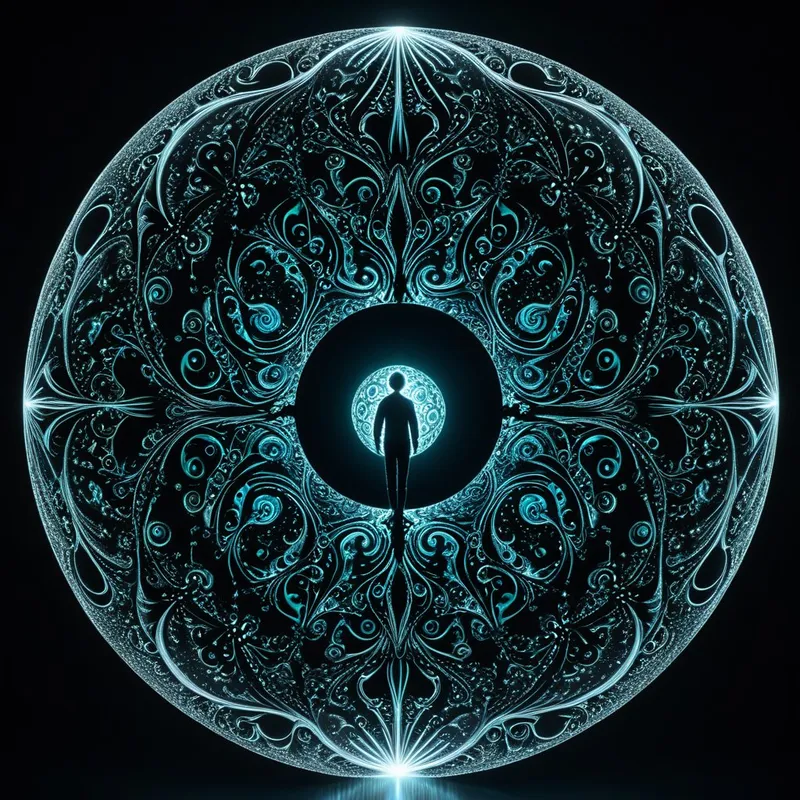
The myth of Atman is a masterful map of the psyche. The personal self, with its desires, fears, and social roles, is the maya-bound ego. It is necessary for navigating the world, but it is not our fundamental identity. The Atman symbolizes the transcendent function of consciousness itself—the pure subject that can never be objectified.
The Atman is the witness, not the actor; the screen, not the movie.
The journey inward, through negation ("neti, neti"—not this, not that), represents the psychological process of dis-identification. We are not our jobs, our traumas, our achievements, or even our personalities. These are contents of the psyche, but not the psyche's essence. The heart-cave where the Atman dwells is the symbolic center of the individual, the Self in the Jungian sense. The final realization of unity with Brahman is the dissolution of the ego-Self axis into pure, non-dual awareness.
The Dreamer's Resonance
In modern dreams, the Atman does not appear as a deity, but as an atmosphere or a transformative object. One might dream of finding a secret, immaculate room inside a familiar but dilapidated house—the untouched core of the psyche. Another might dream of a mirror that reflects not one's face, but a vast, peaceful landscape or a source of light.
These dreams often occur during periods of existential crisis, burnout, or deep introspection, when the ego-structure is fatigued or failing. The somatic feeling is one of profound relief and awe, coupled with a sense of uncanny familiarity. The psychological process is the unconscious reassuring consciousness that behind the struggle of the personal identity, there is an indestructible ground of being. It is the Self signaling its presence, inviting a shift from "doing" to "being."

Alchemical Translation
The alchemical work modeled by the Atman myth is the individuation process in its ultimate expression. The first stage is the nigredo: the "dark night of the soul," the discontent and suffering that forces the question "Who am I?" This is the burning away of naive identification with the persona.
The inward journey of negation is the albedo, the washing clean. We consciously separate from our complexes, our internalized voices, our cultural conditioning. We cease to say "I am angry," and instead observe "There is anger." This creates a space between the ego and the psyche's contents.
The goal is not to become divine, but to recognize that you are nothing but the divine, pretending to be someone.
The final realization is the rubedo, the reddening or enlightenment. It is not an acquisition, but a homecoming. The integrated individual does not vanish; they operate in the world, but from a place of rootedness in the Self. Actions flow from spontaneity, not compulsion. Relationships are engagements, not completions. The world is seen not as a place to extract meaning, but as the luminous play of the one Consciousness that you are. The personal life becomes a vessel for the impersonal, a unique and beautiful expression of the timeless Atman. The struggle for self-improvement transmutes into the grace of Self-recognition.
Associated Symbols
Explore related symbols from the CaleaDream lexicon: