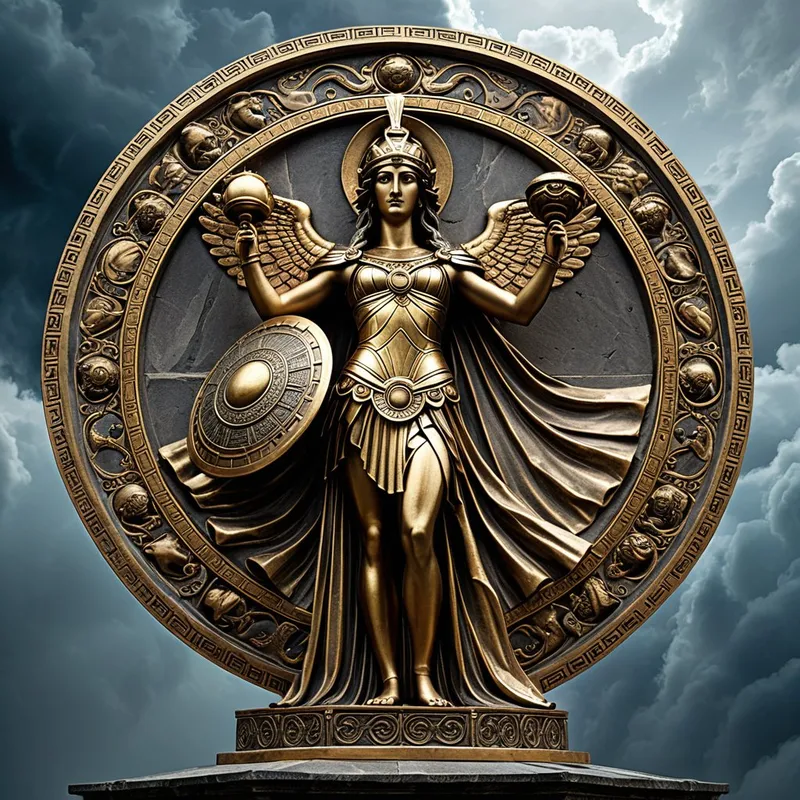
Athena's Shield Myth Meaning & Symbolism
The story of the Aegis, a shield forged by divine smiths, embodying Athena's strategic wisdom and the terrifying power of the Gorgon's gaze.
The Tale of Athena's Shield
Hear now the tale of the Aegis, born not of gentle craft but of cosmic fury and divine necessity. In the deep, fire-lit bellies of the earth, where the air smells of sulfur and ringing bronze, the one-eyed giants, the Cyclopes, toil. Their hammers fall in a rhythm older than the gods themselves, shaping the raw stuff of creation.
Above, on sun-drenched Olympus, a new order stirs. Athena, sprung fully armed from the split skull of her father Zeus, embodies a new kind of power. Hers is not the brute force of the Titans, nor the wild passions of older gods. It is the cold, clear light of strategy, the measured strength of the city wall, the cunning of the weaver’s loom. Yet, to defend this nascent order, she requires a weapon that speaks to both mind and marrow.
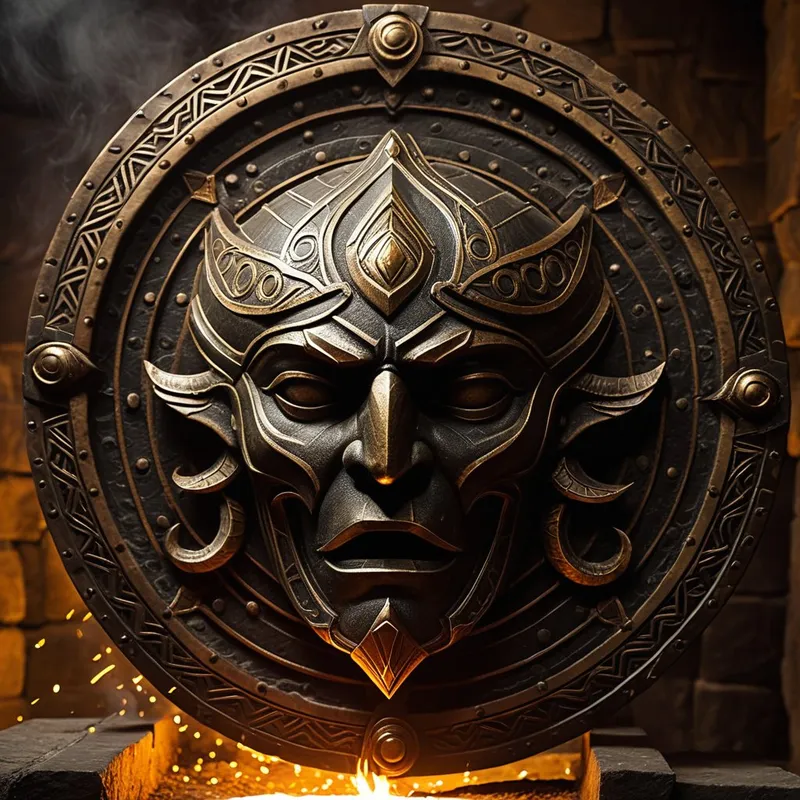
The command goes down to the forge. Not for a sword, thirsty and singular, but for a shield. The Cyclopes take the hide of the primordial she-goat Amalthea, who once nourished the infant Zeus with her milk. They stretch it over a frame of unbreakable adamant. Upon its bronze face, they do not set a benign symbol. They hammer into its very center the ultimate image of dread: the Gorgoneion, the severed head of Medusa.
This is no mere decoration. It is a captured scream, a terror made artifact. Medusa’s hair remains a nest of living, hissing serpents; her wide eyes, though lifeless, hold the petrifying curse. To complete its awful majesty, they fasten to its rim the golden tassels of Eris, which clatter with the sound of impending battle.
Athena takes up the Aegis. It is heavy with paradox. It is a barrier, yet it attacks. It is a defense that carries the most offensive of magics. When she enters the fray, she does not hide behind it. She raises it high, and its power radiates outward. The Gorgon’s gaze, once a random horror, is now directed by a divine will. It does not merely petrify the body; it freezes the chaotic impulse, the mindless rage of the enemy. Before the Aegis, disorder turns to stone, and chaos finds its limit. It becomes the moving bulwark of civilization itself, the terrifying clarity that makes peace possible.
Cultural Origins & Context
The myth of the Aegis is woven into the earliest strands of Greek epic poetry, most notably in the works of Homer. It is not the subject of a single, isolated tale but a recurring, potent symbol within the broader tapestry of divine conflict and heroic endeavor. Passed down by bards in royal halls and at public festivals, the Aegis was a shared cultural shorthand for ultimate divine authority and protection.
Its societal function was multifaceted. For the polis, the city-state, Athena was the patroness, and her shield symbolized the collective defense—the walls, the laws, the shared identity that held chaos at bay. In a warrior culture, it modeled a specific ideal: victory achieved not through berserker fury but through disciplined strategy (metis) backed by overwhelming, awe-inspiring presence. The Aegis was a theological argument: true power (kratos) is the synthesis of raw force (bia) with intelligent application. It was carried not only by Athena but occasionally by Zeus, linking this concept of ordered, protective authority directly to the king of the gods.
Symbolic Architecture
The Aegis is a master symbol of integration, a psychic artifact representing the conscious harnessing of unconscious, terrifying power.
The shield is the conscious mind; the Gorgon upon it is the integrated shadow. One cannot exist without the other if true wholeness is to be achieved.
At its core, the Aegis represents the principle of wise containment. The hide of Amalthea signifies nourishment and primal, chthonic origins—the raw material of the self. Stretched over a frame of adamant (unyielding resolve or principle), it becomes a bounded space, a container for experience.
The central symbol, the Gorgoneion, is the key. Medusa represents the ultimate shadow—that which is so terrifying it petrifies the ego upon sight. She is rage, monstrous femininity, the unmediated power of the unconscious that turns life to static, dead stone. By fixing her image at the heart of the shield, Athena does not destroy this power; she captures and utilizes it. The petrifying gaze is sublimated. It no longer turns the self to stone out of fear; it is projected outward to immobilize external chaos and internal, paralyzing fears.
The golden tassels of Eris complete the symbol. They acknowledge that strife and discord are not eliminated from a protected life; they are incorporated into its very fabric, their chaotic jangle transformed into a warning system, the necessary noise at the borders of the self.
The Dreamer's Resonance
When the motif of Athena’s Shield arises in modern dreams, it signals a critical phase of psychic defense and integration. The dreamer is likely facing a situation of overwhelming external pressure or internal conflict that threatens to paralyze them—a "Medusa" situation.
Somatically, one might dream of feeling exposed, back against a wall, or of a terrifying, mesmerizing presence that one cannot look away from. The appearance of a shield, especially one with a frightening central image (a face, an eye, a snarling mouth), marks a shift. The psyche is mobilizing its resources. This is not a dream of fleeing, but of facing, and doing so with a newly forged tool.
Psychologically, the dream indicates the ego’s attempt to construct a boundary that is not a wall but an active, reflective surface. It is the process of taking a previously paralyzing trauma, fear, or complex (the personal "Gorgon") and, instead of repressing it, turning it into a central part of one's identity and defense. The dream asks: What is the terrifying power you have been avoiding? How can you not only face it but mount it at the center of your being, so its energy protects rather than petrifies you?
Alchemical Translation
The myth of the Aegis is a precise blueprint for the alchemical stage of coagulatio—the process of giving fixed, solid form to volatile spirits. It models the individuation journey of transforming chaotic, unconscious contents into a structured, protective component of the conscious personality.
Individuation is not the slaying of one's monsters, but the divine smith-craft of forging them into armor.
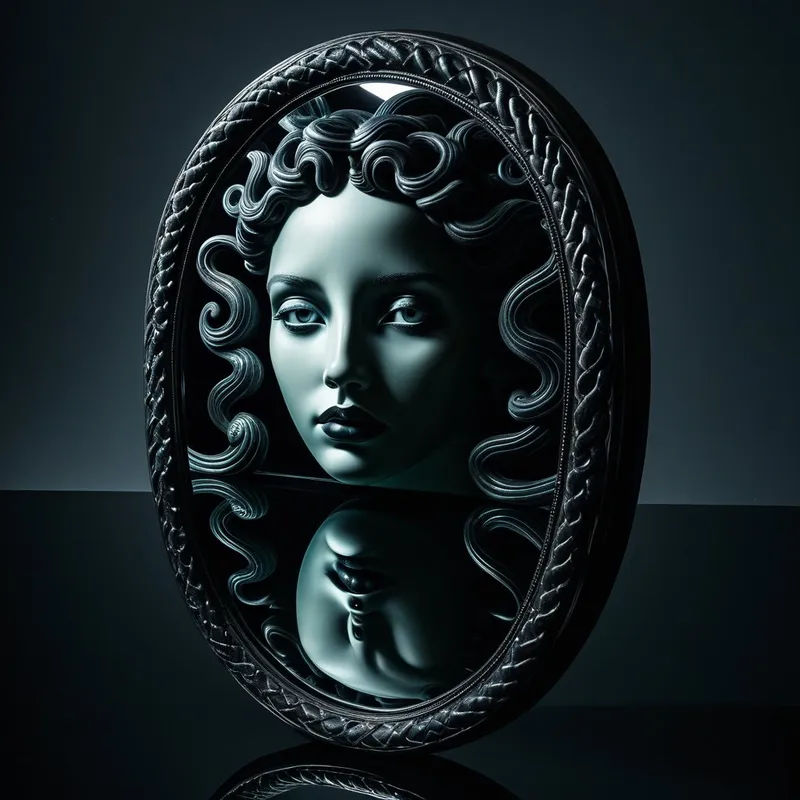
The initial state is one of dangerous, unintegrated power (Medusa at large). The ego, like Perseus, can only approach this power indirectly, using reflection (the shield as a mirror). The transformative act is the "severing"—the difficult, conscious differentiation of this complex from the swamp of the unconscious. This is the separatio.
But the crucial, alchemical step is what follows. One does not discard the severed head. The furnace of the unconscious itself is enlisted to hammer it onto the shield of the ego. This is the coniunctio oppositorum—the marriage of conscious structure (the shield) with unconscious, terrifying power (the Gorgon).
The result is the Aegis: the lapis philosophorum or philosopher's stone of the psyche. It is the solidified, operational form of wisdom. The individual no longer fears their own depth or the chaos of the world, because they carry a principle of order that incorporates and redirects that very chaos. The petrifying gaze of neurosis is transformed into the focused gaze of discernment. One becomes, in a sense, both Athena and her shield—the conscious wielder of a wisdom forged in the deepest, hottest parts of the soul. The protection offered is no longer brittle but dynamic, a wisdom that understands terror so completely it can use its image to keep true terror at bay.
Associated Symbols
Explore related symbols from the CaleaDream lexicon: