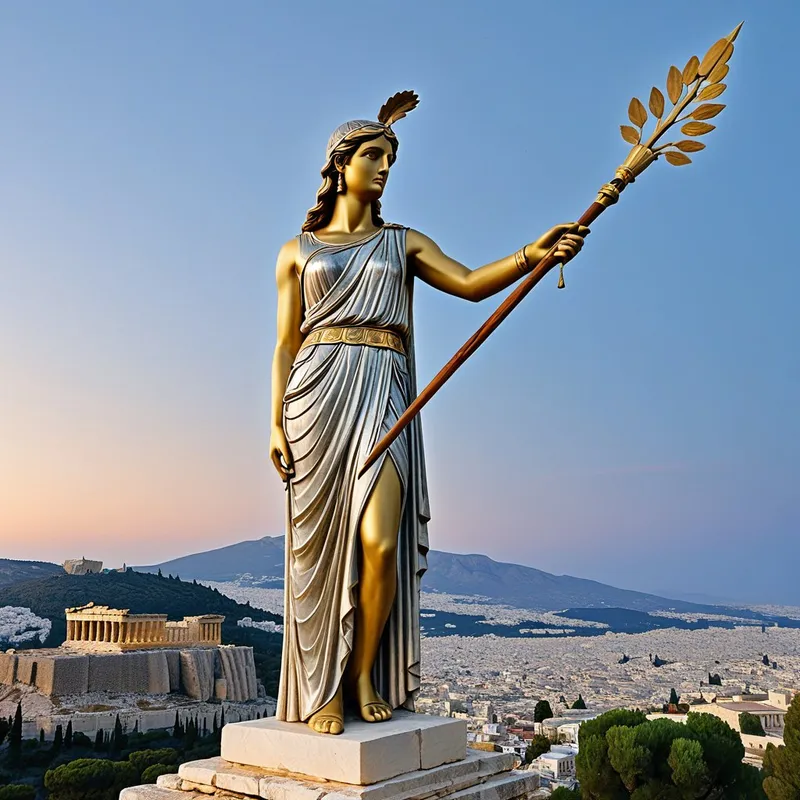
Athena's Olivewood Spear Myth Meaning & Symbolism
The myth of the olivewood spear, born from the sacred tree of Athens, symbolizes the alchemical transformation of raw force into strategic, life-giving wisdom.
The Tale of Athena’s Olivewood Spear
Listen now, and let the smoke of memory curl. The world was young, and the gods walked the high places of the earth. Upon a sun-baked rock, the future heart of a civilization waited, nameless and thirsty. Two mighty divinities descended, their shadows long upon the stone: Poseidon, whose beard smelled of salt and storm, and Athena, whose grey eyes held the calm of the owl’s flight.
The contest was set by the king of the gods himself, Zeus: a gift for the people of this rock. Whose blessing would they choose? Whose patronage would shape their souls?
Poseidon struck first. With a roar that shook the foundations of the world, he drove his three-pronged trident into the barren Acropolis. The earth cracked with a sound like thunder, and from the deep wound, a geyser erupted. But the water that surged forth was not sweet. It was the brine of the sea, salt-white and useless, a symbol of raw, untamed power and naval dominion, yet barren for a thirsty city.
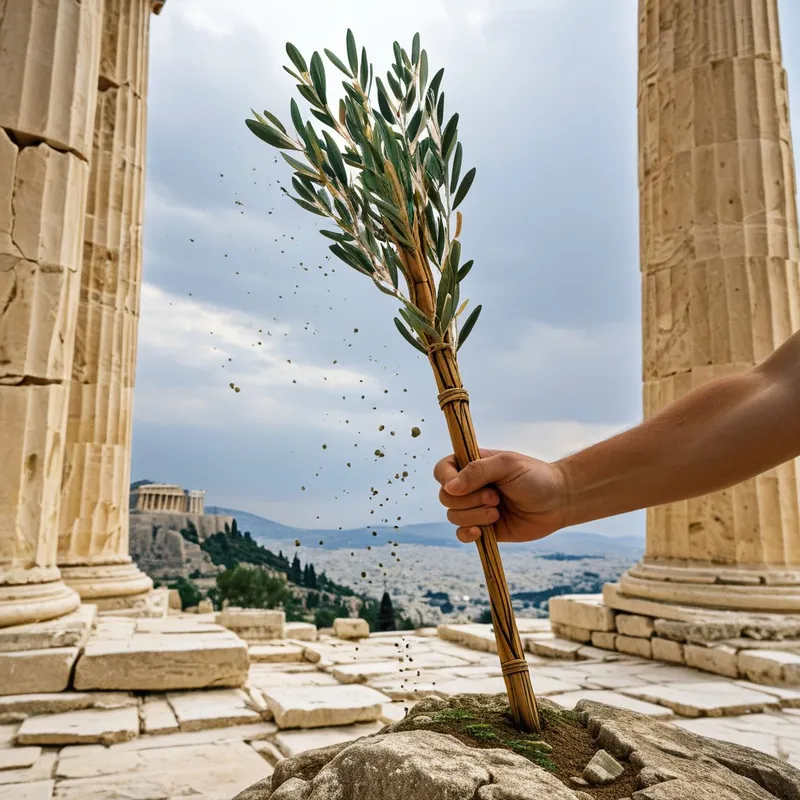
Then stepped forward Athena. She did not roar. She did not strike the earth in fury. She knelt, a gesture of profound connection. In her hand was no weapon of gleaming bronze forged in Hephaestus’s fire, but a spear hewn from the heartwood of a wild olive tree. Its shaft was smooth, strong, and alive with the memory of the earth. With a motion that was both gentle and decisive, she planted the butt of the olivewood spear into the cracked stone where Poseidon’s salt spring pooled.
A silence fell, deeper than the sea. Then, from where the wood met stone, a miracle sprouted. Not a weapon of destruction, but a tree of life. A slender, silver-green shoot pierced the rock, unfurling leaves like whispers. It grew before the astonished eyes of gods and mortals, becoming a full, glorious olive tree. From its roots, a trickle of pure, fresh water began to flow, a spring to quench a city’s thirst. The tree offered food, oil for light and healing, wood for shelter and tool, and peace.
The victory was clear. The olivewood spear was not used to conquer, but to cultivate. It did not take life; it implanted it. King Cecrops and his people chose the gift of the grey-eyed goddess. The rock was named Athens, and the olive tree, sacred and eternal, became its soul, sprung from the very instrument of Athena’s wisdom.
Cultural Origins & Context
This foundational myth, central to Athenian identity, was not merely a story but a civic charter. It was recounted during the grandest of Athenian festivals, the Panathenaia, a procession that wound from the city to the Parthenon. Here, the myth was woven into the very fabric of ritual, reminding citizens that their prosperity, their famed olive oil trade, and their political ideals were divinely ordained gifts of Athena Polias.
The tale served multiple societal functions. It explained the origin of the sacred olive trees in the Pandroseion, from which oil was drawn for the prizes in the Panathenaic games. It legitimized Athenian claims to autochthony—being sprung from the very soil—and to a superior, civilizing wisdom over mere maritime or martial power. The myth was a pedagogical tool, teaching that true strength lies in strategic intellect, sustainable creation, and the arts of peace that emerge from a position of secured strength, symbolized by the spear that becomes a tree.
Symbolic Architecture
The olivewood spear is a supreme symbol of alchemical transformation. It represents the transmutation of one primal substance—raw, aggressive force—into its highest, most life-giving opposite.
The spear is the axis where conflict meets cultivation, where the vertical thrust of will is turned horizontally into rooted, spreading life.
The wood itself is key. Olive wood is hard, resilient, and burns with a clear flame. It is not the metal of war but the living fiber of the earth, shaped by human (or divine) craft. Athena does not wield a spear against the earth, but with it. The point, often imagined as bronze, is the focused application of intellect—the strategic, penetrating insight that identifies the precise point for generative action. The shaft is the enduring, resilient character required to apply that insight over time.
Psychologically, the myth maps the journey from the shadow archetype of Poseidon—the chaotic, emotional, and overwhelming forces of the unconscious—toward the integrated consciousness of Athena. It is not about defeating the unconscious sea, but about channeling its raw power into a structured, conscious form. The salt water of emotion, undrinkable in its raw state, is transformed, through the catalytic intervention of the crafted wood, into nourishing water and the oil of enlightenment.

The Dreamer’s Resonance
When this myth stirs in the modern dreamscape, it often manifests in periods of intense internal or external conflict. The dreamer may find themselves in a barren, rocky landscape—a symbol of a life situation feeling sterile or hopeless. They may witness a violent, impressive, but ultimately useless display of force (a crashing wave, a striking trident).
The pivotal dream image is the act of planting a weapon. A dreamer might take a sword and thrust it into the ground, only to see it take root. Or they might be given a simple wooden staff and feel a compulsion to drive it into a crack in concrete. The somatic sensation is one of release and grounding; the tension held in the arm ready to strike dissolves into the earth, followed by a surge of vitality from below.
This dream pattern signals a profound psychological process: the ego’s recognition that its habitual mode of aggressive defense or forceful advancement is failing. The psyche is advocating for a shift in strategy—from confrontation to cultivation, from asserting dominance to enacting sovereignty. It is the moment the dreamer’s wisdom realizes that the true victory lies not in winning the battle, but in changing the nature of the game entirely.

Alchemical Translation
For the individual on the path of individuation, the myth of the olivewood spear is a master lesson in psychic transmutation. It models the process of taking a wound—the cracked, barren rock of a personal trauma, failure, or conflict (Poseidon’s strike)—and, through the catalyst of conscious wisdom, turning it into the very source of one’s identity and resilience.
The first step is to withdraw the metallic point. This is the cessation of blunt, reactive aggression. The second is to grasp the olive wood—to connect with what is authentically, resiliently you, your core values and innate strengths, which may seem humble compared to the glittering weapons of others. The final, alchemical act is to plant it back into the wound.
Individuation is the courage to return your crafted self to the site of the original rupture, not to reopen it, but to seal it with a new form of life.
This is the creation of the Philosopher’s Stone on a personal level. The salt (sal) of bitter experience, the mercury (mercurius) of adaptive intelligence, and the sulfur (sulfur) of passionate will are combined through the vessel of conscious intention (the crafted spear). The result is not a conquest, but a sacred grove: a personality that draws sustenance from its own transformed struggles, that offers shade and nourishment to itself and others, and that stands as a living testament to the power of wise, strategic creation over mindless destruction. The spear is never discarded; it is fulfilled. It becomes the tree, and the individual becomes both warrior and gardener, protector and creator, rooted in unshakeable wisdom.
Associated Symbols
Explore related symbols from the CaleaDream lexicon: