Athena's Olive Tree Myth Meaning & Symbolism
Athena wins patronage of Athens by gifting the first olive tree, a symbol of enduring peace, wisdom, and cultivated civilization over raw power.
The Tale of Athena's Olive Tree
Listen, and hear of the day the gods themselves contended for the soul of a city yet unborn.
The sun beat down upon the bare, grey rock of the Acropolis, a stark crown above the plains of Attica. The air shimmered with potential, for this high place was destined to be the heart of a great city. But which god would claim its patronage, its name, its very spirit? The matter was brought before the council of the Olympians, and two mighty claimants stepped forward.
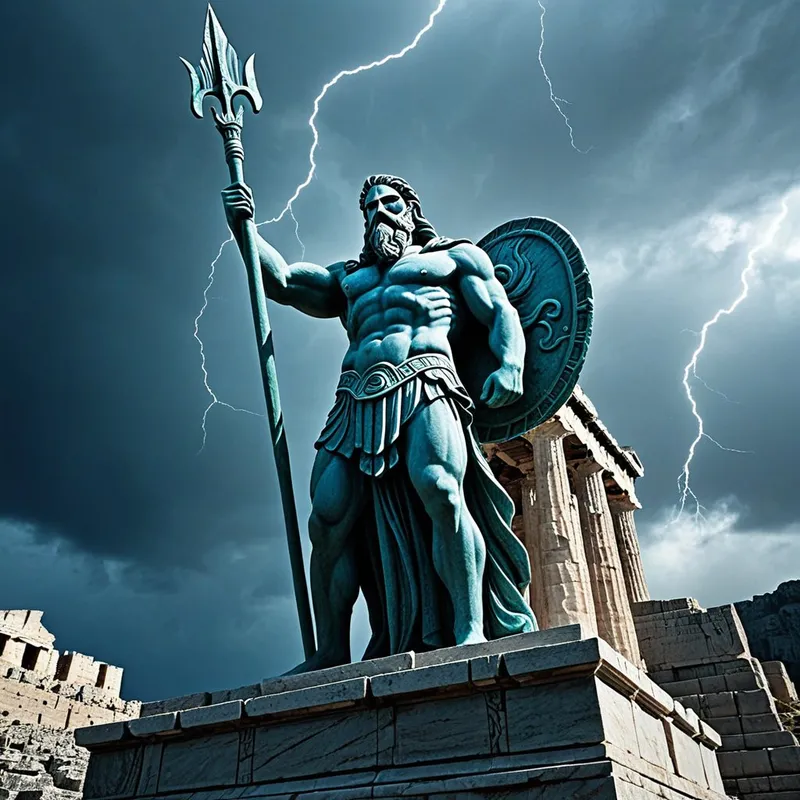
First came Poseidon, the Earth-Shaker. His presence was a gathering storm, the scent of brine and tempest swirling about him. Without a word, he raised his formidable trident and brought it down upon the bedrock with a crack that echoed like thunder. The stone split, and from the wound gushed a magnificent, roaring spring. But as the citizens and gods leaned in, they tasted not fresh water, but the bitter, undrinkable salt of the sea. It was a gift of raw, untamed power—a promise of naval dominance, yes, but also of the sea’s unforgiving, sterile fury.
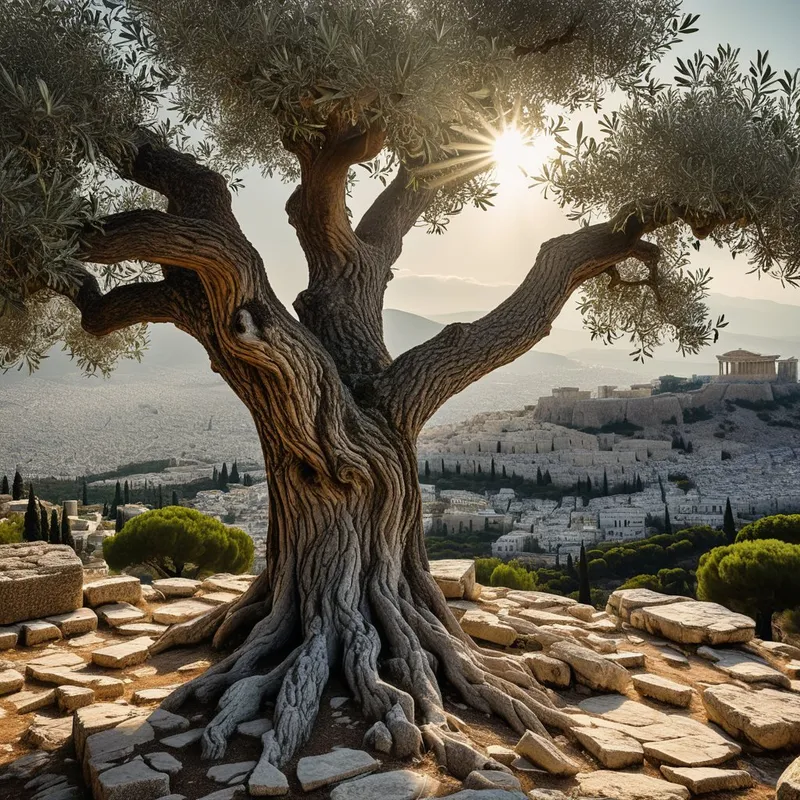
Then came Athena. She approached not with violence, but with a profound, silent contemplation. Her grey eyes, the color of a thoughtful dawn, surveyed the rock, the people, the horizon of time. She knelt, and where her spear-tip touched the earth, it pierced gently. From that small incision, she planted not a weapon, but a seed. The assembly watched, breath held. Slowly, miraculously, a shoot emerged. It grew before their eyes, thickening into a gnarled, silver-trunked tree, spreading branches of dusty green. From its boughs hung clusters of small, firm fruit—the first olive.
The king, the wise Cecrops, examined both gifts. He tasted the salt water and knew it for what it was: a symbol of conflict and barren boast. Then he took an olive, pressed it, and tasted the rich, golden oil. He saw its uses: light for lamps, unguent for the body, nourishment for food, a balm for wounds. He saw the tree itself—its hardy, evergreen nature, its ability to thrive on rocky soil, its promise of harvests for centuries to come. It was a gift not of domination, but of sustenance; not of fleeting spectacle, but of enduring peace and cultivated prosperity.
The verdict was clear. The gods themselves voted, and the victory was Athena’s. The city would be called Athens, and the olive tree, sacred and protected, would forever stand upon its Acropolis as the true marrow of its civilization, a living testament to the triumph of wise creation over destructive force.
Cultural Origins & Context
This foundational myth, central to Athenian identity, is recorded in various fragments from authors like Hesiod and the later traveler Pausanias. It was not merely a folktale but a civic charter, performed and referenced in rituals, depicted on the Parthenon's pediments, and woven into the fabric of Athenian law. The actual, ancient olive tree said to be Athena's gift was housed in the Erechtheion, a complex that also enclosed Poseidon's salt spring, forever entwining the two rival offerings in sacred architecture.
The myth served multiple societal functions. It established Athens’s divine patronage under a deity of strategic intelligence and skilled craft, justifying its political and cultural ascendancy. It also provided an etiological explanation for the profound economic and cultural importance of the olive in Greek life. The olive branch became the universal symbol of peace, and olive oil was central to trade, religion, athletics, and daily sustenance. The story was told to children, recited by priests, and celebrated in festivals like the Panathenaia, reinforcing the core civic values of wisdom, peace, and fruitful labor over brute strength and conflict.
Symbolic Architecture
At its heart, the myth presents a fundamental choice between two kinds of power. Poseidon’s salt spring represents the archaic, chthonic, and impulsive force. It is spectacular, immediate, and linked to the unconscious, emotional depths—powerful, but ultimately sterile and undrinkable for a civilized community. It is the raw id, the unmediated outburst.
Athena’s olive tree is the archetypal symbol of the logos applied to the chaos—the ordering principle that cultivates potential into lasting, life-sustaining form.
The olive tree is not found in nature in that form; it is a product of human (and here, divine) cultivation. It symbolizes civilization itself: the patient application of mind (nous), skill (techne), and foresight to create resources that nourish across generations. Its evergreen nature speaks to enduring wisdom and resilience; its oil, which must be pressed from the fruit, signifies the value born of effort and refinement. The tree is rooted deep in the earth (connected to the chthonic realm) yet reaches for the sky (the realm of intellect and Olympus), becoming a perfect axis mundi for the Athenian psyche, bridging the raw and the refined.

The Dreamer's Resonance
When this mythic pattern surfaces in modern dreams, it often signals a critical inner crossroads. Dreaming of a stark, salty well or a violent wave in a place of expected sustenance may reflect a feeling that one's raw emotions or aggressive drives (the Poseidon force) are proving barren or toxic in one's personal or professional life. It is a somatic signal of emotional sterility or conflict that cannot nourish the soul.
Conversely, to dream of planting a seed on barren rock, or of tending a single, resilient tree in a desolate landscape, points to the nascent emergence of the Athena principle. The dreamer may be in a process of consciously choosing a path of patient cultivation over forceful confrontation. The somatic sensation is often one of quiet, determined focus—a "rooting down" into one's own inner resources. The olive tree in a dream is a profound symbol of the psyche’s innate drive toward self-sustenance and peaceful integration, often appearing when the ego is ready to relinquish a brittle, defensive posture for one of deeper, more resilient growth.

Alchemical Translation
Psychologically, the contest on the Acropolis is an internal drama of individuation. The Acropolis represents the fortified citadel of the conscious ego. The competing deities are powerful archetypal forces within the unconscious vying for dominance in shaping the individual’s identity and worldview.
The initial, instinctual response to a life challenge or a need to establish oneself (to "found a city") is often the Poseidonic reaction: a grand, dramatic gesture of force, a demand for recognition through power, anger, or overwhelming emotion. This, however, leads to the "salt spring"—a situation that looks impressive but is ultimately infertile, leaving one feeling hollow and isolated.
The alchemical work is the transmutation of the salt of bitterness and sterility into the golden oil of wisdom and nourishment. This is Athena’s art.
The victory of Athena symbolizes the ego’s conscious decision to ally itself with the archetype of the animus as Logos (or the inner feminine principle of creative wisdom in a man, the anima as Sophia). It is the choice to respond to conflict not with escalation, but with creative, strategic thought. To "plant the olive tree" is to invest in long-term projects of the soul—skills, knowledge, relationships, and inner peace that require patience to mature. The oil, the final product, is the individuated self: a luminescent, cohesive identity that can heal, illuminate, and sustain itself and others, having integrated its raw, chthonic power into a lasting, civilized form. The myth, therefore, is a permanent map for the psyche: true sovereignty is won not by dominating the rock, but by knowing what to plant upon it.
Associated Symbols
Explore related symbols from the CaleaDream lexicon: