Athena's Birth Myth Meaning & Symbolism
The goddess of wisdom and war is born, fully armed, from the split skull of her father Zeus, a myth of intellect forged from crisis.
The Tale of Athena's Birth
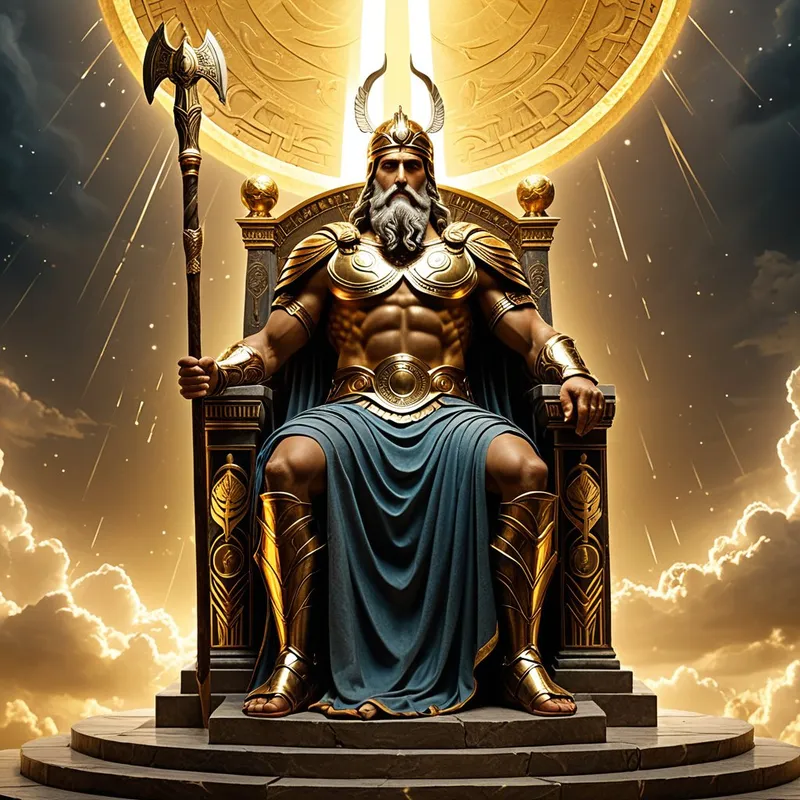
Let the cosmos hold its breath. In the high halls of Mount Olympus, a silence deeper than the abyss had fallen. The lord of thunder, Zeus, was bound by a new and terrible agony. Not the wrath of Titans, nor the sting of rebellion, but a pain blooming within the very fortress of his being—his skull. A pounding, world-forging headache gripped him, a pressure building behind his eyes that promised either apotheosis or annihilation.
For he had swallowed a prophecy, and with it, a goddess. His first wife, the titaness Metis, she of wise counsel and shifting form, carried his child. An oracle of Gaia whispered that this child would be a daughter of surpassing wisdom, but the son to follow would overthrow him. Seized by the same fear that felled his father Cronus, Zeus acted. With honeyed words, he coaxed Metis into a game of transformation, and when she shrank to a drop of water, he swallowed her whole. He believed he had contained the threat, internalizing her cunning as his own.
He was wrong. The essence of Metis did not dissolve; it gestated. Within the dark of the god-king’s head, a new consciousness was forged. Not in the womb of earth or sea, but in the crucible of intellect and divine power. The pain grew until Zeus, the unshakable, roared so mightily that the pillars of the world trembled. Stars shook loose from the firmament.
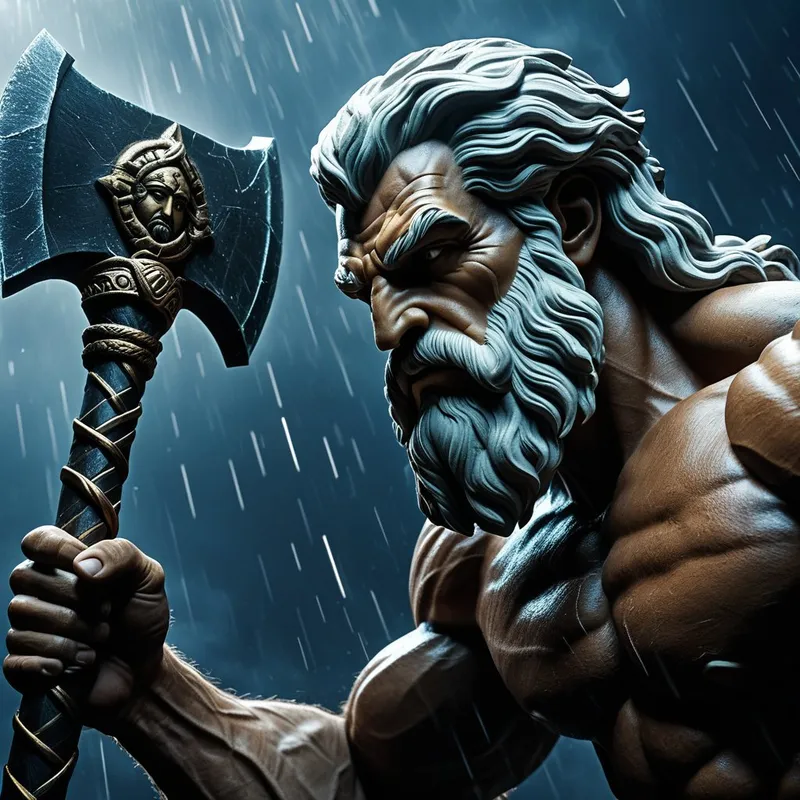
None could soothe him. The other Olympians looked on in terror. Until the resourceful Hephaestus, or in some tellings, the titan Prometheus, took up a great double-headed axe. With a prayer and a heave born of pity and necessity, he brought the blade down upon the sovereign brow of the king of gods.
The sound was not of splitting bone, but of a mountain cracking to reveal a vein of pure light. From the cleft in Zeus’s skull, she emerged—not a babe, but a woman in her full power. Athena, daughter of Zeus and Metis. She sprang forth fully armed, her armor clashing like a symphony of strategy. A helm of gleaming bronze sat upon her brow, a spear of destiny was in her hand, and the terrible, fascinating Aegis was upon her breast. Her grey eyes, eyes that saw all paths and their ends, swept the stunned assembly. She let out a cry—a cry of war, yes, but also of clear, piercing reason that cut through the divine chaos. And the pain of Zeus ceased, replaced by awe. The goddess of wisdom was born, and order was restored, not by force alone, but by the intellect that had, literally, split the old world open.
Cultural Origins & Context
This foundational myth was not mere entertainment; it was a psychic anchor for the Greek worldview, primarily established in Hesiod’s Theogony and echoed in Homeric hymns. It served a critical societal function: to explain and legitimize a seismic shift in cosmic order. The story marks the final, decisive transition from an older, chthonic (earth-based) power structure, symbolized by the swallowing of the earth-titaness Metis, to a new Olympian order governed by patriarchal sovereignty informed by wisdom.
Athena’s unique parentage—born from Zeus alone—was a theological masterstroke. It severed the physical necessity of the mother for creation, placing the seat of generative power in the mind of the male sky-god. Yet, crucially, it did not erase the feminine principle of wisdom (metis); it internalized and subsumed it. This reflected and reinforced the social structures of ancient Greece, where public, political, and strategic power (the realm of Zeus and Athena) was male-dominated, yet relied on the integrated, behind-the-scenes wisdom often associated with the feminine.
The myth was recited at festivals and in philosophical discourse, serving as a narrative cornerstone for Athens, the city that claimed Athena as its patron. It answered a deep cultural question: how does civilized intelligence, strategy, and just warfare (Athena’s domains) come into being? The answer: through a violent, necessary crisis within the established order (Zeus’s headache), resulting in a birth that is both martial and intellectual.
Symbolic Architecture
The symbolism here is a dense, perfect archetypal crystal. At its core is the act of cephalogenesis—birth from the head. This is the ultimate symbol of an idea made manifest, of consciousness giving birth to itself.
True wisdom is not merely acquired; it is born from the splitting open of one’s own preconceptions. It is an eruption from within.
Zeus’s headache represents the unbearable tension of unintegrated knowledge, the psychic crisis that precedes a breakthrough. He has swallowed Metis (practical, cunning wisdom) but cannot digest her; she remains Other within him, causing dysfunction. The axe-stroke, often wielded by Hephaestus (the craftsman), symbolizes the necessary, skillful intervention that breaks open a rigid structure to release what is trapped inside. It is the crisis, the surgery, the creative destruction.
Athena, emerging fully armed, signifies that this born wisdom is not passive or theoretical. It is immediately operational, strategic, and capable of defense and governance. Her association with the olive tree (won in her contest with Poseidon for Athens) alongside her armor shows her domain is not brute force, but the force that protects civilization, craft, and fruitful peace.

The Dreamer's Resonance
When this myth stirs in the modern unconscious, it often manifests in dreams of intense pressure in the head, of skulls cracking or opening, or of giving birth in unusual, intellectual ways. The dreamer may be struggling with a "mind-full" problem—a conceptual block, a strategic dilemma, an ethical quandary that feels like a mental prison.
Somatically, this can correlate with tension headaches, a feeling of being "blocked" in the crown chakra, or a sense of intellectual gestation. Psychologically, the dreamer is in the stage of Zeus’s headache. They have taken in knowledge, experience, or a creative impulse (the swallowed Metis), but it is trapped, causing distress because it demands expression in a new form. The dream is the psyche signaling that the old mode of thinking must be "split open." The birth of Athena in a dream suggests the imminent arrival of a brilliant solution, a clarifying insight, or a new personal philosophy that resolves the long-standing inner conflict, bringing a sense of armed readiness to face the world.

Alchemical Translation
For the individual on the path of individuation, Athena’s birth is a master metaphor for the alchemical solve et coagula—dissolve and coagulate—applied to the psyche. The ego (Zeus) initially seeks to maintain control by incorporating a powerful unconscious content (Metis, the anima or hidden wisdom) on its own terms. This fails, leading to a state of crisis and suffering (the headache).
The transmutation of the soul requires a willing sacrifice of the old self-containment. The axe must fall on the very idea of who you think you are.
The intervention of Hephaestus/Prometheus represents the transcendent function—the agency of the Self that orchestrates a breakthrough when the ego is paralyzed. The "axe" is the shocking insight, the therapeutic intervention, the life crisis, or the act of courage that shatters the ego’s defensive shell.
From this rupture emerges the integrated consciousness (Athena). She is the conjunctio oppositorum—the union of opposites. She is martial (masculine) yet born of a feminine principle; she is of the mind yet embodied in action; she is her father’s child yet her own sovereign entity. For the modern individual, this translates to the birth of a conscious attitude that can hold complexity: one can be strategic and compassionate, intellectual and intuitive, powerful and wise. The goal is not to be Zeus (the tyrannical ego) nor to remain Metis (the swallowed, unexpressed potential), but to become Athena: the self-governing intelligence that was forged in the crisis between them, now acting with clarity and purpose in the world.
Associated Symbols
Explore related symbols from the CaleaDream lexicon: