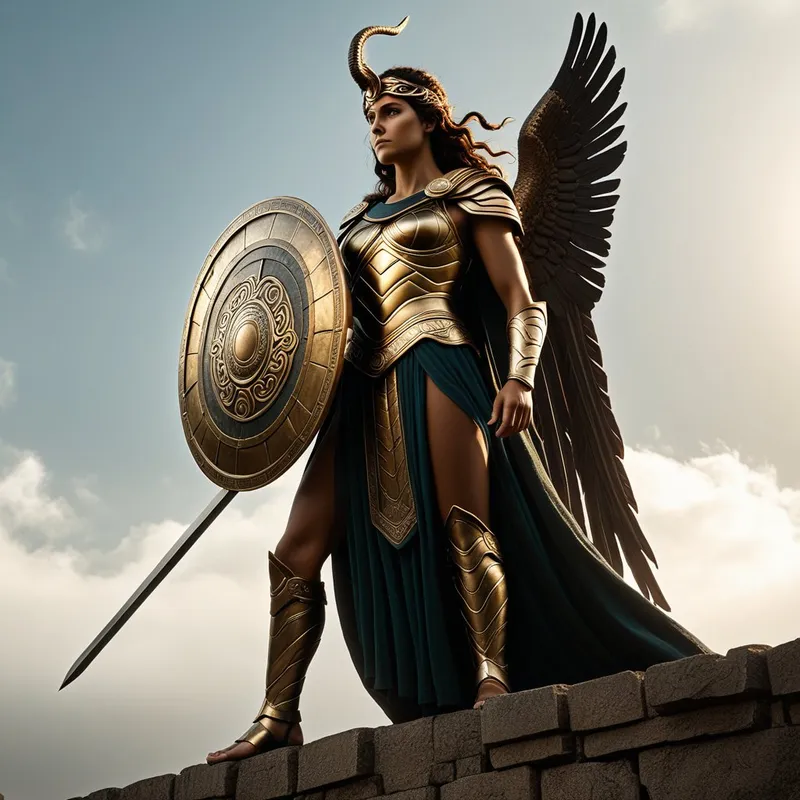
Athena's Aegis Myth Meaning & Symbolism
The story of the divine shield forged by Hephaestus, bearing the Gorgon's head, wielded by Athena as an emblem of strategic wisdom and awe-inspiring power.
The Tale of Athena's Aegis
Hear now the tale of the shield that is not a shield, the skin that became a cosmos. In the high, clear air of Olympus, where light is a substance and thought takes form, a tension hummed. It was the tension of a mind, vast and clarion—the mind of Athena, born not from womb but from the splitting skull of Zeus himself. She who strategized the fall of Troy, who taught mortals the loom and the olive, carried a void where a weapon should be. Not the reckless spear of Ares, nor the trident that shook the earth, but a tool of a different order.
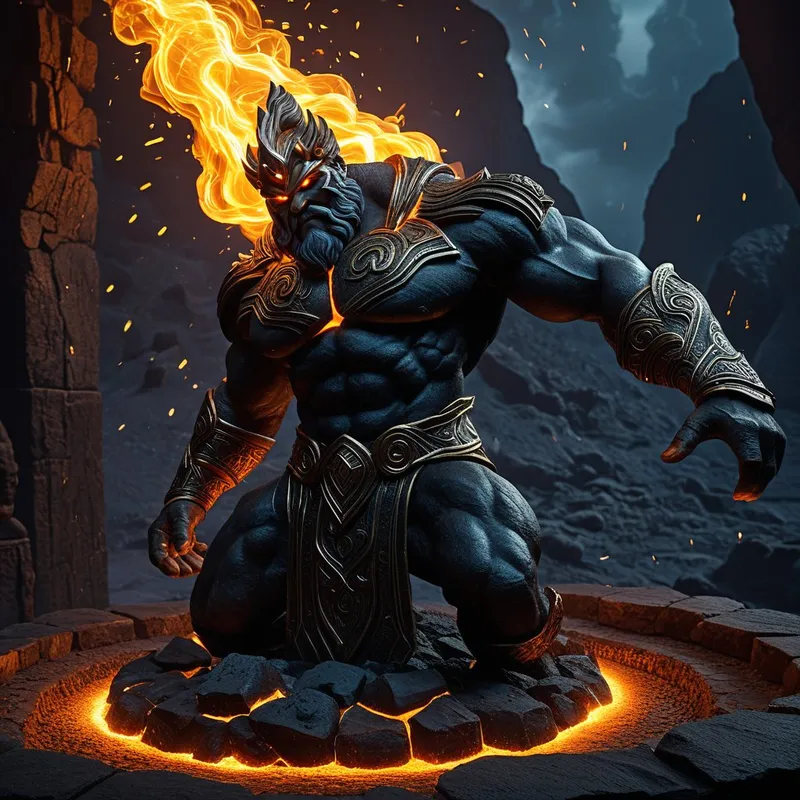
Her footsteps led her down, down from the bright courts to the realm of fire and falling hammers, to the smithy of Hephaestus. Here, the air tasted of ozone and molten bronze. The god labored, his mighty form glistening, muscles coiling like cables as he wrought wonders from the heart of the mountain. "Forge-smith," Athena's voice cut through the din, clear as a bell. "I require a defense, but not a wall. A weapon, but not a blade. I need the very skin of power, something that turns the tide before the first blow is struck."
Hephaestus, who loved her for her mind, nodded. He did not reach for common ore. He took the hide of the divine goat, Amalthea, she who had suckled the king of gods. This skin, imbued with primordial nurture, he stretched upon a frame of star-metal. Upon it, he worked a terror and a wonder. From stores of divine trophies, he set at its center the ultimate prize: the severed head of Medusa</aborgon. Not as a mere trophy, but as a focal point, a captured storm. The serpents of her hair seemed to writhe in frozen bronze; her wide, sightless eyes held a petrifying magic even in death.
He presented it to her. It was not heavy, yet it weighed upon the soul. "The Aegis," Hephaestus named it. Athena took it. She did not don it like common armor. She slung it across her chest, and it became part of her aura. When she strode onto the battlefield of the gods, during the great Gigantomachy, she did not need to swing a sword. She revealed the Aegis. A soundless wave erupted from the Gorgon's visage—a compound frequency of pure, strategic dread and inviolable authority. The monstrous Giants, for a heartbeat, faltered. Their rage met a colder, more ancient force: the terror of being truly seen by a consciousness that cannot be overwhelmed, only out-thought. It was a defense that worked upon the spirit, a weapon that struck the psyche. The tide turned. Not with chaos, but with the imposing, unbearable clarity of a goddess who had weaponized the mind's own capacity for awe.
Cultural Origins & Context
The myth of the Aegis is woven into the very fabric of ancient Greek epic and cult practice. It finds its most famous literary expressions in the verses of Homer, where in the Iliad, Zeus himself lends the Aegis to Achilles to strike terror into the Trojans, and where Athena routinely uses it to divine effect. This was not merely a poet's fancy. The symbol was deeply embedded in societal function. The Aegis was a real ritual object—often a goatskin cloak or a shield—borne in religious processions. Statues of Athena, most notably the colossal chryselephantine statue by Phidias inside the Parthenon, depicted her wearing it.
Its societal function was multifaceted. For the polis, particularly Athens which claimed Athena as its patron, the Aegis symbolized the city's divine protection and the particular quality of that protection: not brute force, but strategic, intellectual, and moral superiority that could deter aggression. It represented the ideal of civilized defense. The myth was passed down by bards at feasts, enacted in festivals, and visualized in ubiquitous art, teaching that true power lies in the combination of cultivated skill (Hephaestus's craft), righteous cause (Athena's domain), and the psychological mastery to channel even monstrous forces (Medusa's power) toward a protective end.
Symbolic Architecture
The Aegis is a profound symbol of integrated consciousness. It is not a denial of terror or the monstrous, but its conscious incorporation and redirection.
The ultimate shield is not one that blocks a blow, but one that transforms the nature of the blow itself, turning raw aggression into stunned awe before it can even land.
At its core, it is a triune symbol. First, the goatskin of Amalthea represents the foundational, nourishing layer of the psyche—the early, supportive structures that allow the ego (Zeus, then Athena) to develop strength. It is the "good enough" mother, the primal trust that undergirds all later courage.
Second, the crafted frame of Hephaestus symbolizes the ego's capacity for discipline, form, and skillful adaptation. It is the conscious mind applying its labor to shape raw materials (instincts, experiences) into a functional tool. This is the realm of technique, strategy, and crafted identity.
Third, and most critical, is the head of Medusa. She represents the petrifying face of the unconscious—the unintegrated trauma, the paralyzing fear, the raw, monstrous aspect of the Self that can freeze development in its tracks. Athena does not destroy this power; she captures and centralizes it. The Gorgon's gaze, once a mindless force of annihilation, is now focused and directed by a conscious will. The terror is not gone; it is harnessed. The Aegis thus symbolizes the psyche that has looked directly into its own darkest, most paralyzing complexes and, rather than being turned to stone (i.e., rendered neurotically rigid), has integrated that power into its defensive and authoritative presence.
The Dreamer's Resonance
When the pattern of the Aegis stirs in the modern dreamer, it signals a profound somatic and psychological process: the ego's struggle to construct a viable, authoritative identity in the face of overwhelming internal or external threats. One might dream of finding a strange, powerful artifact—a mirror that is also armor, or a family heirloom that feels terrifying yet protective. One might dream of facing a monstrous figure, not to fight it, but to somehow wear its image.
Somatically, this can correlate with a feeling of needing to "toughen one's skin," to develop resilience. Psychologically, it is the process of building what depth psychologists call a "complex-containing apparatus." The dreamer is in a state where old defenses are insufficient. They are being called to forge a new structure of Self that can hold and metabolize previously paralyzing contents—shame, rage, ancestral trauma (the Medusa)—without being shattered by them. The dream is an expression of the Self's blueprint for this alchemical operation: to take what was once a source of petrification and place it at the heart of one's protective authority.

Alchemical Translation
The myth of the Aegis is a masterful map for the alchemical stage of coagulatio—the making solid, the formation of the enduring philosophical stone, which in psychological terms is the attained, resilient structure of the individuated personality.
Individuation is not the elimination of one's monsters, but the sacred act of mounting them upon the shield of consciousness, where their fierce energy becomes a ward against lesser fears.
The process begins in the forge (the heat of analysis, intense life crisis, or deep introspection), where the base materials of one's nature—the nurturing but perhaps naive innocence (Amalthea's skin) and the raw, terrifying power of unconscious complexes (Medusa)—are brought together. Hephaestus, the archetype of the diligent craftsman, represents the sustained, often painful, ego-work required: the hammering out of insights, the careful shaping of boundaries, the labor of self-creation.
Athena represents the guiding archetype of the Senex or Sage that oversees this operation. Her birth from the head of Zeus signifies consciousness arising from the pinnacle of psychic authority. She directs the entire process toward a strategic, purposeful end: not explosion, but containment; not chaos, but ordered power.
The triumphant outcome is the Aegis itself—the lapis philosophorum or psychic shield of the individuated individual. This person does not react from unconscious terror (Medusa's wild gaze) nor hide in naive innocence (the simple goatskin). They have consciously integrated their shadow's most potent force. Their presence now carries a natural, unshakeable authority. They can "ward off" psychic invasions—others' projections, societal pressures, internal anxieties—not by fighting each one, but by the sheer, integrated power of their Self-awareness. Their vulnerability has been alchemized into an inviolable defense, their terror transformed into awe-inspiring presence. They have become, in their own sphere, a protective and wise authority, wearing their history not as a wound, but as their most powerful armor.
Associated Symbols
Explore related symbols from the CaleaDream lexicon:
- Clear
- Hood
- Helmet
- Windshield
- Clothing/Armor
- Laser Cutter
- Raincoat
- Tailored Blazer
- Corset
- Steel Gray
- Fluorite Pyramid
- Fluorite Prism
- Sugilite Crown
- Tremolite Crystal
- Tourmaline Slice
- Calcite Layer
- Iron Shield
- Robe of Enlightenment
- Safety Helmet
- Football Helmet
- Cycling Helmet
- Bubble Wrap
- Stainless Steel Utensils
- Hair Clip
- Fingerless Gloves with Gems
- Surge Protector
- Paper Punch
- Picturesque Soundboard
- Dreamcatcher of Thoughts
- Triangular Flag
- Diamond Grid
- Bagua Mirror
- Icy Sharpness
- Animus's Sword
- Minimap
- Myelin
- Shield