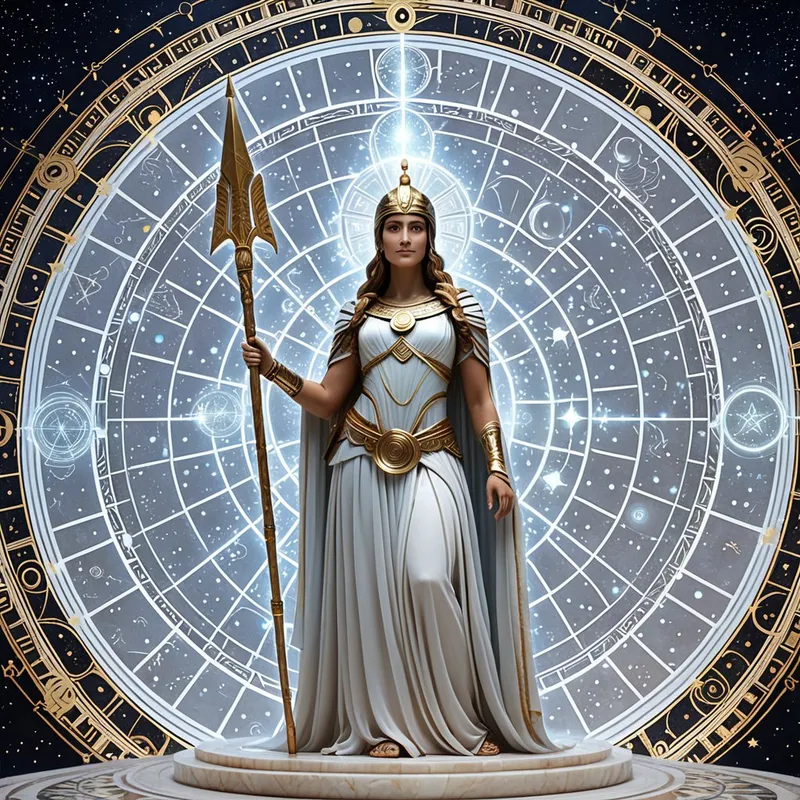
Athena- The goddess w Myth Meaning & Symbolism
A goddess of wisdom and strategy, born fully formed from the mind of a king, embodying the synthesis of thought and action in the face of primal chaos.
The Tale of Athena- The goddess w
Before the world knew its name, there was a silence so deep it was a pressure. In the heart of this silence, within the Chaos, a thought began to form. It was not a gentle wondering, but a tectonic pressure of cognition, a headache of the cosmos. This pressure found its vessel in Ouranos, the Sky-Father, whose brow was the dome of heaven itself.
Ouranos groaned, a sound that shook the foundations of mountains yet unborn. The pressure was not of flesh, but of a concept too vast to be contained. It was the concept of Metis—cunning intelligence, the blueprint of all strategy. He had swallowed this concept whole, fearing the prophecy that its offspring would surpass him. But a concept cannot be digested; it can only be transformed.
The pain crescendoed. It was not the pain of wound, but of birth—a birth in reverse, from the inside out. The divine skull of Ouranos, the very firmament, became a crucible. The gods gathered, not as spectators, but as witnesses to a new order. The air crackled with the ozone scent of revelation. Then, with a sound like the splitting of a continent of marble, his brow shattered.
Not with blood, but with a flash of searing, silver light. From the cleft, she emerged. Not a mewling infant, but a woman in full panoply. Her birth-cry was the ring of spear on shield. Athena- The goddess w stood, tall and unblinking, her armor gleaming with the cool light of a just-dawned star. In one hand she held a spear, its point sharpened by reason. On her chest, the aegis shimmered, a shield woven from the very fabric of strategic defense. Her eyes were grey like a storm-considered sea, seeing not just what was, but all paths of what could be.
The silence that followed was different. It was not the silence of void, but the potent silence of a mind at work. The primal, roaring chaos of unchecked force, embodied elsewhere, now had its perfect counterpoint. Here was the goddess who did not merely fight, but out-thought conflict. She planted the first olive tree, its roots seeking water with the same relentless logic her strategies sought victory, offering not just food but oil for light and peace. She became the patron of the loom, where countless threads—like the variables of fate—were woven into a coherent, beautiful whole. The tale of her birth was not a story of love, but of necessity. Wisdom was not given; it was forged in the unbearable tension between containment and emergence, and arrived, fully formed, to bring order to the world.

Cultural Origins & Context
The myth of Athena- The goddess w finds its most detailed and influential articulation within the corpus of Hesiod and the Homeric hymns, forming a cornerstone of the Hellenic worldview. However, her archetype—the warrior deity of intellect and civilized order—resonates as a universal pattern. In the Greek context, her myth was not merely entertainment but a foundational narrative for the polis (city-state). It was recited by rhapsodes, enacted in festivals like the Panathenaia, and embedded in the civic architecture of Athens, which bore her name.
Societally, her function was multifaceted. She legitimized a form of authority based on strategic wisdom and justice over brute force, providing a divine model for kings and lawmakers. For craftspeople, she sanctified skill and technical mastery. Her virginity (Parthenos) symbolized her autonomy and her complete dedication to the realm of the polis and the mind, unswayed by the passions that governed other deities. The myth served as a cultural container for the values of civilization itself: planning, artistry, law, and the application of disciplined thought to the challenges of human community and survival.
Symbolic Architecture
Athena- The goddess w represents the triumphant emergence of conscious, differentiated intellect from the undifferentiated, and often tyrannical, primal mind. Her birth from the head of the sky-god is the ultimate symbol of logos—reason, word, and structure—manifesting to govern chaos.
She is the moment the unformed idea crystallizes into a viable plan, the sudden clarity that cuts through confusion like her spear.
The swallowed Metis signifies wisdom internalized but repressed, a potential that becomes a psychic pressure until it is born anew in a more evolved, integrated form. Athena is that new form: not raw cunning, but applied wisdom. Her associated symbols are a lexicon of this architecture: the owl denotes the ability to navigate the unconscious dark with conscious sight; the olive tree represents strategic peace and sustainable prosperity born from deep-rooted intelligence; the loom symbolizes the capacity to weave disparate threads of experience into a coherent narrative or identity. She embodies the synthesis of masculine-associated strategy and feminine-associated craft, transcending simple gender binaries to represent a complete, self-possessed psychic faculty.

The Dreamer’s Resonance
When the pattern of Athena- The goddess w stirs in the modern dreamer, it signals a profound psychological process: the painful but necessary birth of a new cognitive faculty or perspective. Somatically, this may be experienced as tension headaches, a feeling of cranial pressure, or a stiff neck—the body mirroring the mythic “splitting of the skull.”
Psychologically, the dreamer may be struggling with a problem they have “swallowed”—an idea, a responsibility, or a creative potential they have internalized but not acted upon, which is now causing immense psychic strain. Dreams of sudden, brilliant solutions, of finding a weapon or tool in a moment of crisis, or of a serene, armored female figure intervening in a chaotic scenario all resonate with this archetype. It is the psyche’s announcement that the period of unconscious incubation is over; a fully-formed insight, strategy, or aspect of the Self is ready to emerge and take its place in the dreamer’s waking life. The process is often preceded by dreams of confinement or intellectual frustration, the modern echo of Metis trapped within.

Alchemical Translation
The alchemical journey modeled by Athena- The goddess w is the sublimation of raw instinct into conscious strategy, a core operation in the individuation process. The prima materia is the swallowed, undifferentiated mass of potential wisdom and instinct (Metis). The containing vas is the existing, often rigid, conscious attitude or ego-structure (the skull of Ouranos).
The nigredo, or blackening, is the unbearable pressure of this contained potential, the depression and frustration of unexpressed insight. The albedo, or whitening, is the brilliant flash of realization, the splitting open of old structures. The born goddess is the rubedo—the red, fully-realized and operational new consciousness.
For the modern individual, this translates to those pivotal moments when a long-held, internalized complex (a “swallowed” identity, a parental expectation, a buried talent) can no longer be contained. The ensuing psychological crisis—the “splitting headache” of the soul—is not a breakdown, but a breakthrough. The goal is not to destroy the old king (the existing ego), but to be born from it, transforming its very substance. The individual learns to wield the spear of discernment, wear the aegis of healthy boundaries, and weave the tapestry of their life with the deliberate skill of a craftsperson. They become, like Athena, a sovereign center of wise action, born from their own deepest struggles with insight.
Associated Symbols
Explore related symbols from the CaleaDream lexicon: