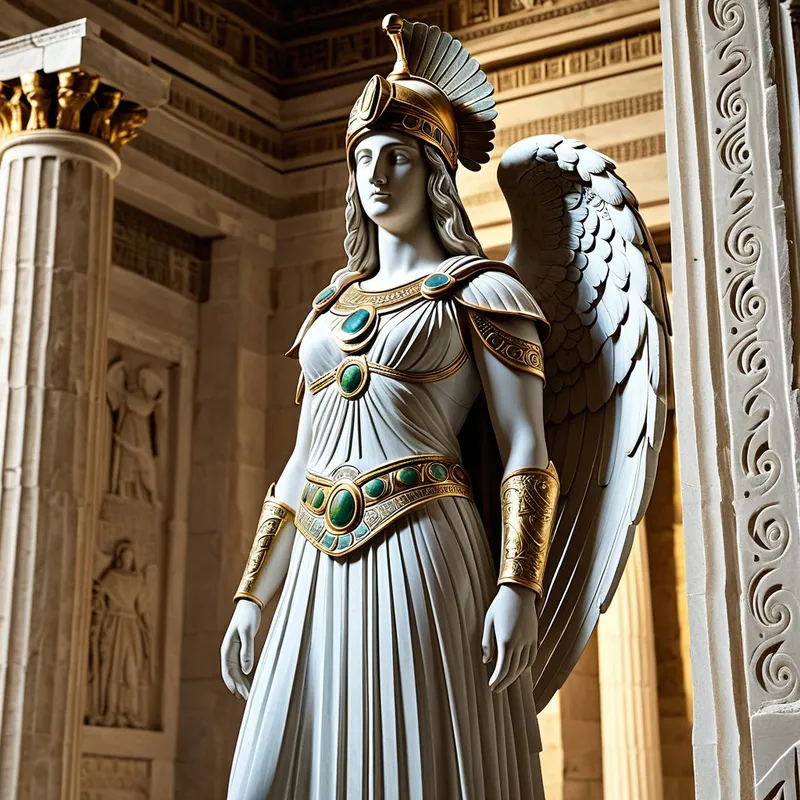
Athena Parthenos Myth Meaning & Symbolism
The myth of the goddess born fully armed from the mind of Zeus, embodying the alchemical union of intellect, strategy, and inviolable self-containment.
The Tale of Athena Parthenos
Listen, and let the air grow still. Before the world knew the rhythm of the seasons or the strife of mortals, the cosmos was a realm of titanic hungers. Zeus, the Thunderer, had swallowed his first wife, the Titaness Metis, for she was with child. A prophecy had whispered on the winds of fate: the son born of Metis would surpass his father, just as Zeus had surpassed Cronus. So, in a act of fearful sovereignty, Zeus consumed the mother of wisdom whole, believing he had contained the threat within the fortress of his own divine flesh.
But life cannot be so easily imprisoned. A seed of destiny, planted in the dark, must grow. Deep within the cranial vault of the god-king, a pressure began to build. It was not the brute force of a Titan, but the relentless, shaping force of intellect. Metis, from within, began to craft her child—not with clay and water, but with thought and strategy. She forged a helmet of unyielding reason, a spear of piercing insight, and the aegis of terrible, clarifying truth.
The pain that then seized Zeus was of a kind never known in heaven. It was not the wound of a weapon, but the agony of a universe being born inside a single mind. His skull became a cosmic forge, his brow the dome of a world in labor. He roared, and the sound shook the pillars of Olympus. Stars trembled in their courses. The other gods gathered, not in war, but in bewildered dread. What cataclysm could bring the All-Father to his knees?
Hephaestus, the artificer, understood the language of pressure and form. He took up his heaviest axe, not to harm, but to midwife. With a blow that rang like a primordial bell, he cleaved the divine skull. From the fissure, there was no blood, but a light so pure it cast no shadow.
And she emerged. Not a squalling infant, but a woman in the full glory of her power. Athena Parthenos sprang forth, fully armored, her battle cry a shout of pure, articulate reason that silenced the chaos. She shook her spear, and the very ether resonated with order. She stood before the pantheon, her grey eyes seeing not just surfaces, but the architecture of all things. The pain in Zeus’s head ceased, replaced by a profound and awe-struck understanding. The prophecy was fulfilled, yet subverted. The child had surpassed the father not through violence, but through a wisdom that completed him. She was his thought made manifest, his sovereignty perfected. And from that day forth, she was the Parthenos—the Virgin—whole unto herself, born not of the womb, but of the luminous, terrible, and creative mind.

Cultural Origins & Context
The myth of Athena Parthenos is not a folktale but a foundational charter, central to the Athenian self-conception. Its most famous vessel was the monumental chryselephantine (gold and ivory) statue by Phidias that stood in the Parthenon. This statue was less a piece of art and more a theophany—a permanent site of the goddess’s numinous presence. The myth itself was enacted and reaffirmed during the Panathenaia, a procession that culminated in offering a new peplos (robe) to the ancient cult statue.
The story was passed down through the epic tradition, most notably in Hesiod’s Theogony, which codified the genealogies and power dynamics of the gods. In this context, the myth served multiple societal functions. It established Athena’s unique authority as a goddess who bypassed maternal lineage, deriving her power directly from the patriarchal chief god, thus legitimizing her role in the male-dominated spheres of war and statecraft. It also presented a model of divine birth that transcended biology, emphasizing intellect (metis) as the ultimate creative principle. For Athens, a democracy that prized civic order, strategic warfare, and craft (both artistic and political), Athena Parthenos was the perfect divine patroness—a goddess of civilization who contained her formidable power within the bounds of law, strategy, and impeccable self-containment.
Symbolic Architecture
Athena Parthenos is not merely a goddess of war and wisdom; she is the archetypal symbol of consciousness born from the collision of raw power and deep cunning. Her birth is an intra-psychic event of the highest order.
The true citadel is not made of stone, but of a thought so complete it needs no other for its defense.
Zeus swallowing Metis represents the ego’s attempt to incorporate and control the deep, fluid intelligence of the unconscious (Metis, meaning "cunning wisdom"). But the unconscious cannot be digested; it must be gestated. The ensuing "headache" is the psychic tension that precedes a breakthrough in consciousness—the painful, necessary pressure that forces a new structure of being into existence. Athena is that new structure. She is the logos born of mythos, the articulate strategy born of primal wisdom.
Her virginity (parthenos) is the key. It does not signify sexual abstinence in a mundane sense, but psychological autonomy. She is "one-in-herself," a self-contained system. Her weapons—the spear, the aegis with the Gorgoneion—are not for aggression but for defense of this psychic integrity. The spear discriminates; the aegis petrifies chaotic, disintegrating influences (turning them to "stone," or giving them definitive form). She represents the capacity to hold a position, to maintain clarity and purpose, without being fragmented by external demands or internal passions.

The Dreamer's Resonance
When the pattern of Athena Parthenos stirs in the modern dreamer, it often signals a profound process of intellectual or spiritual "head-birth." The somatic experience may mirror Zeus’s agony: tension headaches, a feeling of pressure in the crown or brow, insomnia fueled by relentless mental activity. Psychologically, the dreamer is in the forge of their own skull.
Dreams may feature scenes of being trapped inside a confined, cranial space, or of a powerful, armored feminine figure emerging from a rock, a tree, or a building. There might be imagery of being given or forging a tool (a key, a pen, a specific piece of technology) that feels like an extension of the mind. This is not the birth of a child, but the birth of a capability—a new faculty of judgment, a strategic plan, a philosophical stance, or a creative work that has been gestating under immense internal pressure. The dreamer is midwifing their own sovereign intellect, often after a period of having "swallowed" a problem or insight they could not initially process.

Alchemical Translation
The alchemical journey modeled by Athena Parthenos is the opus contra naturam—the work against nature—not in defiance of the natural world, but in the pursuit of a consciousness that transcends instinctual, biological patterning. It is the path of individuation through intellect and self-containment.
The goal is not to escape the primal forge, but to become the artificer within it.
The first stage is the incorporatio: the "swallowing" of Metis. This is the necessary, if arrogant, act of the conscious ego taking responsibility for the deep, often unsettling wisdom of the unconscious. It feels like containment, but it is the beginning of gestation. The ensuing crisis—the splitting headache—is the nigredo, the dark night of the soul where old structures of thought are unbearable but the new one has not yet emerged. This is the critical dissolution.
Hephaestus’s axe-blow is the catalytic intervention, often corresponding to a sudden insight, a therapeutic breakthrough, or an external event that "cracks open" the situation. It is an act of precision, not violence. From this fissure emerges Athena, the albedo—the whitening, the dawn of a new, luminous consciousness. She is the fully-realized psychic function that can navigate the world with disciplined clarity.
For the modern individual, this myth calls for the courage to endure the pressure of one’s own unfolding. It asks us to stop seeking validation or completion from the outside ("the womb") and instead commit to the arduous, glorious process of giving birth to our own sovereign mind. To become Parthenos is to achieve a state where one’s authority, creativity, and defense are generated from an inner, inviolable citadel of self-knowledge. It is to wear the aegis not as a threat, but as a declaration: I am composed, I am clear, and from this center, I will engage the world.
Associated Symbols
Explore related symbols from the CaleaDream lexicon: