Athena Ergane Myth Meaning & Symbolism
The myth of Athena Ergane reveals the goddess as patron of craft, weaving divine wisdom into human skill, transforming raw effort into sacred creation.
The Tale of Athena Ergane
Hear now the tale not of thunderous battle, but of the hum that fills the space between heartbeats. It begins not on Olympus, but in the dusty, sun-warmed courtyards of mortal homes, where hands, chapped and capable, yearned to make meaning from the raw stuff of the earth.
The air in Athens was thick with the scent of olive wood, damp clay, and human sweat. People toiled—potters spun form from mud, weavers fought chaos on their looms, smiths wrestled fire and metal. Their labor was a prayer, but often a prayer of frustration. Fingers fumbled. Threads snapped. Vessels cracked in the kiln. The gap between the vision in the mind and the thing in the hand was a chasm of despair.
It was in such a moment, in a humble courtyard where a young woman named Arachne wept over a tangled warp, that the air changed. The scent of olive groves after rain cut through the dust. A presence, both formidable and calm, filled the space. She was there—not as Athena Promachos, but as a woman of solemn grace, her grey eyes holding the patient light of a cloudy dawn. This was Athena Ergane.
She did not speak of glory or destiny. She knelt in the dust beside the broken loom. Her hands, which could wield the thunderbolt of her father, now moved with infinite care. She did not perform a miracle. She demonstrated a principle. She showed Arachne how to tension the warp, not by force, but by understanding the nature of the thread. She spoke of the rhythm of the shuttle, a rhythm that mirrored the breath, and of the pattern not as a prison, but as a dialogue between order and inspiration.
Word traveled on the breath of awe. The goddess was among them. She visited the potter, guiding his thumb to shape a curve that held both strength and grace. She stood by the smith, not quenching his fire, but teaching him its song—when to strike, when to let the metal dream. She moved through the city like a season, and wherever she paused, skill was born not as a secret hoarded, but as a truth revealed. The conflict was not against a monster, but against the inner chaos of unguided effort. The rising action was the steady click-clack of looms finding their rhythm, the hiss of well-tempered metal, the whisper of a stylus on wax. The resolution was not a trophy, but a city transformed: a tapestry of harmonious labor, where every crafted object became a vessel for a fragment of divine metis, a testament that the work of human hands could, with mindful reverence, touch the hem of the eternal.
Cultural Origins & Context
The figure of Athena Ergane emerges from the very bedrock of ancient Greek society, where identity was inextricably linked to one's ergon. This was not merely "labor" in a modern economic sense, but one's proper function, one's contribution to the cosmic and civic order. The myth, less a single narrative than a pervasive cultural understanding, was passed down not only by poets like Hesiod but more powerfully through ritual and daily practice.
Her worship was central to the Panathenaia, Athens' greatest festival. Here, the city's finest weavers, under the guidance of the priestesses of Athena, would craft a magnificent saffron-colored robe (peplos) for the ancient wooden statue of the goddess. This annual act was a profound civic and religious drama: the entire polis reaffirming its covenant with its patron through the sacred, collective act of craft. The myth of Athena Ergane served as the divine sanction for all skilled work—from shipbuilding and metalwork to weaving and pottery. It elevated techne (craft, art) from mundane necessity to a participatory act in the ordering of the world, a way for mortals to collaborate with the divine intelligence that structured the cosmos itself.
Symbolic Architecture
Athena Ergane represents the archetypal marriage of consciousness (sophia) and material manifestation. She is the psychic principle that mediates between the brilliant, abstract idea and the resistant, physical world. Her symbols are a lexicon of this mediation:
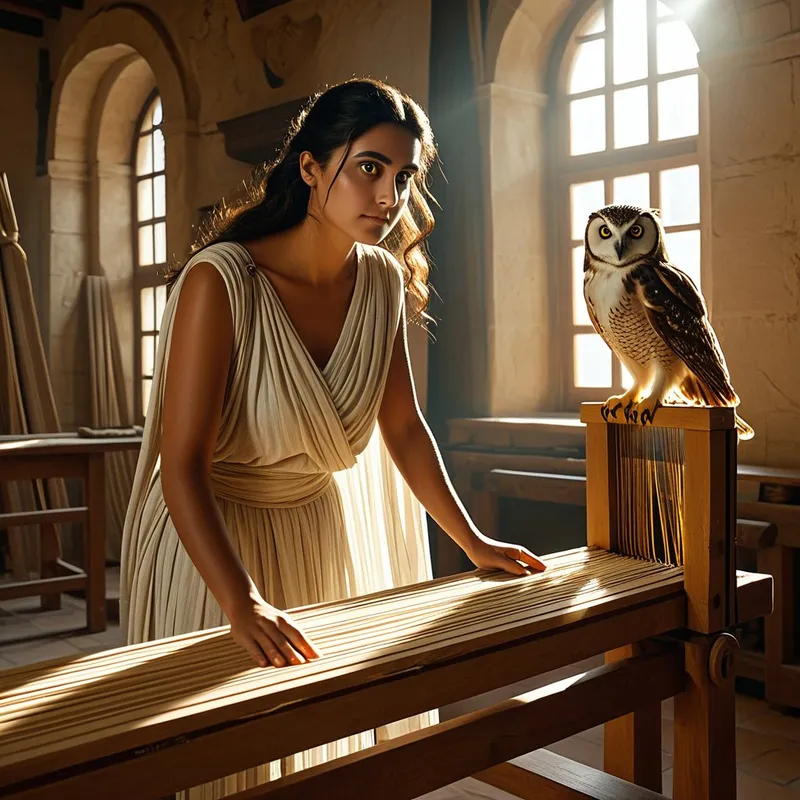
- The Loom: The primary symbol. The vertical warp threads represent the unchanging laws, principles, and structures (cosmic order, logos). The horizontal weft is the dynamic, creative impulse of the individual, the unique life-thread. Weaving is the act of integrating the two into a coherent, beautiful whole—a life, a work, a self.
- The Owl (Glaux): Not merely a symbol of wisdom, but of wisdom that sees in the dark. It represents the insight needed to navigate the shadowy, unconscious materials of one's craft—the hidden flaws in the clay, the subconscious patterns driving one's art, the unspoken truths one tries to shape.
- The Simple Peplos (not Armor): As Ergane, she often sheds the aegis. This signifies that the work here is not defensive warfare but vulnerable creation. It is the courage to be exposed in the act of making, without the armor of perfectionism or ego.
True creation is not an act of imposing will upon chaos, but of entering into a conscious dialogue with the inherent patterns of the materials—both without and within.
The psychological core is the transformation of raw, often frustrating, life energy (libido) into disciplined, meaningful form. The "contest" with Arachne, in its deepest reading, is not a petty rivalry but the inevitable inner conflict between divine inspiration (Athena) and human hubris (Arachne's claim to unaided, self-generated skill). The myth warns that skill divorced from reverence—from connection to a transpersonal source of order—becomes a spider's trap, a self-referential web that ultimately ensnares the creator.

The Dreamer's Resonance
When the pattern of Athena Ergane stirs in the modern dreamscape, it signals a profound engagement with the process of individuation through craft. The dreamer may not dream of the goddess directly, but of her symbolic landscape.
You might dream of a complex, beautiful machine or instrument you must learn to operate, feeling both awe and frustration. This is the psyche presenting the "loom" of a new skill, relationship, or life phase. The dream calls for patient apprenticeship to its logic. Another common motif is tangled threads, knotted cords, or a mess of wires that must be patiently sorted. This somaticizes a feeling of psychic or creative blockage. The hands in the dream, struggling yet determined, are the ego learning the Ergane principle: order is not forced, but discovered through attentive, repetitive engagement.
Dreams of forging a tool, writing in an unknown but beautiful script, or shaping a vessel that keeps collapsing point directly to the alchemical stage of nigredo—the blackening, the frustrating first attempts where the material resists. The presence of an owl observing quietly, or a calm, authoritative female figure who offers a single, precise correction, is the archetypal aid arriving. The dream is orchestrating the inner encounter with the guiding, formative principle of the Self, teaching the ego how to cooperate with a wisdom greater than its own to shape a life of authentic, skillful expression.
Alchemical Translation
The myth of Athena Ergane is a precise manual for the alchemical opus, the great work of soul-making. It models the process of psychic transmutation from base matter (unconscious potential, raw talent, chaotic life experience) into the philosophical gold (a coherent, skillful, and meaningful life).
- Calcinatio (The Firing): This is the initial, often painful, engagement with the raw material—the decision to write the book, learn the craft, face the therapy, build the relationship. It is the heat of effort, the sweat and tears of early failure, the burning away of the fantasy of easy genius. Athena does not spare the mortal this fire; she meets them within it.
- Coagulatio (Giving Form): This is the core Ergane process. The fiery, volatile energies are given a forma, a pattern. The repetitive, disciplined practice—the daily writing, the deliberate communication, the mindful attention—acts as the loom. Through this conscious, repetitive action (opus contra naturam), the scattered contents of the psyche begin to coalesce into a recognizable shape, a nascent skill, a forming character.
- Sublimatio (Elevation): The final stage is not an escape from the material, but its transcendence within the material. The crafted object—the finished poem, the healed relationship, the mastered skill—is no longer just a poem or a skill. It has become a vessel of meaning, a symbol of the inner transformation achieved. The labor itself is sanctified. The weaver is woven into a larger tapestry; the potter is shaped by the clay. The individual, through devoted work on their specific ergon, realizes their unique thread in the grand pattern of the Self.
Individuation is the craft of weaving the thread of one's singular life—with all its knots, breaks, and unique color—into the eternal warp of the archetypal pattern, until the weaver and the weave become one.
To invoke Athena Ergane is to commit to this sacred, frustrating, and glorious work. It is to ask not for a finished product, but for the patience to learn the loom, the courage to face the tangled threads of one's own nature, and the wisdom to see, at last, the divine pattern emerging from the humble work of one's own hands.
Associated Symbols
Explore related symbols from the CaleaDream lexicon: