Athena & Arachne Myth Meaning & Symbolism
A mortal weaver's supreme skill challenges a goddess, leading to a contest of divine and human artistry that ends in a fateful, eternal transformation.
The Tale of Athena & Arachne
Hear now a tale spun not from wool, but from fate itself, a story woven on the loom of the world. In the land of Lydia, there lived a maiden named Arachne. She was not of noble birth, her father a simple dyer of cloth, yet her fingers held a magic all their own. When she sat before the loom, the world held its breath. Her shuttle flew like a hummingbird, her threads danced. She wove tapestries so lifelike that nymphs would leave their streams to gaze upon meadows they thought were real, and birds would peck at the woven grapes. From every corner of Hellas, people came to watch her work, whispering that not even Athena, patron of weavers, could match her.
The whispers, carried on the wind, reached the gleaming halls of Olympus. Athena, the gray-eyed goddess, she who had sprung fully formed from the mind of Zeus, heard them. Her heart, a blend of divine wisdom and immortal pride, stirred. Disguising her radiance in the cloak of a frail, grey-haired old woman, she descended to Lydia. She found Arachne in her courtyard, the air thick with the scent of dyed wool and the rhythmic clack-clack of the loom.
“Child,” the crone rasped, “your skill is a gift from the gods. Give praise to Athena, lest your hubris invite her wrath.”
Arachne did not look up from her work. “If Athena’s skill is greater, let her come and prove it. My talent is my own.”
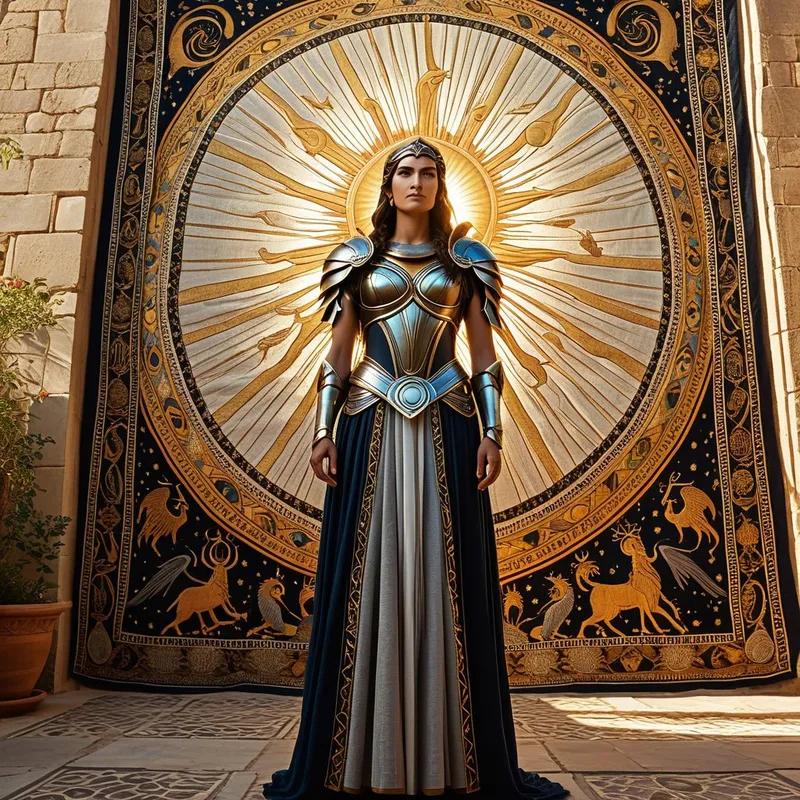
At this, the disguise fell away like mist. A blinding light filled the courtyard. There stood Athena, tall and terrible in her armor, her gaze like polished spearpoints. “You have been heard,” the goddess declared, her voice the sound of a city preparing for war. “You challenge me? Then let there be a contest. Let the looms decide.”
Two looms were erected side by side. The air crackled with tension. Athena began, her movements precise and grand. She wove the glorious, terrifying pageant of the gods: the twelve Olympians in their majesty, Gaia at their feet, and in the four corners, four scenes of mortals who had dared defy the gods and been transformed into mountains, birds, and stones—a dire warning woven in thread of gold.
Arachne, her face pale but set, began her own work. Her tapestry was a masterpiece of audacity. She depicted the gods not in glory, but in deception. There was Zeus, a swan, a bull, a shower of gold, pursuing mortal lovers. There was Poseidon in his guises, Dionysus in his revels. Each scene was a masterpiece of technique, breathtaking in its beauty, devastating in its insolence. It was perfect. It was flawless. It was an indictment.
The work done, both weavers stepped back. Even Athena, in the cold furnace of her anger, could find no flaw in Arachne’s technical skill. The mortal had, indeed, matched the goddess. But the content was a blasphemy that could not be borne. The goddess’s wrath, cold and sharp, finally broke. She tore the magnificent, offending tapestry to shreds. Then, with her shuttle of boxwood, she struck Arachne once, twice, three times upon the brow.
A profound shame, hotter than any anger, flooded Arachne. She could not bear the weight of the goddess’s judgment, nor the ruin of her own pride. She fashioned a noose from a strand of her own thread and sought to hang herself from a rafter.
But Athena was not done. “Live,” the goddess commanded, her voice softening with a pity that was itself a punishment. “But you and your descendants shall hang forever, forever weaving.” As she spoke, she sprinkled Arachne with the juices of a magical herb. The maiden’s body shrank and contorted. Her hair fell out, her nose and ears vanished. Her limbs grew long and thin. She was transformed into the first spider, condemned to spin and hang from her own thread for all time, a weaver eternally creating from her own essence.
Cultural Origins & Context
This potent myth comes to us primarily from the Roman poet Ovid, in his epic Metamorphoses. While Ovid was Roman, the tale is deeply Greek in its ethos, reflecting core tensions in Hellenic society. It is a story told not just about art, but about the social and cosmic order. In a culture where the boundary between mortal and divine was the ultimate law, Arachne’s sin was not merely pride (hubris), but the mortal assertion of absolute, autonomous skill. The myth served as a cautionary tale about the limits of human endeavor and the necessity of piety (eusebeia). It was a narrative tool to reinforce the hierarchy of the cosmos: gods create; mortals, at best, emulate with gratitude. The loom itself was a central cultural artifact, a symbol of feminine virtue, domestic order, and narrative itself—to “spin a yarn.” This story, likely shared in symposia and by traveling storytellers, wove together lessons about respect for the gods, the dangers of unchecked talent, and the paradoxical divine punishment that is also a form of preservation.
Symbolic Architecture
At its core, this myth is an archetypal confrontation between the established, ordering principle of consciousness and the raw, brilliant, and subversive power of the instinctual psyche.
Athena represents the ego in its highest, most cultured form: wisdom, strategy, civic order, and sanctioned creativity. She is consciousness that has successfully separated from the primal chaos (born from Zeus’s head). Her weaving is cosmogonic—it creates and upholds the official, hierarchical world.
Arachne symbolizes the genius of the shadow and the anima/animus. Her skill is innate, untutored, and eruptive. She does not create the official story; she reveals the hidden, often scandalous, narrative that underpins it—the desires, deceptions, and passions of the gods (the archetypal forces themselves). Her tapestry is not of order, but of truth, however uncomfortable.
The contest is not between good and evil, but between the official version of the Self and its repressed, brilliant, and defiant shadow.
The transformation into a spider is the ultimate symbolic act. It is not mere punishment, but a profound metamorphosis. Arachne is not destroyed; she is condensed into the pure essence of her nature. The spider weaves its web from its own body, a perfect metaphor for the individual who must, after a crushing encounter with a dominant authority (internal or external), retreat into the self to create a world entirely from inner substance. The web is both a trap and a masterpiece, a self-made universe and a prison of one’s own identity.
The Dreamer’s Resonance
When this myth pattern stirs in the modern dreamscape, it signals a critical juncture in one’s creative or professional life. To dream of a weaving contest suggests an intense inner conflict between one’s authentic, possibly rebellious voice (Arachne) and an internalized, critical authority figure (Athena)—be it a parent, a societal expectation, or one’s own rigid superego.
Dreaming of tearing a beautiful, intricate creation may point to a somatic experience of self-sabotage, where the dreamer’s conscious mind rejects a profound but uncomfortable truth emerging from the unconscious. Dreaming of transforming into, or being trapped in, a web signifies a feeling of being caught in the very patterns of one’s own genius or neurosis, spinning endlessly from one’s own psyche without connection to the outer world. The dream may carry sensations of constriction in the throat or chest (the noose, the hanging), pointing to stifled expression and a profound fear of being judged for one’s deepest insights or talents.
Alchemical Translation
The alchemical journey modeled here is the nigredo to coagulatio of the creative spirit. The brilliant, naive talent (Arachne’s initial pride) must confront the crushing, authoritative reality principle (Athena’s judgment). This confrontation is the necessary death—the tearing of the tapestry, the strike of the shuttle. The ego’s grand, rebellious project is dismantled.
The path to individuation often requires the humiliating descent from a hubristic peak into a condensed, animal-state of being, where one learns to create not for glory, but from sheer, instinctual necessity.
The suicidal impulse is the old identity’s desire to escape the unbearable tension of this confrontation. But the goddess—the Self, the greater psychic totality—intervenes. The transformation into the spider is the coagulatio, the coagulation of the soul into a new, durable form. The dreamer is forced inward, to spin a world from their own substance. No longer seeking to best the gods (external validation, parental approval, societal acclaim), the individual learns to create the web of their own life from the silken thread of their unique experience and perspective. The web is the new, authentic identity structure: fragile, self-made, intricate, and functional. It is a life of artistry born not of defiance alone, but of a hard-won, isolated self-containment. One becomes, eternally, both the weaver and the woven, the artist and the artifact, suspended in the tension of one’s own creation. This is the individuated creator: no longer in contest with the world, but having become a world unto themselves, forever spinning the delicate, strong, and beautiful pattern of their own fate.
Associated Symbols
Explore related symbols from the CaleaDream lexicon: