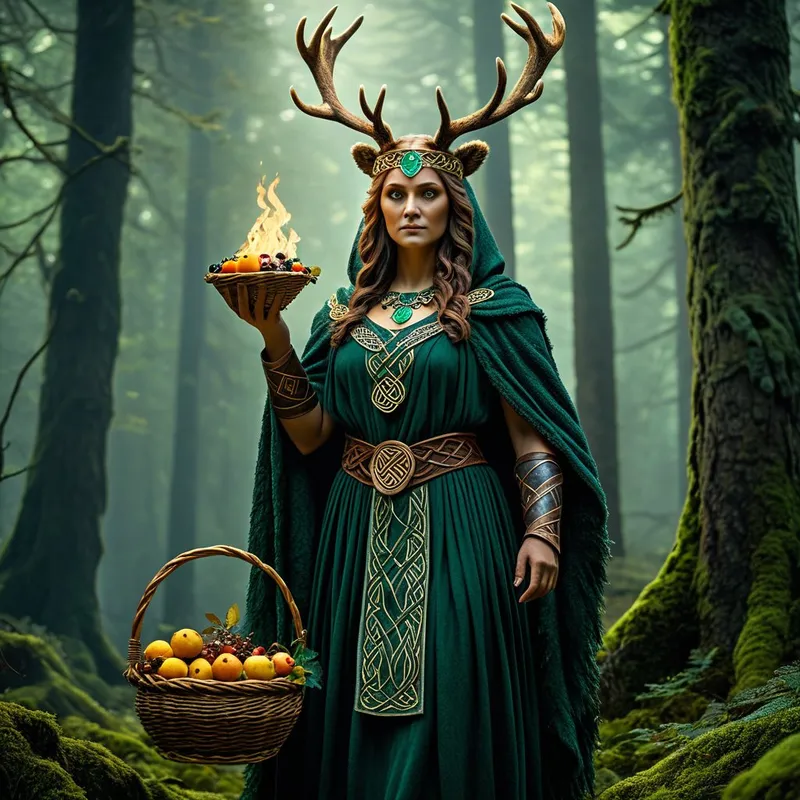
Artio Myth Meaning & Symbolism
The myth of Artio, the Celtic bear goddess, reveals the sacred cycle of withdrawal, fierce guardianship, and the soul's seasonal transformation.
The Tale of Artio
Listen. The forest holds its breath in the deep time between the fiery death of autumn and the tentative birth of spring. The air is a sharp blade of frost, and the world sleeps beneath a blanket of silence. But in the heart of the Nemeton, in a chamber of earth and root, a great power stirs. Not in fury, but in the profound, slow rhythm of a dream.
She is Artio. She is the shape of the mountain’s shadow and the softness of the den’s dark. Her form is the great brown bear, fur thick with the scent of pine and loam, claws that have turned the earth and felled the rotten tree. Yet in her eyes, which gleam like pooled dark water in the cave’s gloom, there is a knowing that is not animal alone. She is the guardian of the deep, cyclical truth: that to possess great strength, one must first know profound rest.
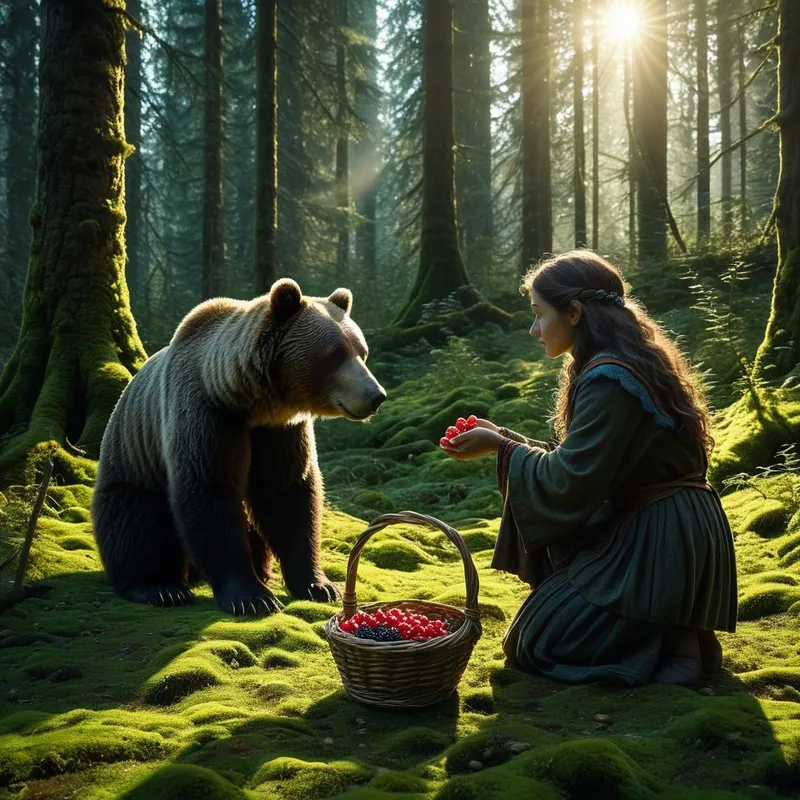
The story is not one of epic battle, but of sacred encounter. A hunter, perhaps, or a lost soul drawn by the forest’s whisper, stumbles upon her clearing. Not the empty, sleeping winter wood, but a pocket of impossible abundance. Here, the last autumn berries glow like jewels, nuts lie unclaimed, and the air is warm with the exhalation of the earth itself. And there She is. Not as a sudden terror, but as a monumental presence, seated, watching. A basket of plenty rests beside her massive paw.
Fear turns the blood to ice. The instinct is to flee, to raise a weapon, to become the aggressor in the face of such awesome, quiet power. But the myth whispers a different command: Be still. See. The hunter’s breath steadies. He meets her gaze—an eternity held in a moment. He does not take from the basket; he understands it is an offering, a test of perception. He lowers his head, not in submission, but in recognition. He sees the goddess in the beast, the provider in the predator, the deep, dreaming soul of the wild itself.
And in that seeing, the alchemy occurs. The fierce guardian does not rise in wrath, but in acknowledgment. A low rumble, not a growl, but the sound of a mountain settling. She accepts his presence. The contract is sealed not in words, but in shared breath in the sacred grove. He leaves, not with a trophy, but with a truth etched upon his spirit: that he is part of the cycle, subject to its laws of retreat and return, of fierce protection and gentle abundance. The forest releases him, and Artio returns to her dreaming watch, the cycle holding, complete.
Cultural Origins & Context
The figure of Artio comes to us not through a continuous bardic epic, but through potent, fragmented whispers from the Celtic world, primarily the lands of the Helvetii. Her most direct evidence is a remarkable stone inscription and statuette from Muri, near Bern, Switzerland—a region whose very name may derive from the Celtic word for bear, bero. This artifact shows a seated female figure with a basket of fruit facing a large bear. The inscription reads, "ARTIONI BEDE," or "To Artio, the (goddess) of the Bear-People."
This was not a myth for grand temples, but a deeply localized, immanent deity of the forested landscape. She was likely venerated by communities whose lives were intimately tied to the rhythms of the bear and the bounty of the untamed wood. Her worship was practical and profound. She governed the terrifying and awe-inspiring reality of the bear: an animal of immense power that could provide nourishment (from its hunted meat, from the berries it led one to) and sudden, violent death. She was the spirit of the wild larder and its fierce warden. Storytellers, perhaps hunters or elders of the tribe, would have recounted encounters with her spirit to explain the rules of the wild: respect, reciprocity, and the sacredness of the cycle of hibernation and emergence.
Symbolic Architecture
Artio is not a goddess of distant Olympus, but of the immediate, breathing earth. Her symbolism is an architecture of paradox, built on the foundational truth of nature’s cycles.
The bear does not conquer winter; she becomes it. Her victory is not in battle, but in the profound surrender to the dark, where all transformation is seeded.
First, she embodies the Sacred Cycle. The bear’s hibernation is not mere sleep; it is a voluntary descent into the underworld of the self, a death-like state from which new life emerges. Artio models this essential rhythm: withdrawal, gestation, and empowered return. This is the pattern of creativity, of grief, of any deep psychological process.
Second, she represents the Unity of Opposites. She is the nurturing provider (the basket of fruit) and the fearsome protector (the bear’s form). She holds the tension between abundance and ferocity, between the life-giving forest and the dangerous wild. She is the mysterium tremendum et fascinans made flesh—we are both drawn to her bounty and terrified of her power.
Finally, she is the Guardian of the Deep Self. Her den is the collective unconscious. To encounter her is to encounter the instinctual, untamed, and profoundly wise aspect of the psyche that modern life often seeks to suppress or ignore. She guards the raw, potent energy of our own nature.

The Dreamer's Resonance
When the pattern of Artio stirs in the modern dreamer, it often signals a necessary, instinct-driven turning point in the soul’s season. To dream of a bear, especially a she-bear, or of a deep, earthy cave, is to receive a summons from this archetype.
Somatically, one might feel an overwhelming urge to retreat, to "hibernate"—a profound fatigue that is not illness but a calling inward. There may be cravings for dense, earthy foods, a longing for silence, or a visceral need for the comfort of darkness and blankets. Psychologically, this is the psyche enforcing a necessary withdrawal from external demands to attend to an inner process. Conversely, dreams of a bear emerging from a cave, or a protective, fierce maternal presence, often coincide with a period of re-emergence. The dreamer is integrating a powerful, previously dormant strength and is ready to defend a newly established boundary or a vulnerable, creative offspring (a project, a relationship, a new self-concept). The bear in the dream is rarely attacking; it is presenting. The emotional tone—awe, calm fear, profound peace—reveals whether the dreamer is in conflict with or in alignment with this deep instinctual self.
Alchemical Translation
The myth of Artio provides a non-linear, cyclical map for the alchemical process of individuation. It models psychic transmutation not as a heroic slaying of dragons, but as a sacred surrender to organic rhythm.
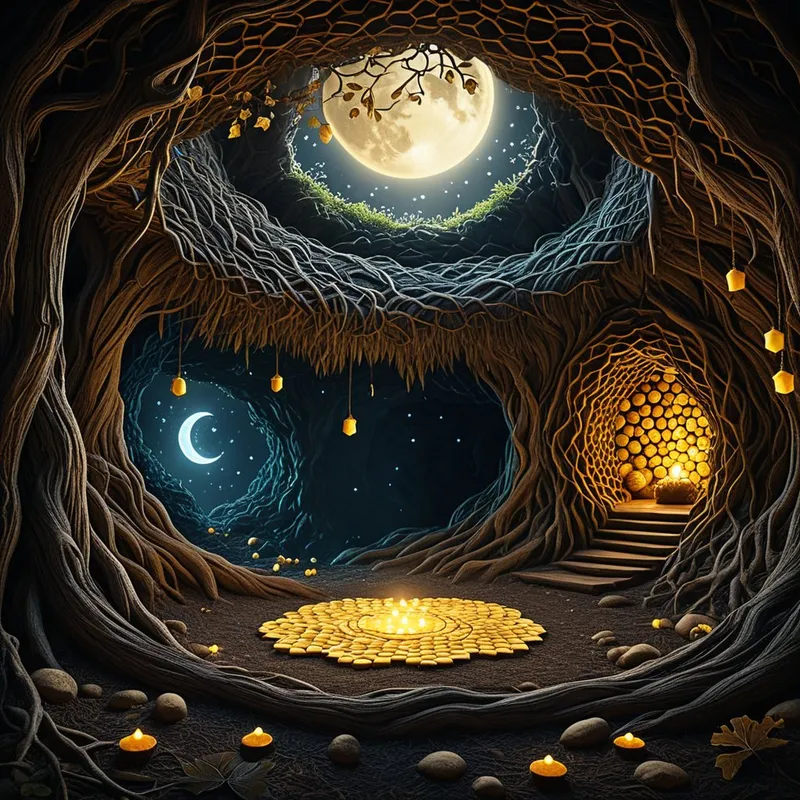
The first alchemical stage, the nigredo, is Artio’s hibernation. It is the necessary descent into the "black earth" of the psyche, the depression, the confusion, the void where old identities break down. This is not failure, but the crucial first step of the cycle. The ego must consent to this dissolution, to enter the cave.
The alchemical vessel is not the flask of the laboratory, but the dark, warm den of the soul, where the heat of introspection works in silence.
The albedo is the quiet clarity found in the den, the moment of recognition between the hunter and the goddess. It is the insight that emerges from stillness: the realization that the fierce, instinctual self (the bear) is not an enemy to be slain, but a guardian to be recognized and integrated. The basket of fruit is the symbol of this new, nourishing consciousness born from the encounter.
Finally, the rubedo is the empowered return. It is Artio as the integrated archetype: the individual who emerges from their period of retreat with a fierce, protective love for their own authenticity and a nurturing capacity to feed their world from a place of deep, cyclical wisdom. The strength is no longer brute force, but the formidable, grounded power of one who knows the seasons of their own soul and guards its sacred grove accordingly. The transmutation is complete when the cycle is honored—knowing that after the emergence, in its own time, will come again the sacred call to the nourishing dark.
Associated Symbols
Explore related symbols from the CaleaDream lexicon: