Arjuna's Practice Myth Meaning & Symbolism
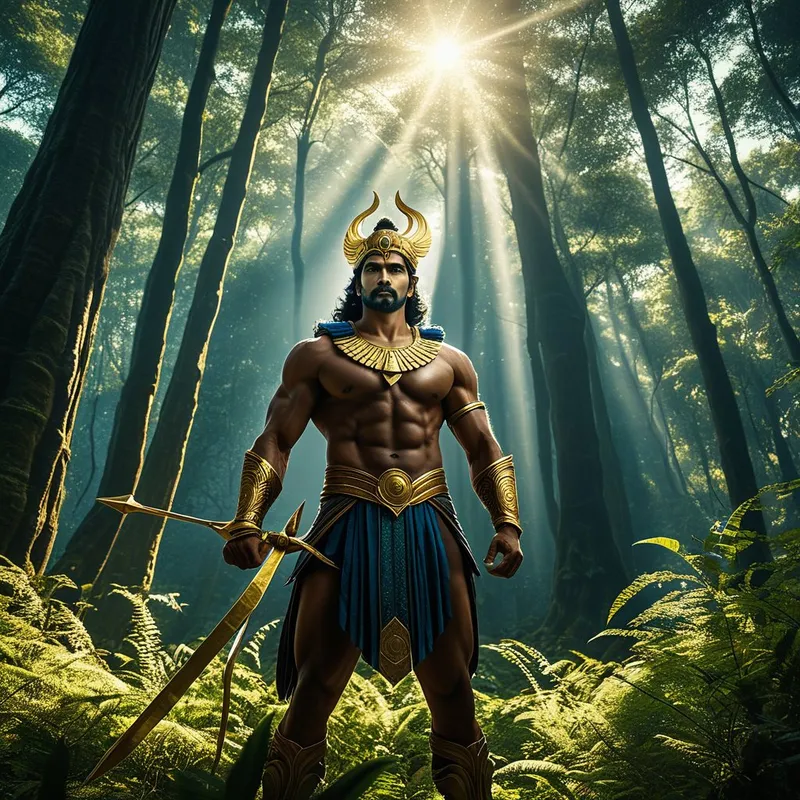
The Pandava prince Arjuna, through unwavering focus, sees only the eye of a wooden bird, earning the ultimate boon of divine vision from his guru Drona.
The Tale of Arjuna's Practice
Listen, and let the silence of the ancient forest settle upon you. The air in the gurukula is thick with the scent of damp earth and flowering ashoka. Here, under the watchful gaze of the great teacher Dronacharya, the young princes of the Kuru dynasty stand poised, their bows like extensions of their own taut spirits.
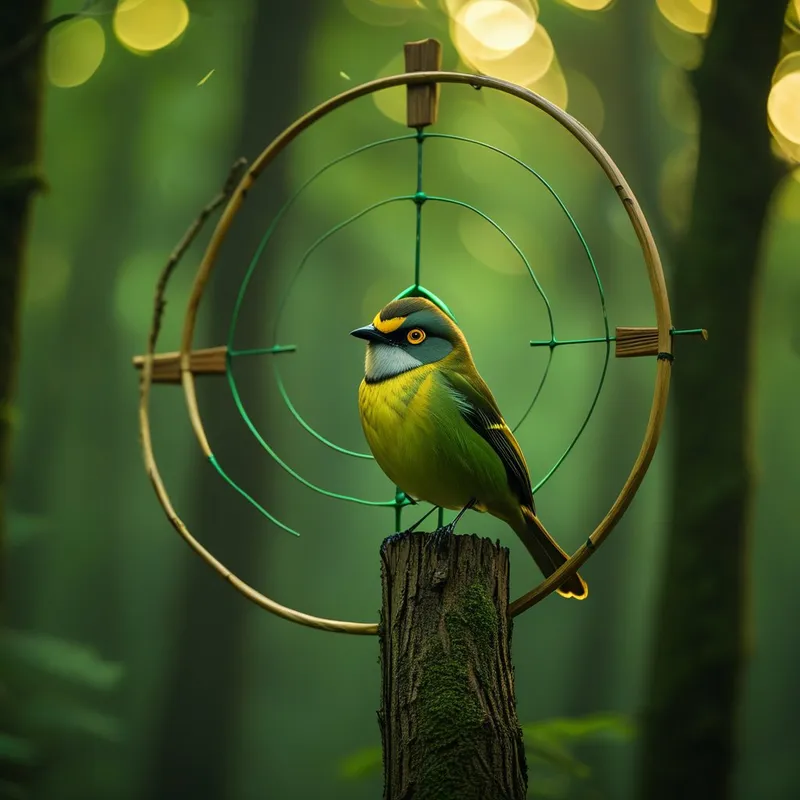
Drona, his form as still as a mountain, has devised the ultimate test. High upon the branch of a great tree, he has placed a wooden bird. Its body is carved, its wings still, but its eye is painted with lifelike precision. “Take your bows,” Drona’s voice cuts the stillness. “Aim. Tell me what you see.”
The first prince steps forward, the eldest of the Kauravas. He nocks his arrow, the string creaking. “I see the bird, Gurudeva,” he declares. “I see the tree, the leaves, the sky beyond.” Drona’s face is a mask of stone. “Lower your bow. You see nothing.”
One by one, the princes come. Each describes the forest, the branch, the bird’s plumage, the clouds. Each is sent away with a silent shake of Drona’s head. The world is too much with them; their vision is cluttered with creation.
Then steps forward Arjuna. His movement is not a movement but a transition into a different state of being. The forest sounds—the chirp of crickets, the rustle of leaves—fade into a distant hum. The vibrant greens and browns of the grove soften into a monochrome haze. He draws the bowstring to his cheek, the weight of the world falling from his shoulders. His breath becomes the wind.
“What do you see, Arjuna?” Drona asks, his voice now a whisper from another realm.
Arjuna’s eyes are locked ahead, unblinking. “I see only the eye of the bird.”
“Do you see the tree? The branch? The sky?”
“No, Gurudeva. Only the eye.”
A profound silence, deeper than before, blankets the clearing. It is the silence of a universe condensed into a single point. “Release,” Drona commands.
The arrow does not so much fly as it manifests at its destination. There is no sound of impact, only the sudden, perfect vacancy where the wooden eye had been. The bird remains, untouched but for the vanished pupil. Arjuna lowers his bow. The world floods back in—color, sound, the feel of the earth beneath his feet. But he is changed. In that moment of absolute focus, he has passed through a doorway. Drona smiles, a rare sunbreak. He has found his disciple, the one whose consciousness can become a single, flawless arrow aimed at the heart of truth. This is not the end of practice, but its true beginning. The boon granted is not just skill, but a new faculty of sight.
Cultural Origins & Context
This episode is nestled within the vast epic of the Mahabharata, a foundational text of Hindu culture composed over centuries, likely between 400 BCE and 400 CE. It functions as a shiksha, an instructional parable within the larger narrative of princely education and dharma. Recited by bards and learned scholars, this story was not merely about archery but about the pedagogy of excellence. It was told to young students in gurukulas and to courtly audiences as an exemplar of the guru-disciple relationship and the qualities required for mastering any sacred art—be it statecraft, music, or spiritual practice.
Its societal function was multifaceted. It reinforced the hierarchical yet deeply personal bond of the guru-shishya parampara (teacher-disciple lineage), where the guru’s role was to perceive and cultivate the latent potential within the student. It also established a cultural ideal: supreme achievement is born not from brute force or even innate talent alone, but from a psycho-spiritual discipline that filters the cosmos down to a singular point of purpose. Arjuna, as the model disciple, embodies the ideal of ekagrata (one-pointedness), a concept central to both Yogic and early educational philosophies.
Symbolic Architecture
The myth is a pristine map of consciousness in pursuit of a transcendent goal. Every element is an archetypal symbol.
The Wooden Bird is not a living creature but a crafted object, a symbol of the conceptual target. It represents any idealized goal—enlightenment, mastery, a life’s purpose—that is static, defined, and set apart from the flow of ordinary life. Its Eye is the bindu, the dimensionless point. In Hindu cosmology, the bindu is the source from which all creation expands. Here, it is the singular aperture through which the infinite must be perceived.
Drona, the guru, is the personification of discerning consciousness. He does not create the target nor the archer’s skill; he creates the condition for revelation. His question, “What do you see?” is the eternal question posed by the Self to the ego. The other princes represent the distracted, worldly mind (manas), which perceives relationships, contexts, and comparisons—the tree, the sky, the bird’s body. They see everything about the goal except the goal itself.
Arjuna’s declaration, “I see only the eye,” is the moment the individual will aligns completely with the objective reality of the target. It is the death of the peripheral self.
Arjuna here is the purified instrument. His success is not an act of willpower over distraction, but the total dissolution of distraction into the field of awareness. The Arrow is the realized action that flows from this state. It is not “his” arrow any longer; it is the inevitable consequence of correct perception, as natural as a fruit dropping from a ripe branch. The practice (abhyasa) is the alchemical process by which the archer, the bow, the arrow, and the target cease to be separate entities and become a unified event.
The Dreamer's Resonance
When this myth stirs in the modern unconscious, it rarely appears as an epic forest scene. Instead, it manifests as dreams of radical, tunnel-vision focus. You may dream of staring at a single point on a blank page until the rest of the world dissolves, or of hearing a constant, faint hum that demands all your attention, pushing other sounds into oblivion. You might dream of trying to complete a task—threading a needle, solving a puzzle—while voices and shadows clamor at the edges of your perception, and a profound relief floods you only when you finally stop hearing them.
Somatically, this dream pattern correlates with a psychological process of convergence. The dreamer is likely at a crossroads, overwhelmed by options, opinions, responsibilities, and the noise of their own internal committee. The psyche is attempting to initiate a healing contraction, a pulling-in from diaspora to a sovereign center. The anxiety in the dream is the resistance of the ego, which clings to its identity as a complex, multi-tasking entity. The resolution—the moment of pure focus—is the somatic recognition of the soul’s true capacity: to choose one thing and, in that choice, become whole. It is the dream of shedding the burden of multiplicity.
Alchemical Translation
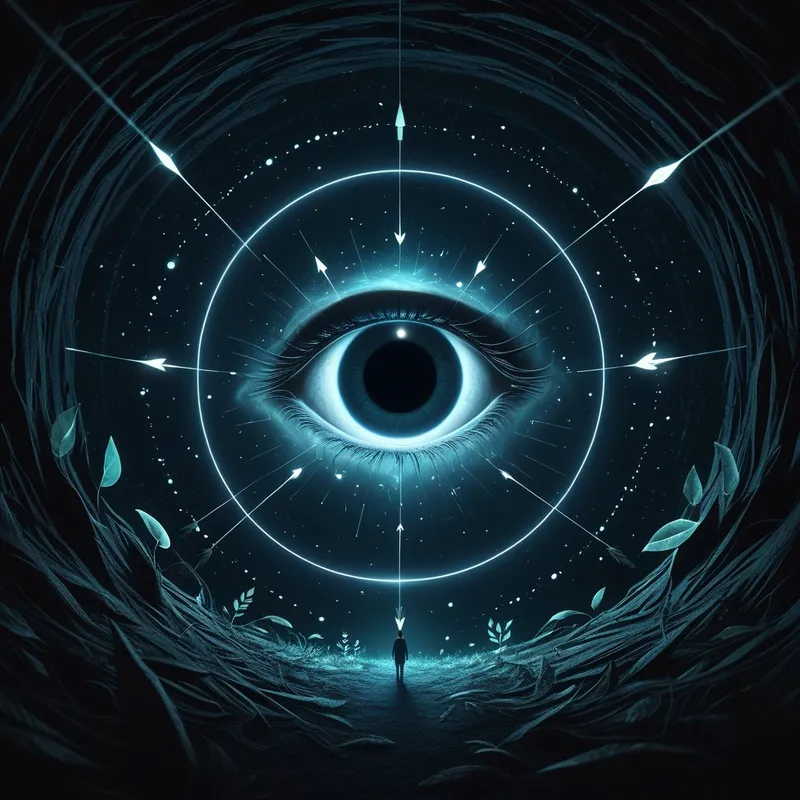
The alchemy of Arjuna’s practice is a master model for the Jungian process of individuation—the journey toward becoming an integrated, undivided Self. The scattered princes represent the fragmented psyche, the complex of personas, shadows, and archetypal energies that pull us in a dozen directions. Drona represents the inner Self, the inner guru that knows our central purpose but can only guide us when we learn to listen to its specific, pinpoint question.
The first stage of this inner alchemy is Withdrawal. This is not escapism, but the conscious, disciplined decision to pull back psychic energy (libido) from the myriad attachments and diversions of the personal and collective world—the “tree” and the “sky.”
The second, crucial stage is Definition. One must craft or discern the “wooden bird”—the symbolic goal of the individuation process. This is not a worldly ambition, but an image of wholeness, perhaps encountered in dreams or active imagination. It must be clear and distinct.
The core transmutation occurs in the third stage: Unification of Perception. Here, one must practice seeing only the eye of the goal. Psychologically, this means allowing all other identities—the successful professional, the wounded child, the critical parent—to blur into the background. In their place, only the central, calling image of the Self remains in sharp focus.
From this unified perception flows the fourth stage: Action as Emanation. Action is no longer a struggle of will against resistance. It becomes an emanation, as effortless and true as Arjuna’s arrow. In life, this translates to decisions and creations that feel inherently right, necessary, and free from the paralysis of conflict. The practice is never truly over; it is the continual return to the one point, the eye of the bird, through the daily discipline of choosing essence over noise. We become, like Arjuna, not just heroes of action, but sovereigns of our own attention.
Associated Symbols
Explore related symbols from the CaleaDream lexicon: