Arjuna's Celestial Journey Myth Meaning & Symbolism
The warrior Arjuna ascends to the celestial realm of Indra, undergoing trials to master divine weapons and confront the paradox of his own heroic destiny.
The Tale of Arjuna's Celestial Journey
The earth still trembled from the cataclysm at Khandava. Arjuna, the peerless archer, stood amidst the ashes, his limbs heavy with a victory that felt hollow. The fire-god Agni was sated, but a deeper hunger gnawed at the warrior’s soul—a thirst for a power that could not be found on any earthly battlefield. It was then that the sky, a bruised purple, began to pulse. The air grew thick with the scent of ozone and lotus. A chariot descended, not of wood and iron, but of light and intention, drawn by steeds that breathed clouds. Its driver was Indra’s own charioteer, Matali. The message was a summons, not a request: “Come. Your father awaits.”
The ascent was a stripping away. The familiar greens and browns of the world fell away beneath him, replaced by the dizzying, endless blue of the firmament. The chariot pierced the veil of clouds, entering Amaravati, a realm where thought crystallized into form. Here, palaces floated on melodies, and rivers flowed with nectar. The Apsaras, like embodied desire, danced with a grace that made the heart ache. But their smiles held no warmth for Arjuna; they were ornaments of a paradise that was not yet his.
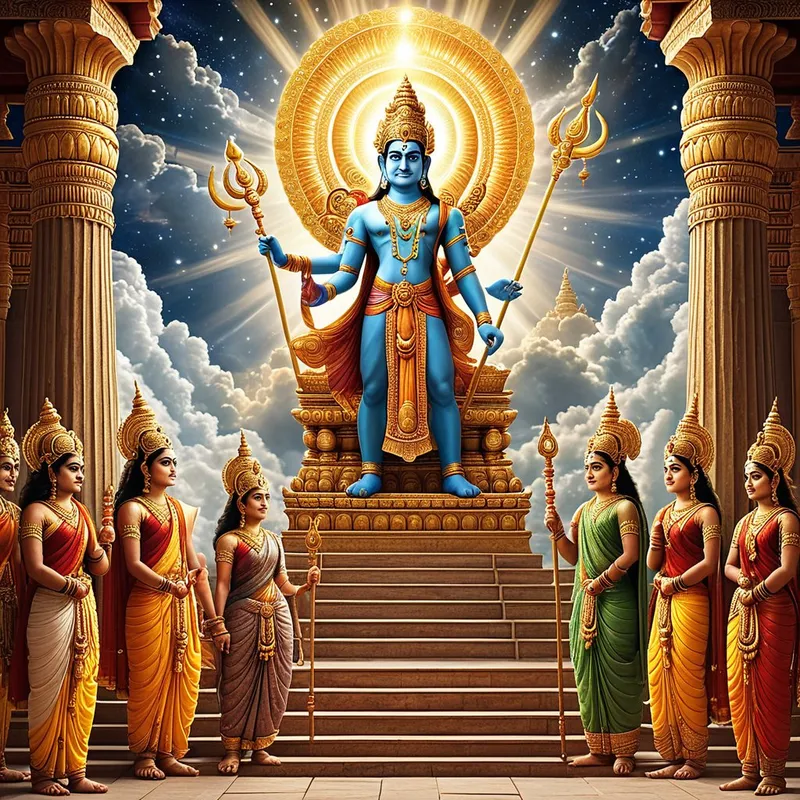
Indra, enthroned, was majesty incarnate. His form radiated a calm, terrible authority. “Welcome, my son,” the voice echoed, not in the air, but in the marrow. “Your valor on earth has earned you a greater test. Here, you will learn the arts of the gods.” The training was an ordeal of spirit. Celestial gurus taught him the songs that could summon storms and the mantras that could unmake mountains. He mastered weapons that hummed with their own consciousness: the Vajra, the Pasha, and others that defied mortal names. Yet, with each divine skill mastered, a profound loneliness grew. He was a stranger in heaven, a mortal among immortals, his human heart a dissonant note in the perfect symphony of paradise.
The test came not in war, but in music. The great Gandharva Chitrasena was sent to teach him the sacred arts of song and dance. In this softening, in this embrace of beauty for its own sake, Arjuna faced a subtler enemy: the seduction of eternal pleasure. To forget his earthly brothers, his sworn duty Dharma, and the looming shadow of the great war, would be the sweetest defeat. He walked the perfumed gardens, a warrior disarmed by beauty, wrestling with the ultimate temptation: to cease being a hero.
But the memory of his mother’s sorrow and his brothers’ exile was a tether he could not sever. He approached Indra, not as a supplicant, but as a prince claiming his inheritance. “I have learned the celestial arts. Now grant me the weapons for which I came. My place is not here, but on the field of Kurukshetra, where Dharma itself bleeds.” Seeing the unwavering fire of purpose in his son’s eyes, Indra smiled. He bestowed the final, terrible weapons and the divine bow Gandiva. The descent was not a fall, but a deliberate return. Arjuna rode the chariot back to earth, no longer just a mighty warrior, but a conscious instrument of the divine will, carrying heaven’s fury in his quiver and its unbearable loneliness in his heart.
Cultural Origins & Context
This episode is woven into the vast tapestry of the Mahabharata, specifically within the “Aranyaka Parva” (The Book of the Forest). Composed and refined over centuries, from roughly 400 BCE to 400 CE, the epic served as a cultural, philosophical, and cosmological encyclopedia for ancient Indian society. The story of Arjuna’s ascent would have been recited by traveling bards Sutas at royal courts and public gatherings, its auditory splendor painting the celestial realm in the minds of listeners.
Its societal function was multifaceted. On one level, it legitimized the superhuman prowess of the Pandava heroes, explaining the source of their seemingly impossible abilities in the coming war. On a deeper level, it modeled the Kshatriya Dharma ideal: even the greatest earthly hero must seek higher sanction and training. The journey to Indra’s court mirrors the Vedic concept of Yajna—a sacred endeavor where the aspirant (Arjuna) offers his earthly achievements to gain divine boons. It reinforced a worldview where the human and divine realms were in constant, permeable dialogue, and where individual destiny was a collaborative project between personal effort and grace.
Symbolic Architecture
Arjuna’s journey is a masterful map of the soul’s ascent from the personal to the transpersonal. He begins in the “ashes” of a completed, exhausting duty—a state of spiritual burnout where old victories lose meaning. The summons from heaven represents the call of the Self, the total, integrated psyche, often imaged as a divine parent (Indra).
The celestial realm is not a reward, but a crucible. It represents the world of archetypes—the pure, eternal forms of power, beauty, and knowledge that exist beyond our personal psychology.
Arjuna’s mastery of divine weapons symbolizes the ego’s arduous task of integrating powerful, autonomous complexes from the unconscious. These are forces (like rage, strategic intellect, or creative inspiration) that can possess us if not properly “wielded.” His training in the arts with Chitrasena is crucial; it represents the necessity of relating to these powerful forces not just with strength, but with sensibility, rhythm, and appreciation. The seduction by the Apsaras is the peril of inflation—of becoming identified with these archetypal energies and wishing to remain in the blissful, amnesiac state of the unconscious paradise, abandoning one’s individual life task.
His conscious decision to return, armed with divine tools but anchored by human duty, marks the successful negotiation. He does not become a god; he becomes a vessel for the divine.
The Dreamer's Resonance
When this myth stirs in the modern unconscious, it often manifests in dreams of vertiginous ascension: glass elevators shooting through skyscrapers, climbing endless staircases to unknown offices, or flying over alien yet strangely familiar cityscapes. The somatic feeling is one of both exhilaration and profound anxiety—the thrill of elevation coupled with the terror of leaving solid ground behind.
Psychologically, this dream pattern signals a critical phase of “ascent” in the dreamer’s life. This could be a promotion, a spiritual awakening, or the attainment of a long-sought skill or recognition. The conflict Arjuna faced is the dreamer’s conflict: the fear of being corrupted by success, of losing one’s authentic self in a new, rarefied identity (“the impostor syndrome” mythologized). The celestial pleasures that tempt Arjuna translate to the seductions of status, the narcissistic glow of admiration, or the desire to retreat into a bubble of privilege and disconnect from former bonds and responsibilities. The dream is asking: Now that you have reached this height, who are you? Will you be seduced by the view, or will you remember your purpose and bring the treasure back down?

Alchemical Translation
The alchemical process mirrored here is that of Sublimatio—the ascent of the spirit, the refinement of base matter into a higher, volatile state, followed by the essential Coagulatio—the return to solid, usable form. Arjuna is the prima materia, the skilled but unfulfilled warrior-ego. His journey to heaven is the heating and distillation in the alchemical vessel, separating the essential spiritual gold from the dross of mere earthly ambition.
Individuation is not about becoming divine, but about becoming responsibly human, using the transcendent perspective gained in the “heavens” to engage more fully with the “earth.”
The mastery of celestial weapons is the acquisition of psychological tools—perhaps the ability to set fierce boundaries (the Vajra), to bind chaotic impulses (the Pasha), or to articulate a clear life-aim (the arrows of Gandiva). The dance with the Gandharva is the development of eros, of relatedness and aesthetic sensibility, without which power becomes sterile and destructive. The ultimate alchemical gold is not a weapon, but discernment: the conscious choice to leave the paradise of unconscious identification and return to the flawed, conflict-ridden earthly realm—the field of Kurukshetra, which is our own daily life—and fight for what is right. Arjuna returns not as a perfected being, but as a conscious human, carrying the unbearable tension of being a bridge between two worlds. This is the model for our own psychic transmutation: to ascend in vision, but to descend in service, forging a personality capable of holding both the divine gift and the human burden.
Associated Symbols
Explore related symbols from the CaleaDream lexicon: