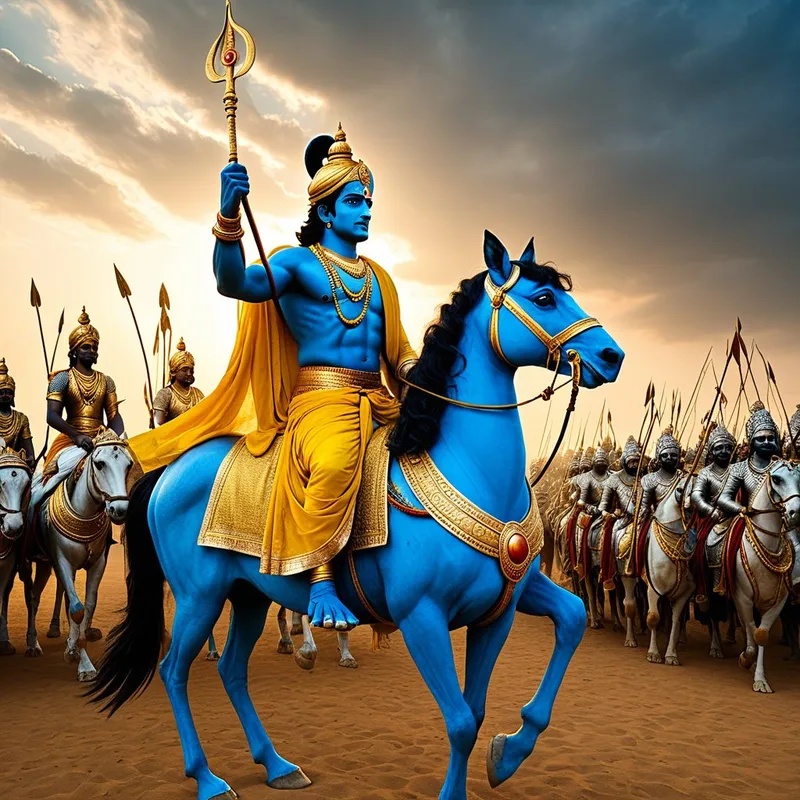
Arjuna and Krishna Myth Meaning & Symbolism
A warrior's crisis of conscience on a cosmic battlefield is resolved through divine dialogue, revealing the path of selfless, enlightened action.
The Tale of Arjuna and Krishna
Hear now the tale of the great tremor that shook a warrior’s soul, a tremor that echoed across the field of destiny. The air on Kurukshetra was thick with the scent of dust, sweat, and impending thunder. Two colossal armies, the Pandavas and the Kauravas, stood facing each other, a sea of glittering spears and silent fury. Conches blared, drums throbbed like the heartbeat of [the earth](/myths/the-earth “Myth from Hindu culture.”/) itself.
In the space between the armies stood a single chariot, yoked to white steeds. Within it stood [Arjuna](/myths/arjuna “Myth from Hindu culture.”/), the greatest archer of his age, his fingers tracing the curve of his divine bow, [Gandiva](/myths/gandiva “Myth from Hindu culture.”/). But his eyes, sharp enough to sever a bird in flight, were clouded. He looked across the field and saw not enemies, but faces: beloved uncles who sang him to sleep, revered teachers who taught him the art of war, dear cousins with whom he shared his youth. His charioteer, his friend, his cousin—[Krishna](/myths/krishna “Myth from Hindu culture.”/)—waited, hands resting lightly on the reins.
“Take me between the armies, O Keshava,” Arjuna commanded, his voice tight. “Let me see those who have gathered here, hungry for battle.”
Krishna, whose skin was the color of a rain-cloud and whose eyes held the depth of all creation, guided [the chariot](/myths/the-chariot “Myth from Tarot culture.”/) into the no-man’s-land. And there, in that terrible stillness before the storm, Arjuna’s valor crumbled. The bow slipped from his grasp. His limbs grew heavy, his mouth parched. A great wave of grief and confusion rose within him. “What victory can bring joy when it is purchased with the blood of my kin?” he cried. “I see only sin in the slaughter of my elders. I will not fight.” He sank onto the floor of the chariot, a hero undone by the vision of his duty.
And then, the charioteer spoke. But the voice was no longer that of a companion. It was the voice of the universe itself, gentle yet unmovable as a mountain. “You grieve for those who do not deserve grief,” said Krishna. “The wise do not mourn for the living or the dead.” Thus began a dialogue that would resonate for millennia. Krishna did not command; he revealed. He spoke of the eternal soul, the [Atman](/myths/atman “Myth from Hindu culture.”/), which is never born and never dies. He spoke of duty, [Dharma](/myths/dharma “Myth from Hindu culture.”/), the sacred order one must uphold.
He revealed his own cosmic form, the [Vishvarupa](/myths/vishvarupa “Myth from Hindu culture.”/)—a terrifying, magnificent vision of all time, all creation, and all destruction contained within a single body. Arjuna saw the cosmos being born and devoured in the fiery mouths of the God before him. He saw the warriors on the field already rushing into those mouths, their fates sealed by time’s relentless will. Humbled and awe-struck, Arjuna begged for the return of the familiar, four-armed form.
Finally, Krishna unveiled the path: not of inaction, but of action without attachment to its fruits. “Your right is to action alone, never to its results,” he declared. The charioteer’s lesson was complete. The conch sounded once more. Arjuna, his despair transmuted into clarity, his personal sorrow dissolved into a cosmic perspective, picked up Gandiva. The chariot of destiny rolled forward, and the war began—not as a massacre, but as the execution of a sacred, terrible duty, guided by divine wisdom.
Cultural Origins & Context
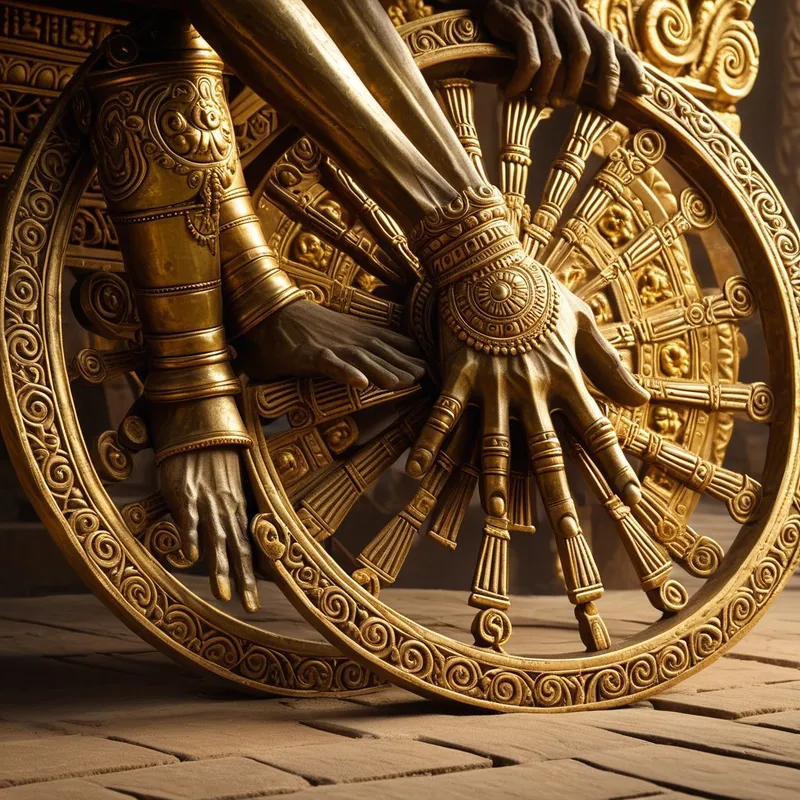
This dialogue forms the heart of the [Bhagavad Gita](/myths/bhagavad-gita “Myth from Hindu culture.”/), a text embedded within the epic Mahabharata. Composed in Sanskrit over centuries, likely between the 5th [century](/myths/century “Myth from Biblical culture.”/) BCE and 2nd century CE, the Mahabharata is a vast tapestry of history, philosophy, and mythology, recited by [bards](/myths/bards “Myth from Celtic culture.”/) known as sutas. The Gita itself is believed to be a later, profound philosophical interpolation into this narrative.
Its societal function was multifaceted. For the warrior Kshatriya class, it provided a theological justification for righteous war, resolving the tension between the principle of non-violence (Ahimsa) and the duty to protect Dharma. For the broader culture, it served as a concise guide to life, synthesizing the paths of knowledge (Jnana Yoga), devotion (Bhakti Yoga), and disciplined action ([Karma Yoga](/myths/karma-yoga “Myth from Hindu culture.”/)). It was not merely a story but a smriti (remembered) text, a living scripture passed down through guru-disciple lineages and public recitations, designed to guide individuals through life’s most paralyzing ethical dilemmas.
Symbolic Architecture
The myth is a perfect map of the [human](/symbols/human “Symbol: The symbol of a human represents individuality, complexity of emotions, and social relationships.”/) [psyche](/myths/psyche “Myth from Greek culture.”/) in [crisis](/symbols/crisis “Symbol: A crisis symbolizes turmoil, urgent challenges, and the need for immediate resolution or change.”/). Arjuna represents the individual ego, highly skilled and principled, yet utterly confounded when its personal morality clashes with the impersonal demands of [destiny](/symbols/destiny “Symbol: A predetermined course of events or ultimate purpose, often linked to spiritual forces or cosmic order, representing life’s inherent direction.”/) and cosmic law. The battlefield of Kurukshetra is not merely a geographical [location](/symbols/location “Symbol: The symbol of ‘Location’ signifies a sense of place, context, and the environment in which experiences unfold.”/); it is Dharmakshetra, the field of righteousness. It symbolizes the inner battlefield where our own conflicting duties, desires, loves, and loyalties wage war.
The chariot is the body; the senses are the horses; the mind is the reins. But he who has no understanding, whose mind is always uncontrolled, his senses are unmanageable, like the vicious horses of a charioteer.
Krishna, the charioteer, is the guiding principle of higher [consciousness](/symbols/consciousness “Symbol: Consciousness represents the state of awareness and perception, encompassing thoughts, feelings, and experiences.”/)—[the Self](/myths/the-self “Myth from Jungian culture.”/), the [Brahman](/myths/brahman “Myth from Hindu culture.”/) in personal form. He does not fight the battle for Arjuna; he steers him, providing the [perspective](/symbols/perspective “Symbol: Perspective in dreams reflects one’s viewpoints, attitudes, and how one interprets experiences.”/) needed for [the ego](/myths/the-ego “Myth from Jungian culture.”/) to act in alignment with a greater whole. His [revelation](/symbols/revelation “Symbol: A sudden, profound disclosure of truth or insight, often through artistic or musical means, that transforms understanding.”/) of the Vishvarupa is the shocking, awe-ful [moment](/symbols/moment “Symbol: The symbol of a ‘moment’ embodies the significance of transient experiences that encapsulate emotional depth or pivotal transformations in life.”/) when [the ego](/myths/the-ego “Myth from Jungian culture.”/) comprehends the vast, impersonal machinery of existence, of which its personal [drama](/symbols/drama “Symbol: Drama signifies narratives, emotional expression, and the exploration of human experiences.”/) is but a tiny, predetermined part.
The central teaching of Nishkama [Karma](/myths/karma “Myth from Hindu culture.”/)—[action](/symbols/action “Symbol: Action in dreams represents the drive for agency, motivation, and the ability to take control of situations in waking life.”/) without desire for reward—is the psychological key. It represents the [movement](/symbols/movement “Symbol: Movement symbolizes change, progress, and the dynamics of personal growth, reflecting an individual’s desire or need to transform their circumstances.”/) from a personal, ego-driven [identity](/symbols/identity “Symbol: Identity represents the sense of self, encompassing personal beliefs, cultural background, and social roles.”/) (“I am the doer, I will enjoy the fruits”) to an instrumental identity (“I am a channel through which duty is performed”). This dissolves [anxiety](/symbols/anxiety “Symbol: Anxiety in dreams reflects internal conflicts, fears of the unknown, or stress from waking life, often demonstrating the subconscious mind’s struggle for peace.”/), [despair](/symbols/despair “Symbol: A profound emotional state of hopelessness and loss, often signaling a need for transformation or surrender to deeper truths.”/), and the fear of sin, freeing the individual to act with supreme effectiveness and [peace](/symbols/peace “Symbol: Peace represents a state of tranquility and harmony, both internally and externally, often reflecting a desire for resolution and serenity in one’s life.”/).
The Dreamer’s Resonance
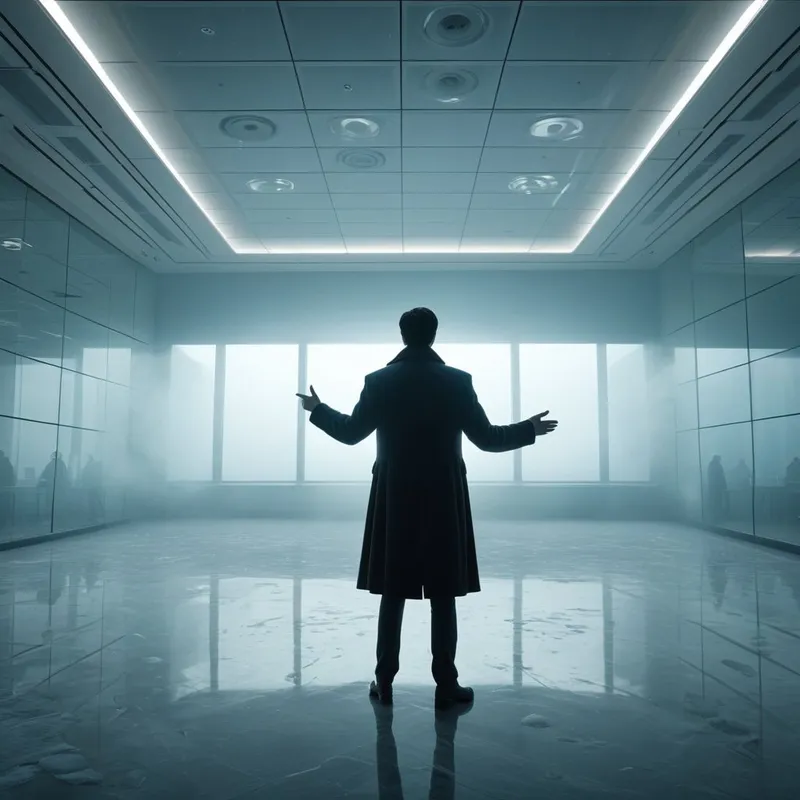
When this myth stirs in the modern dreamer, it often manifests as a dream of profound paralysis before a necessary but dreaded action. You may dream of standing at [the threshold](/myths/the-threshold “Myth from Folklore culture.”/) of a new career, a relationship ending, or a necessary confrontation, but your limbs are lead, your voice is gone. The “enemy” army may appear as a boardroom of colleagues, a family gathering, or even a chorus of your own self-doubts.
The somatic experience is one of collapse: the sinking feeling, the weakened knees, the literal “I can’t go on.” Psychologically, this is the ego’s identification with a partial, personal truth (“I must be kind/loyal/safe”) clashing with a more demanding, transpersonal imperative of growth or truth (“You must change/leave/speak”). The dream signals that the conscious attitude is stuck, and a deeper, guiding wisdom—the inner Krishna—must be consulted. The dream may introduce a calm, authoritative figure (a mentor, a stranger, even a knowing animal) who offers not a solution, but a shift in perspective, often pointing toward a larger context the dreamer has refused to see.
Alchemical Translation
The alchemical process modeled here is the transmutation of despair into enlightened action, the core of Jungian individuation. The “Kurukshetra” is the psyche itself, where the complex of personal attachments (the “kin” we must slay) wars against the call of the Self to evolve. Arjuna’s paralysis is the necessary [nigredo](/myths/nigredo “Myth from Alchemical culture.”/), the blackening, [the dark night of the soul](/myths/the-dark-night-of-the-soul “Myth from Christian Mysticism culture.”/) where old values die.
Krishna’s discourse is the [albedo](/myths/albedo “Myth from Alchemical culture.”/), the whitening, the illuminating insight from the Self. It does not comfort the ego but shatters its limited frame of [reference](/myths/reference “Myth from Global/Universal culture.”/) with the vision of the Vishvarupa—the terrifying yet liberating recognition of the archetypal patterns that govern our lives. This is the confrontation with [the collective unconscious](/myths/the-collective-unconscious “Myth from Jungian culture.”/) in its raw, awe-full power.
To perform one’s own duty, however imperfect, is better than to perform another’s duty perfectly. By doing one’s innate duty, a person does not incur sin.
The final stage, [rubedo](/myths/rubedo “Myth from Alchemical culture.”/) or reddening, is Arjuna picking up his bow. This is not a return to his former, unconscious heroism. It is action reborn, now performed with conscious understanding, detached from the personal “I,” and aligned with the Dharma of one’s own unique being. For the modern individual, this translates to finding the “charioteer” within—that inner compass of wisdom that allows us to engage fully in the battles of life (career, relationships, creativity) not from a place of anxious desire or fear, but from a place of serene, purposeful flow, executing our unique duty in the grand, mysterious scheme of things. We become, like Arjuna, instruments of a will greater than our own, and in that surrender, find our ultimate freedom and power.
Associated Symbols
Explore related symbols from the CaleaDream lexicon: