Aristophanes' Speech in Plato's Symposium Myth Meaning & Symbolism
A story of primal, spherical humans split by the gods, forever yearning to reunite with their lost half, explaining the origin and agony of love.
The Tale of Aristophanes’ Speech in Plato’s Symposium
Let me tell you of a time before time, a shape of humanity now lost to the ages. In the beginning, we were not as you see us now—upright and lonely, two-legged and searching. No. Our original form was round, a sphere entire, and we rolled with purpose and terrible joy across [the earth](/myths/the-earth “Myth from Hindu culture.”/). We had four hands, four legs, and a single head with two faces gazing in opposite directions, set upon a circular neck. We were whole unto ourselves, and in our wholeness, we were mighty.
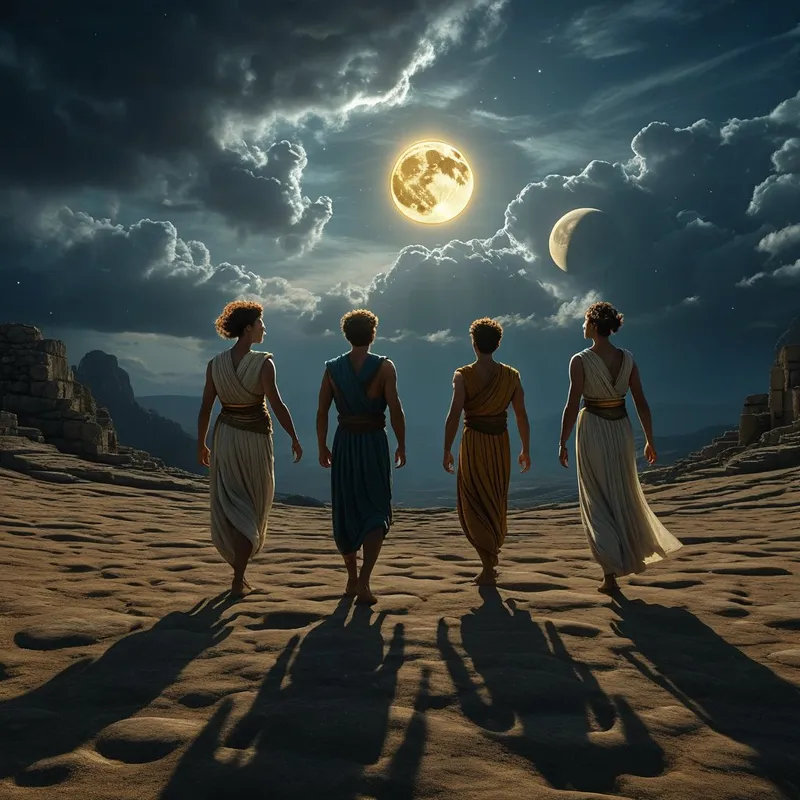
There were three sexes, not two. The children of the sun were double-male. The children of the earth were double-female. And the children of [the moon](/myths/the-moon “Myth from Tarot culture.”/) were the androgynous ones, part male and part female. They moved not by walking, but by cartwheeling with all eight limbs, swift as a rolling wheel, powerful and complete. Their ambition knew no bounds. They sought to scale the heavens, to challenge the gods themselves, to make an assault upon Olympus.
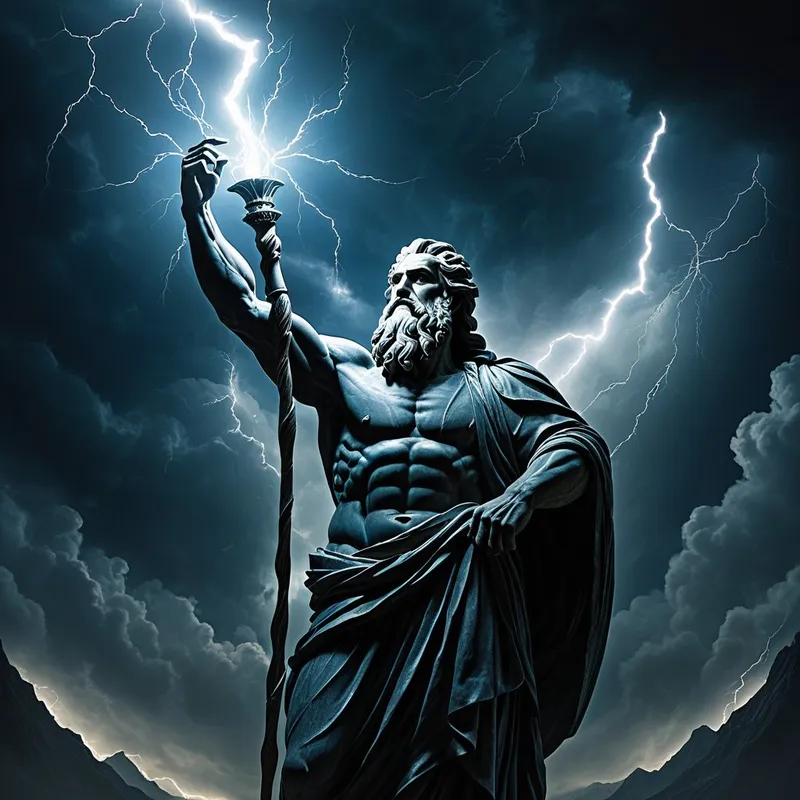
The gods convened in council. Zeus pondered. To destroy this proud race was to lose their worshippers, their sacrifices. Yet to let their insolence stand was unthinkable. Then a solution, both cruel and merciful, came to him. “Let us cut them in two,” he declared, “as one slices a hard-boiled egg with a hair. They will be weakened, humbled, and their numbers will be doubled, increasing our tribute.”
And so it was done. [Apollo](/myths/apollo “Myth from Global/Universal culture.”/) was summoned. As each spherical being was split, [Apollo](/myths/apollo “Myth from Global/Universal culture.”/) turned the face and the neck to face the ghastly wound, pulling the skin tight like a drawstring pouch to form the navel, the eternal seal and reminder of our primal unity. He smoothed the chest and molded the form you now recognize as human.
But the consequence was a horror beyond imagining. Each half, once severed, was consumed by a longing for its other. They would not eat, they would not sleep. They threw their arms about their other half, seeking to grow together again, and in their desperate embrace, they began to perish. Taking pity, Zeus devised another plan. He moved our genitals to the front, so that in embracing, we might find some brief solace, a temporary release from the agony of separation. And if a man-half met his woman-half, they would embrace and procreate. If man found man, or woman found woman, they would still embrace and find satisfaction in union, and then turn to the labors of life.
Thus, love was born. Not as a gentle affection, but as a searing, primal force: the name of our ancient desire and pursuit of wholeness, the desperate seeking of our sundered other half. When we find them, we are struck silent by a sense of ancient belonging, a wordless understanding. This is the origin of our deepest longing. We are all, forever, looking for our missing piece.
Cultural Origins & Context
This story does not echo from a temple hymn or a bardic epic of heroes. It emerges from the most rarefied air of Athenian intellectual life: [the symposium](/myths/the-symposium “Myth from Greek culture.”/). In Plato’s dialogue The [Symposium](/myths/symposium “Myth from Greek culture.”/), a group of men, including the philosopher [Socrates](/myths/socrates “Myth from Greek culture.”/), the general Alcibiades, and the comic playwright [Aristophanes](/myths/aristophanes “Myth from Greek culture.”/), gather to drink wine and deliver speeches in praise of Eros.
Aristophanes, recovering from hiccups, delivers this myth not as a sacred truth, but as a profound and playful philosophical conceit. Its context is critical. It is a story told within a story, a piece of crafted rhetoric designed to explain the overpowering, often irrational nature of love. It functions as an etiological myth, explaining the origin of human sexuality, romantic orientation, and the piercing feeling of “recognition” in love. In the competitive, homoerotic, and philosophically charged atmosphere of the symposium, the speech serves to ground the abstract concept of Eros in a visceral, bodily, and deeply human narrative of loss and longing.
Symbolic Architecture
At its core, the myth is a grand [metaphor](/symbols/metaphor “Symbol: A figure of speech where one thing represents another, often revealing hidden connections and deeper truths through symbolic comparison.”/) for the [human](/symbols/human “Symbol: The symbol of a human represents individuality, complexity of emotions, and social relationships.”/) [condition](/symbols/condition “Symbol: Condition reflects the state of being, often focusing on physical, emotional, or situational aspects of life.”/) of perceived incompletion. The original spherical being symbolizes a state of [psychic wholeness](/symbols/psychic-wholeness “Symbol: A state of complete integration between conscious and unconscious aspects of the psyche, representing spiritual unity and self-realization.”/) and self-sufficiency, a pre-conscious [paradise](/symbols/paradise “Symbol: A perfect, blissful place or state of being, often representing ultimate fulfillment, harmony, and transcendence beyond ordinary reality.”/) where the opposites (male/female, sun/[moon](/symbols/moon “Symbol: The Moon symbolizes intuition, emotional depth, and the cyclical nature of life, often reflecting the inner self and subconscious desires.”/), active/passive) are contained within one entity.
The wound of separation is the birth of consciousness; the scar of the navel is the seal of our individuality and the proof of our shared, severed origin.
The act of splitting by Zeus represents the necessary, yet traumatic, [movement](/symbols/movement “Symbol: Movement symbolizes change, progress, and the dynamics of personal growth, reflecting an individual’s desire or need to transform their circumstances.”/) from unconscious unity into conscious duality. It is [the fall](/myths/the-fall “Myth from Biblical culture.”/) into individuality, into [gender](/symbols/gender “Symbol: Gender in arts and music represents the expression, performance, and cultural construction of identity through creative mediums.”/), into the subject-object [relationship](/symbols/relationship “Symbol: A representation of connections we have with others in our lives, often reflecting our emotional state.”/) that defines human experience. The relentless, [life](/symbols/life “Symbol: The symbol of ‘Life’ represents a journey of growth, interconnectedness, and existential meaning, encompassing both the joys and challenges that define human experience.”/)-threatening search for the “other half” is not merely about romantic love, but about the [soul](/symbols/soul “Symbol: The soul represents the essence of a person, encompassing their spirit, identity, and connection to the universe.”/)‘s [quest](/symbols/quest “Symbol: A quest symbolizes a journey or search for purpose, fulfillment, or knowledge, often representing life’s challenges and adventures.”/) for its own missing components—the [anima](/symbols/anima “Symbol: The feminine archetype within the male unconscious, representing soul, creativity, and connection to the inner world.”/) or [animus](/symbols/animus “Symbol: In Jungian psychology, the masculine inner personality in a woman’s unconscious, representing logic, action, and spiritual guidance.”/), the denied parts of [the self](/myths/the-self “Myth from Jungian culture.”/), the sense of completeness we project onto others.
The three original sexes offer a non-binary, holistic view of human [nature](/symbols/nature “Symbol: Nature symbolizes growth, connectivity, and the primal forces of existence.”/), suggesting that our current categories are themselves fragments of a more complex whole. The myth validates all forms of love as equally sacred pursuits of that original whole.

The Dreamer’s Resonance
When this myth stirs in the modern unconscious, it manifests not as a literal dream of spherical beings, but as the feeling-toned imagery of the search. One may dream of wandering through endless corridors looking for a specific, unknown room. Of holding a broken locket, searching for its matching half. Of seeing a stranger’s face across a crowded space and feeling a shock of profound, inexplicable recognition that lingers upon waking.
Somatically, this can feel like a deep ache in the chest, a literal “heartache,” or a sense of hollow incompletion. Psychologically, the dreamer is navigating the tension between autonomy and merger. The dream asks: What part of myself have I severed and projected onto [the world](/myths/the-world “Myth from Tarot culture.”/)? What wholeness do I seek outside that actually resides within? The agony of the searching halves in the myth mirrors the modern anxiety of dating, the fear of never finding “the one,” and the profound loneliness of the individuated ego.

Alchemical Translation
The alchemical journey modeled here is not of conquering a [dragon](/myths/dragon “Myth from Chinese culture.”/), but of reconciling a fundamental split. The [prima materia](/myths/prima-materia “Myth from Alchemical culture.”/), the base substance, is the wounded, searching half-human. The process begins with the [nigredo](/myths/nigredo “Myth from Alchemical culture.”/)—the blackening—which is the acknowledged pain of separation, the burning longing that feels like a deficiency.
The goal of love, in its deepest alchemical sense, is not to find another to complete you, but to become so whole that your completion attracts its mirror.
The work is one of [coniunctio oppositorum](/myths/coniunctio-oppositorum “Myth from Alchemical culture.”/), [the conjunction](/myths/the-conjunction “Myth from Alchemical culture.”/) of opposites. But the first and most critical conjunction must be internal. The modern individual must turn their gaze from [the horizon](/myths/the-horizon “Myth from Various culture.”/) to their own navel—that divine scar. They must recognize that the “other half” they seek externally is a symbol for their own inner opposite, their own repressed qualities, their own latent wholeness.
The [triumph](/myths/triumph “Myth from Roman culture.”/) is not a final, static reunion with an external beloved (though that may be its beautiful shadow). The true psychic transmutation is the realization that the spherical form is not a memory to be regained, but a potential to be grown into. It is the conscious integration of one’s masculine and feminine aspects, one’s strength and vulnerability, one’s solar ambition and lunar receptivity. One becomes, through the work of self-knowledge and acceptance, a new kind of whole—not the rolling, unconscious sphere of the beginning, but a conscious, individuated unity that has earned its own circumference. In this state, relationship is no longer a desperate grasping to heal a wound, but a sacred encounter between two complete worlds.
Associated Symbols
Explore related symbols from the CaleaDream lexicon: