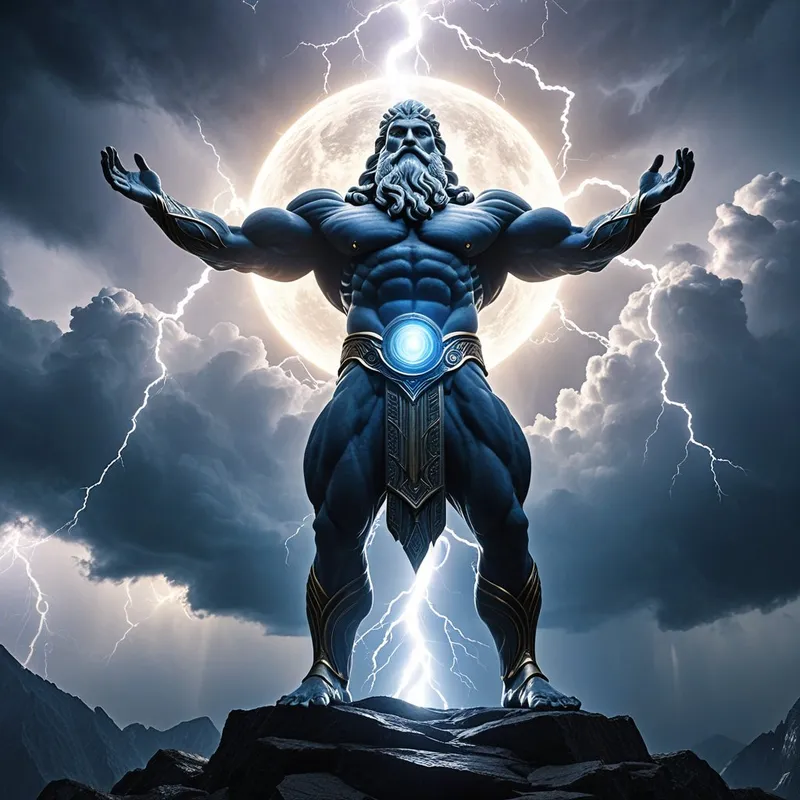
Aristophanes Myth Meaning & Symbolism
A story of primal, spherical beings split in two by the gods, forever yearning for their lost half to become whole again.
The Tale of Aristophanes
Listen, and I will tell you of a time before time, a shape of humanity now lost to the memory of waking life, but which the heart remembers in its deepest ache.
In the beginning, we were not as you see yourselves now—solitary figures stumbling through the world. No. Our ancestors were creatures of profound and terrifying wholeness. Each was a sphere, rolling with purpose and power. Each had four hands and four legs, and a single head with two faces gazing in opposite directions, set upon a neck that could swivel like the heavens. They were of three kinds: some were double-male, born of the sun. Some were double-female, born of the earth. And some were the androgynous, male-and-female, born of the moon, which shares the nature of both.
These spherical beings were mighty. Their strength was such that they dared to challenge the gods themselves, scaling the slopes of Olympus with a pride that shook the foundations of the cosmos. Their ambition cast a shadow over the divine order.
Zeus, in his council with the other gods, was faced with a dilemma. To destroy them with thunderbolts was to lose the worship of mortals. Yet, to let their insolence stand was unthinkable. A solution, both cruel and ingenious, was conceived.
"Let us cut them in two," Zeus proclaimed, his voice the rumble of distant storm clouds. "They will be weakened, their numbers doubled, and their devotion to us assured as they forever seek to mend their broken state."
And so it was done. The great god took each rolling sphere and split it cleanly down the middle, as one might slice an apple with a knife, or as a farmer divides an egg. As each was cut, Hephaestus was commanded to pull the skin tight over the raw wound, fashioning a navel as the seal of this divine surgery, and to twist the head around to face the terrible, newly-created scar.
The aftermath was a spectacle of pure pathos. Each half, now a creature of two legs and two arms, a single face turned outward in perpetual longing, awoke to a world of unbearable absence. They did not seek food or shelter first. They threw their arms around their other half, clinging desperately, weaving limbs together, trying to fuse back into one being. They refused to eat or move, and began to perish from grief.
Taking pity, Zeus devised another adjustment. He moved their genitals to the front. Now, when a half embraced its counterpart, it could find a fleeting semblance of union, a temporary cessation of the longing, and turn its attention to the mundane necessities of life. And so we remain: halves of a primal whole, forever scanning the crowd for the face that feels like home, embracing in the hope that, for a moment, two might become one again.

Cultural Origins & Context
This haunting narrative is not found etched on temple walls or in epic cycles of heroes. It comes to us from the philosophical playground of Plato's Symposium, a dialogue set at a drinking party where guests take turns praising Eros. The speaker is the comic playwright Aristophanes, who offers this myth not as religious dogma, but as a philosophical allegory wrapped in the guise of a comic, yet deeply poignant, origin story.
Its societal function was multifaceted. For Plato's audience, it served as a sophisticated exploration of the nature of love (eros), elevating it from mere physical attraction to a spiritual quest for primordial completion. It also provided an etiological myth for sexual orientation—the double-male halves seeking men, the double-female seeking women, and the androgynous halves seeking the opposite sex. More broadly, it articulated a profound Greek cultural value: the terror of hubris (overweening pride) and its consequences, while simultaneously validating the deepest human yearning for connection as a divine, if tragic, inheritance.
Symbolic Architecture
The myth’s power lies in its stark, geometric symbolism of the human condition. The original spherical being represents a state of psychic totality, a pre-conscious wholeness where the opposites (male/female, sun/earth, active/receptive) are contained within a single, self-sufficient unity.
The original wound is not the splitting, but the consciousness of being split. Our navel is the god’s signature on the decree of our separation.
The act of splitting by Zeus symbolizes the inevitable fall into duality—the emergence of consciousness itself, which is always a movement away from unconscious wholeness. It is the birth of the ego, forever feeling incomplete, forever sensing a lost paradise. The desperate clinging of the halves is the raw, instinctual drive of eros in its purest form: not merely sexual, but the soul's magnetic pull toward what it perceives as its missing complement, its symblepon (the fitting-together piece).
The navel, so comically and cruelly fashioned by Hephaestus, becomes the ultimate symbol. It is a scar of divinity and a seal of mortality, a permanent reminder of our severed origin and our embodied, limited state.

The Dreamer's Resonance
When this myth stirs in the modern unconscious, it rarely appears as ancient Greeks. It manifests as the somatic dream of profound, wordless yearning. One might dream of a mirror that shows not a reflection, but the perfect stranger who is somehow you. One might dream of a puzzle where the final piece, when placed, causes the entire picture to glow with a warmth that floods the dream-body. Or conversely, one might dream of a painful, clean division—a tree split by lightning, a gem cracked in two—where the grief of separation is a physical ache upon waking.
These dreams signal a psychological process of recognition. The psyche is highlighting a profound sense of incompletion, often projected onto a quest for the "perfect" partner, the "ideal" job, or the "missing" piece of knowledge that will make life whole. The dream is pointing to an inner schism, a split between conscious identity and disowned parts of the self (the shadow, the anima, or animus). The crawling search across the plain is the labor of integration.

Alchemical Translation
The alchemical journey modeled here is not about finding the external other to complete you. That is the literal, tragic reading that keeps us crawling. The true transmutation is the Coniunctio Oppositorum—the sacred marriage within.
The goal is not to find your missing half, but to become the sphere that once contained both halves. Individuation is the conscious re-creation of the original, spherical being.
The first stage is the nigredo: the acknowledgment of the wound, the burning sense of absence and longing. This is the painful but necessary consciousness of our split state. The second is the albedo: the refinement, where we stop projecting our wholeness onto another and begin to identify the "other half" as an internal quality we have disowned—our own capacity for strength, receptivity, creativity, or vulnerability. The final stage is the rubedo: the integration. Here, the search turns inward. The embrace is no longer a clinging to another person, but a conscious holding of inner opposites in a tense, creative union. The navel-scar ceases to be a mark of shame and becomes a sacred sigil, a reminder that our wholeness is not a pre-conscious given, but a conscious achievement forged in the fires of our own lived experience. We do not return to the sphere; we become it anew, through awareness. Our love for another then transforms from a desperate need for completion into a celebration between two wholes, a sacred echo of a unity each has found within.
Associated Symbols
Explore related symbols from the CaleaDream lexicon: