Argos Myth Meaning & Symbolism
The tale of Argos Panoptes, the hundred-eyed giant tasked by Hera with guarding Io, a story of relentless watchfulness and ultimate, poignant sacrifice.
The Tale of Argos
Hear now the tale of the sleepless watcher, a story woven from divine jealousy and mortal suffering. The air on Olympus was thick with suspicion. Hera, whose gaze missed nothing, had seen a new cloud gather around her husband, the lord of the sky. Zeus, ever the trickster, had cloaked the river nymph Io in a shroud of thick, dark mist, hoping to hide his latest infidelity. But the mist itself was a betrayal, a stain upon the clear air that Hera’s divine senses could not ignore.
She descended to the earth, her footsteps causing the flowers to bow. Zeus, in panic, transformed the trembling Io into a creature of pure, snowy white—a beautiful heifer. “A fine beast,” Hera said, her voice sweet as poisoned honey. “A gift for me, husband?” Trapped by his own ruse, Zeus could only nod. And so Hera claimed the heifer, and for its guardian, she chose a servant unlike any other: Argos Panoptes.
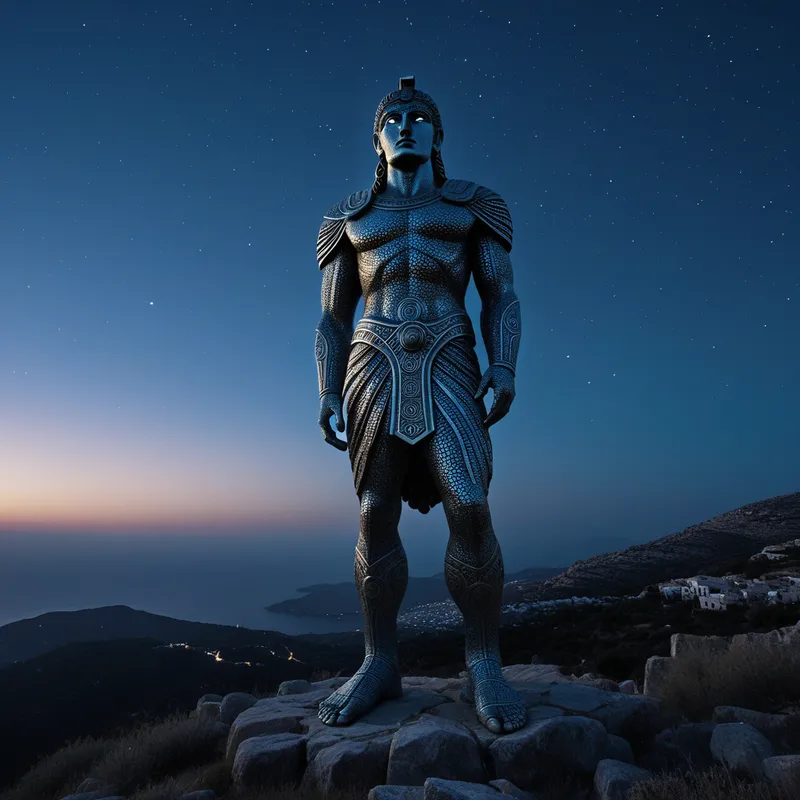
He was a giant, but his true power lay not in strength, but in sight. A hundred eyes were set upon his body—upon his arms, his back, his mighty brow. They were eyes of every hue: deep brown like forest soil, grey like storm clouds, blue like a summer sky. And they never all slept at once. While fifty rested, fifty remained open, watchful, piercing. He led the white heifer to a secluded, grassy meadow, tethered her with gentle but unbreakable bonds, and took his post. He became the perfect prison. Io, trapped within her bovine form, could only low in despair, her human mind screaming behind the beast’s eyes, while the hundred eyes of Argos witnessed her every shuddering breath, her every tear that fell into the grass.
Zeus, writhing with guilt and desire, called upon his cleverest son, Hermes. “Go. Lull the watcher to sleep. Free her.” Hermes, donning his traveler’s cloak and sandals, descended. He did not come as a warrior, but as a shepherd. He sat upon a rock near Argos, took out his lyre, and began to play. The melody was a river of forgetfulness, a stream of drowsy peace. He sang tales of the nymph Syrinx transformed into reeds, of Echo fading into nothing but voice—stories of change and loss. One by one, the eyes of Argos began to dim. The heavy lids of eighty, then ninety eyes fluttered closed. But ten remained open, fixed on Io, duty holding them fast.
So Hermes told one more tale, weaving it with the enchantment of his caduceus. He spoke of the god of sleep himself, Hypnos, and of the gentle touch of his son, Morpheus. As he spoke, he gently waved the staff before the giant’s face. The final ten eyes surrendered. All one hundred were shrouded in darkness. The watcher slept. And in that moment of perfect vulnerability, Hermes, the swift one, drew a sickle-shaped blade and with a single, merciful stroke, severed the head of Argos from his shoulders. The giant’s vigil was ended. The heifer was loosed, but her torment was far from over. Hera, honoring her fallen servant, took his hundred eyes and set them forever in the tail of her sacred bird, the peacock, where they stare into eternity. And Io, driven by a gadfly sent by the vengeful queen, began her long, maddened flight across the world.

Cultural Origins & Context
The myth of Argos is primarily preserved in the epic compilations of later antiquity, most notably in Ovid’s Metamorphoses, though its roots are far older, echoing in fragments from earlier Greek poets. It functioned as an aetiological myth, explaining the origin of the peacock’s magnificent, eye-spotted tail. Beyond this, it was a powerful narrative strand within the larger, sprawling saga of Io, a tale told to map the known world through her wanderings and to illustrate the catastrophic ripple effects of divine discord on mortal lives.
Told by bards and later written by scholars, the story served as a stark reminder of the capricious and often cruel nature of the gods. Argos himself represents the ultimate instrument of divine will—unwavering, incapable of disobedience, and ultimately sacrificial. His tale underscores a common Greek theme: that caught between the wills of greater powers, even magnificent beings are mere pawns, and their loyalty is rewarded not with salvation, but with a memorialization in nature. The myth reinforced the societal value of duty and vigilance, while also mourning the tragic cost such absolute service can demand.
Symbolic Architecture
Argos is the embodiment of conscious vigilance. His hundred eyes represent total awareness, the ego’s attempt to monitor and control all aspects of the psyche and the external world. He is the perfect guard, symbolizing a state of hyper-vigilance where no shadow, no repressed desire (Io), can escape scrutiny.
The watcher must sleep so the prisoner can flee; the conscious mind must relinquish control for the soul to begin its transformative journey.
Io, transformed and imprisoned, is the instinctual, creative, or divine spark within us that is captured and distorted by the structures of possession (Hera) and guilt (Zeus). Argos’s fatal sleep, induced by Hermes—the god of boundaries, communication, and the guide of souls—symbolizes the necessary dissolution of rigid ego-consciousness. It is only when the watchtower of the ego is momentarily stilled that the deeper, imprisoned self can be released, even if into a painful, gadfly-driven journey of becoming.
The Dreamer's Resonance
To dream of Argos is to dream of being watched, or of being the watcher. It speaks to a psychological state of exhausting hyper-vigilance. The dreamer may be experiencing anxiety, paranoia, or a feeling of being trapped in a role of relentless responsibility, guarding some vulnerable part of themselves or another.
Somatically, this can manifest as tension in the neck and shoulders (the burden of watching), insomnia, or a constant state of "fight-or-flight" readiness. Psychologically, it indicates a conflict between an overactive, controlling conscious mind and a deep, instinctual self that yearns for freedom but is tethered and misunderstood. The dream is a signal from the psyche that the current mode of guardedness is unsustainable and that the "Hermes" function—the clever, mediating, transformative principle—must be invoked to end the stalemate, even if it feels like a betrayal of one’s duty.

Alchemical Translation
The alchemy here is the transmutation of rigid vigilance into compassionate witnessing, and of imprisoned spirit into a soul on a destined path. Argos represents the prima materia of unwavering duty. His sacrifice is the necessary mortificatio—the death of an old, static structure of consciousness.
The process begins with the recognition of the "Io" within: the authentic, divine spark that has been animalized and bound by complexes (Hera’s jealousy, Zeus’s guilt). The ego’s hundred-eyed guard must be honored for its service, then gently put to rest through the Hermetic art—through storytelling, music, or dialogue with the unconscious (the caduceus). This is not an act of violence but of liberation. The killing of Argos is the dissolution of an identification; the placing of his eyes in the peacock’s tail is the coniunctio, the integration of that vigilant awareness into a new, beautiful, and holistic form. The eyes are not lost; they are transformed from instruments of control into ornaments of awe, a pattern in the greater tapestry of the Self.
The ultimate goal is not to remain the sleepless guard, nor the maddened heifer, but to become the peacock—to integrate the fragments of watchful experience into a display of wholeness, where every eye has seen, and every seeing has become part of a magnificent, unfolding truth.
Associated Symbols
Explore related symbols from the CaleaDream lexicon:
- Eye — The central symbol of Argos, representing total awareness, surveillance, and the fragmented consciousness that cannot see the whole.
- Guardian — Argos as the ultimate protector, a symbol of unwavering duty and the psychological defenses that can become a prison.
- Sacrifice — The death of Argos, a necessary surrender of one form of consciousness to allow for the movement and transformation of another.
- Transformation — The core theme, seen in Io’s change into a heifer, Argos’s eyes into peacock feathers, and the entire journey of the myth.
- Goddess — Hera, whose will sets the tragedy in motion, representing the powerful, possessive, and vengeful aspects of the feminine divine.
- Messenger — Hermes, the agent of change who uses guile and art to dissolve rigidity and facilitate liberation.
- Bird — The peacock, the final resting place of Argos’s eyes, symbolizing the integration of fragmented vision into a display of beauty and immortality.
- Journey — The forced, painful flight of Io after her release, representing the difficult but necessary path of the liberated self.
- Greek Temple — The structural, ordered world of the gods from which these chaotic, transformative decrees emanate.
- Dream — The state Hermes induces in Argos, representing the threshold of the unconscious where rigid control is relinquished.
- Fate — The inescapable trajectory set by divine conflict, which Argos, Io, and even Hermes serve, often beyond their own wills.
- Shadow — The repressed desire (Zeus and Io) that Argos is tasked with guarding, and the darker aspects of duty and vengeance that drive the plot.
- Friendly Dog