Ares/Mars Myth Meaning & Symbolism
The volatile god of war, embodying raw conflict and the terrifying, necessary chaos that precedes order and authentic courage.
The Tale of Ares/Mars
Hear now the clash that shakes the very pillars of Olympos. It is not the harmonious thunder of Zeus, but a wild, discordant roar that rises from the plains below. It is the sound of Ares.
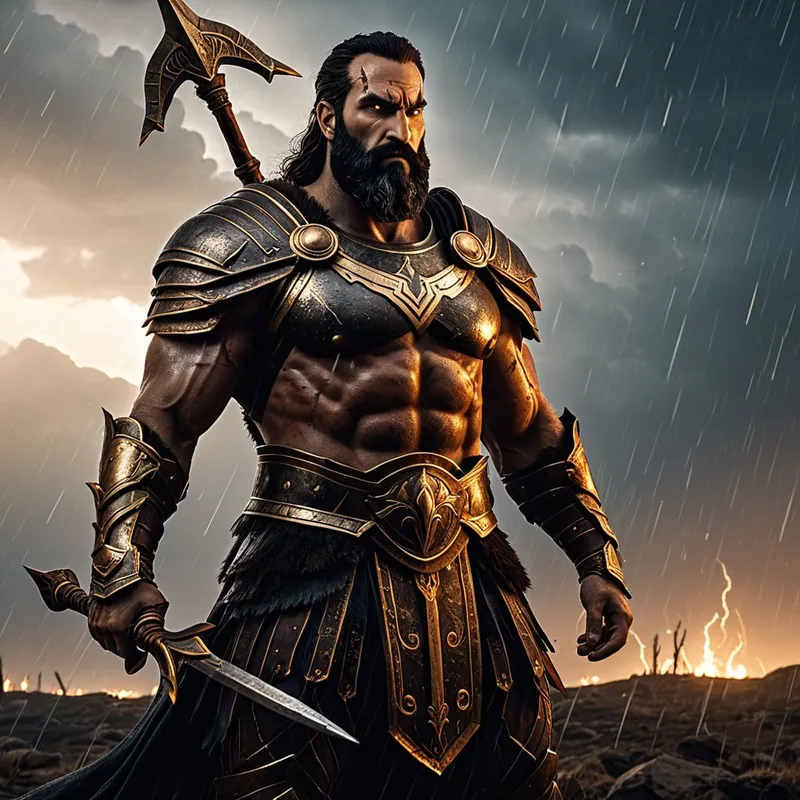
He does not walk; he storms. Where his sandaled foot falls, the earth does not yield but screams, cracking open to drink the libation of battle. His chariot is not drawn by noble steeds, but by Phobos and Deimos—Terror and Panic—beasts whose breath is the choking dust of rout, whose whinnies are the shrieks of men whose courage has turned to water. He wears armor not for glory, but as a second skin of rage, polished not to a mirror sheen but stained with the grime and gore of countless fields.
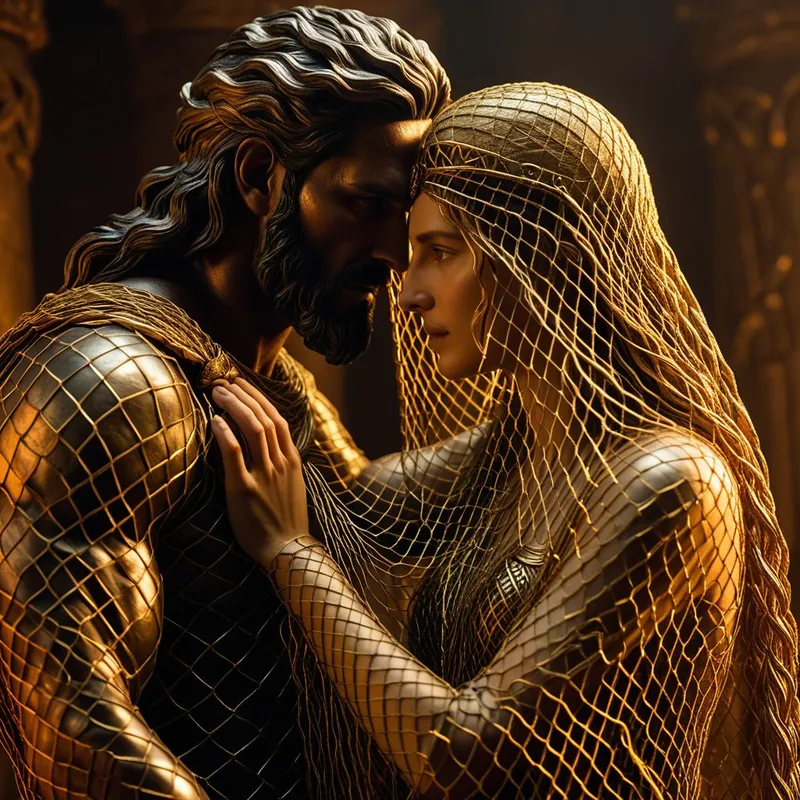
He is the beloved of Aphrodite, a union that baffles the ordered mind. In the secret hours, the god of raw destruction finds solace in the arms of the goddess of binding creation. Their passion is another kind of war, a sweet, consuming conflict that defies the cold forge of her husband, Hephaestus. And it is Hephaestus, the clever, limping smith, who crafts their humiliation: a net of bronze threads, finer than spider-silk, unbreakable as fate. He catches them entwined, not in a bedchamber, but suspended in the divine air of his own hall, a spectacle for the laughter of the gods. Ares’s rage then is impotent, his martial fury useless against cunning artistry.
His battles are rarely triumphs. He is stabbed by the mortal Diomedes, guided by Athena, and bellows with a sound that shakes ten thousand men. He is trapped in a bronze jar by the giant Otus and Ephialtes, and languishes there for thirteen months, a caged tempest, until the trickster Hermes steals him free. He is a force constantly met, contained, and mocked by intellect, order, and craft. Yet, he always returns. The conflict never ends; it only sleeps, and his breathing is the distant drum of preparation, the sharpening of blades in the dark.
Cultural Origins & Context
The figure of Ares emerges from the complex tapestry of Greek religious thought not as a national patron of heroic warfare, but as its terrifying, ambivalent personification. Unlike the Roman Mars, who was revered as a fatherly protector and a symbol of civic power, the Greek Ares was a deeply problematic god. His cult was not central to the civic identity of city-states like Athens, which favored the strategic, disciplined Athena. Instead, Ares represented the brutal, chaotic, and shameful aspects of battle: the frenzy, the slaughter, the stench of the field after the heroes had won their glory.
His myths were passed down primarily through epic poetry, like Homer’s Iliad, where he is a petulant, often ineffective participant, and through later literary sources that explored the gods’ foibles. He functioned as a societal shadow figure. To worship Ares was to acknowledge a terrifying truth: that beneath the veneer of civilization and strategic reason lay a raw, destabilizing power that was necessary for survival but dreadful to behold. His altars were often placed outside city walls, a literal and symbolic containment of the chaos he embodied. He was a god to be appeased, to be called upon in desperate defense, but never truly loved or trusted.
Symbolic Architecture
Ares is not war as policy or heroic endeavor. He is the archetypal embodiment of the instinct for conflict itself—the undifferentiated surge of aggression, the fight in the animal brain, the red haze of rage that obliterates thought.
He is the necessary chaos that precedes order, the raw ore from which the sword of will must be forged.
Psychologically, Ares symbolizes the untamed Libido in its most aggressive form. He is pure, unmediated energy, often at odds with the ego’s desire for control (represented by Zeus) and the societal persona’s need for harmony and strategy (represented by Athena). His constant humiliation in myth reflects the civilized psyche’s attempt to deny, trap, and ridicule this primal force. His union with Aphrodite is profoundly symbolic: it marries the drive to separate and destroy (Ares) with the drive to unite and create (Aphrodite), suggesting that at their root, Eros and Conflict are intertwined energies of intense, life-altering engagement with the world.

The Dreamer's Resonance
When the Ares pattern storms into modern dreams, it rarely appears as a literal god of war. It manifests as the somatic experience of unchecked aggression and vital force. You may dream of being trapped in a tightening space (the bronze jar), symbolizing a life situation where your anger or assertive energy is stifled, leading to a feeling of explosive pressure. Dreams of violent, chaotic storms or being pursued by terrifying, impersonal forces (the chariot of Phobos and Deimos) can point to anxiety and panic attacks that have their root in unexpressed conflict or a perceived threat to one's psychic territory.
Conversely, dreaming of finding a powerful, ancient weapon or feeling an surge of immense, fearless strength can signal the healthy awakening of this archetype. It is the psyche’s call to establish boundaries, to fight for one’s space, or to engage directly with a life conflict that has been avoided through over-intellectualization or passivity. The dream is asking: where in your life have you disowned your right to healthy aggression?

Alchemical Translation
The individuation process does not seek to eliminate the Ares energy, but to integrate it—to free him from the bronze jar of repression and harness his chariot. The first alchemical stage is acknowledgement. One must confront the inner Ares, to feel the heat of one’s own rage, competitiveness, and desire for conflict without immediate judgment or spiritual bypassing.
The second stage is differentiation, separating the raw force from its destructive expression. This is the work of Athena applied to the stuff of Ares. It asks: What is this energy truly for? Is it a blind reaction, or can it be focused into the courage to have a difficult conversation, to leave a toxic situation, to defend a vulnerable part of oneself or another?
The transmutation is complete when the spear of aggression becomes the scepter of sovereignty—when the power to destroy is willingly disciplined into the power to protect and to act with fierce integrity.
Finally, the union with Aphrodite symbolizes the ultimate integration. The alchemized Ares energy becomes the passionate, fierce commitment to what one loves. It is the father’s protective fury, the activist’s righteous anger, the artist’s ruthless editing of their own work. It is no longer chaos for its own sake, but the vital, cutting force that clears the ground for new growth, the necessary conflict that births a more authentic, undivided self. To integrate Ares is to become whole, not peaceful—capable of both tenderness and the terrifying, beautiful strength required to truly engage with life.
Associated Symbols
Explore related symbols from the CaleaDream lexicon: