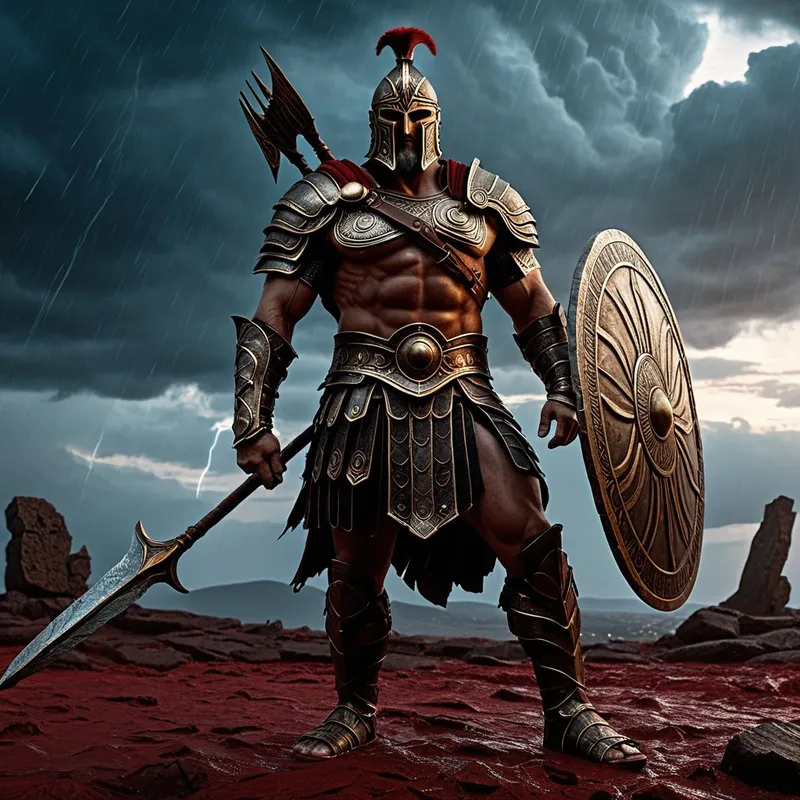
Ares Myth Meaning & Symbolism
The myth of Ares, god of war, reveals the terrifying yet essential archetype of raw, untamed instinct, chaos, and the shadow's vital, disruptive power.
The Tale of Ares
Hear the sound that precedes all others in the world of men: the shriek of bronze on bronze, the wet thud of spear finding home, the choked cry that is the last prayer to any god. This is the hymn of Ares. He does not arrive with strategy or the cool justice of his sister Athena. He erupts.
Picture the field of Troy, not in its heroic moments, but in its raw, screaming heart. The air is thick with dust and the iron scent of fate. Here strides Ares, not as a general but as the battle-fever itself. His armor is not polished for parade but scarred and darkened. With him come his children—Phobos and Deimos—who are not soldiers but sensations, chilling the blood of the bravest hero, turning ordered ranks into a panicked herd. He roars, and the roar is not a command but a force of nature, a gale that strips away reason. He fights not for a city or a cause, but for the glorious, terrible ecstasy of the strife itself. He is the moment the shield wall breaks, the pure chaos from which no tale of individual glory can yet be born.
Yet, even this raw force knows capture. The clever god Hephaestus, husband to Aphrodite, forged a net finer than spider-silk but unbreakable as destiny. When Ares lay with Aphrodite in the smith-god’s own bed, the net fell, trapping them mid-embrace. Hephaestus called all Olympus to witness. The laughter that echoed in the hall was not kind. The mighty god of war, rendered helpless, a spectacle of lust and folly. It took Poseidon’s promise of recompense to secure his release. Ares, shamed, fled to his northern homeland, his rage now cold and personal.
His battles were not always victorious. The giant Otus and Ephialtes once trapped him in a bronze jar for thirteen months, a prisoner of his own boundless aggression. The mortal Heracles wounded him, sending him howling back to Olympus. Even his father, Zeus, despised him, calling him the most hateful of all the gods. Ares was never the triumphant hero. He was the necessary storm, feared by all, loved by none, eternally crashing against the orders that sought to contain him.

Cultural Origins & Context
The figure of Ares emerges from the deep, ambivalent relationship the ancient Greeks held with warfare. Unlike the Romans who later venerated Mars as a founding, civic father, the Greeks of the Archaic and Classical periods viewed the raw, destructive aspect of war with profound anxiety. His myths are preserved primarily in Homer’s Iliad and in various hymns and later literary sources, told not to inspire patriotic fervor but to illustrate a terrifying divine reality.
He had few major cult centers, most notably in the warlike region of Thrace and in Sparta, a society uniquely structured around martial discipline. Yet even in Sparta, the worship was cautious. His societal function was not as a patron to emulate, but as a force to acknowledge, propitiate, and hopefully channel. The telling of his tales around hearths and in symposia served as a cultural container for the trauma of battle—a way to name the inexplicable frenzy and terror that descended upon men in combat, separating it from human agency and attributing it to a capricious, divine power. He was the mythic answer to the question: "What comes over us when the world dissolves into blood?"
Symbolic Architecture
Ares is the archetype of the undifferentiated, primal force. He is not war as policy or defense, but war as pure psychological and physical eruption.
He represents the shadow of the polis, the chaotic roar that civilization is built upon and must eternally defend against, yet which it secretly requires to define its own borders.
Psychologically, Ares symbolizes the raw, unmediated instinct—the surge of rage, the flash of lust, the will to dominate that arises before the ego can censor it. He is the part of the psyche that does not negotiate, does not plan, and does not care for consequence. His humiliation in the net of Hephaestus is profoundly symbolic: the raw instinct (Ares) and the captivating allure of desire (Aphrodite) are trapped and exposed by the cunning, structuring intelligence of the craftsman (Hephaestus). It is the moment the conscious mind catches the unconscious in a compromising act and holds it up for judgment, resulting in shame and retreat.
His imprisonment in the bronze jar by the Aloadae giants speaks to the fate of uncontained aggression: it eventually traps itself, becoming a screaming, impotent force sealed away from the world, a psychic energy turned inwards into suffocating depression or explosive, self-destructive fits.

The Dreamer's Resonance
When the energy of Ares stirs in the modern dreamscape, it rarely appears as a literal god. Instead, one dreams of sudden, violent intrusions into ordered spaces: a wild animal bursting into a boardroom, a forgotten basement flooding with hot, rust-colored water, or the dream-ego itself committing an act of shocking, unpremeditated violence.
Somatically, this can correlate with a felt sense of pent-up pressure, a clenching in the jaw or fists, or episodes of unexplained irritability that feel alien to the dreamer’s self-concept. Psychologically, it signals a confrontation with the repressed shadow—the bundle of aggressive, selfish, and "uncivilized" impulses that the persona has worked hard to exclude. The dream is the psyche’s attempt to re-admit this exiled energy. The chaos is not merely destructive; it is a demand for recognition. The terrifying figure in the dream, the invading force, is a disowned part of the dreamer’s own vitality, which has taken on a monstrous form because it has been denied expression for so long.

Alchemical Translation
The alchemical work with the Ares archetype is not to become him, but to perform the transmutation of his base metal. The goal is not to unleash raw chaos, but to integrate its fierce, undiluted power into the service of the whole self.
The first step is the nigredo: to courageously face the "most hateful" part of oneself, to sit in the shame of the trapped and exposed instinct without fleeing to northern exile.
This means acknowledging one’s own capacity for rage, for selfish desire, for the will to power, without immediate judgment or spiritual bypassing. The second step is the solutio: to release the instinct from its bronze jar of repression. This is not an explosion, but a conscious, contained melting—allowing the feeling to be felt in the body, perhaps through intense physical exercise, primal scream, or authentic expression in a safe container.
Finally, the coagulatio: to forge the raw, red ore of Ares into a tool. This is the work of Hephaestus. The undifferentiated aggression becomes the focused will to set boundaries. The blind lust becomes passionate commitment. The chaotic energy becomes the courage to rebel against an internal or external tyranny that stifles life. The integrated Ares energy provides the fierce, unapologetic vitality required to defend one’s psychic territory, to fight for what one loves, and to embody a strength that is fluid and responsive, not just reactive. He becomes, not the destroyer of one’s world, but the fierce and necessary protector of one’s authentic, sovereign self.
Associated Symbols
Explore related symbols from the CaleaDream lexicon: