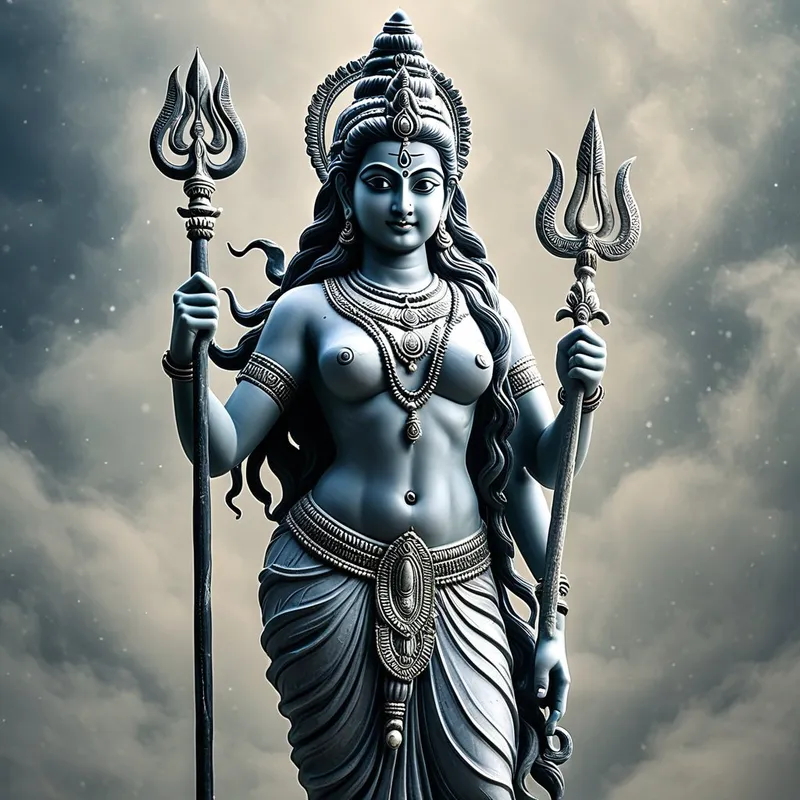
Ardhanarishvara Myth Meaning & Symbolism
A single divine form, half male and half female, representing the ultimate unity of consciousness and energy, spirit and matter, within one sacred body.
The Tale of Ardhanarishvara
Listen, and let the silence between the words speak. In the time before time, when the cosmos was a single, pulsing breath, the great ascetic Shiva sat in the fathomless depths of meditation. His consciousness was absolute, a mountain of pure spirit, unmoving and alone. Around him, the world lay dormant, for creation cannot dance without the spark of relationship. The goddess Parvati, who is the world itself in female form—its rivers, its mountains, its desiring heart—approached him. She was love incarnate, the dynamic force of life that seeks union.
Yet, a chasm lay between them. Shiva, in his sublime isolation, was complete. Parvati, in her vibrant immanence, was also complete. But their completeness was separate, and in that separation, the universe held its breath. The sages whispered of a coming synthesis, a sacred collision that would set the wheel of life turning in its truest rhythm.
The moment arrived not with a clash, but with a longing so profound it became a creative act. Parvati, yearning to share in her lord’s deepest tapas (austerity), to be not beside him but within his very experience, made her desire known. Shiva, the great yogi, perceived not a request, but a fundamental truth. He saw that absolute consciousness, Purusha, is sterile without the activating power of Prakriti, the primal nature. He saw that spirit is directionless without energy, and energy is chaotic without spirit.
And so, in an act of divine grace that was also an act of supreme necessity, he opened himself. It was not an embrace, but a merging. There was no battle, no conquest—only a willing, glorious dissolution of boundaries. From his own infinite substance, the right half of his form remained as himself: the serene, ash-smeared ascetic with the crescent moon in his hair, the serpent around his neck, the trident in hand. And from his being, he manifested the left half as the goddess Parvati: golden-skinned, adorned with precious silks and jewels, her form graceful, one hand resting gently on her thigh.
Thus, Ardhanarishvara was born—"The Lord Who is Half Woman." One body, one breath, one divine heartbeat shared between two polarities. The divine couple, once two, were now one singular reality. The universe exhaled, and creation flowed in perfect, balanced harmony.
But the old world tests the new. The sage Bhringi, fiercely loyal to Shiva alone, vowed to worship only the male half. He would circumambulate the deity, but he would circle only Shiva’s side. Seeing this, Parvati, the left half of the very form he approached, absorbed Shiva into her own being, leaving Bhringi with no "pure" Shiva to circle. Undeterred, the sage took the form of a bee, attempting to bore through the divine midline to reach his chosen god. In response, the compassionate yet firm Ardhanarishvara made Bhringi lose all his support, rendering him without the sustenance that comes from the feminine principle of the earth. Bhringi, weakened and humbled, understood. He saw the indivisible whole. From that day, he is depicted with a third leg, a divine gift of support from the unified deity, so he may always worship the complete truth.

Cultural Origins & Context
The iconography and philosophy of Ardhanarishvara find early expression in the Vedas, in the concept of the cosmic person, Purusha, and later crystallizes in the puranic literature and agamic texts governing temple iconography, around the early centuries of the Common Era. This form is not the product of a singular narrative but emerges from a deep, persistent undercurrent in Hindu thought: the principle of non-duality (Advaita).
Its societal function was multifaceted. On one level, it served as a theological statement, visually articulating the inseparable nature of the masculine and feminine principles (Purusha and Prakriti) in the act of creation. On another, it provided a divine model for social and spiritual harmony. In a culture with defined social roles, Ardhanarishvara presented an ultimate ideal where difference does not imply hierarchy but essential partnership. The form was carved in stone, cast in metal, and painted on temple walls—a constant, silent sermon on unity, intended for kings and commoners, ascetics and householders alike, reminding all that divinity itself is the perfect marriage of opposites.
Symbolic Architecture
Ardhanarishvara is the ultimate symbol of reconciled duality. It is not a hybrid or a mixture, but a perfect, seamless synthesis where each half retains its distinct qualities while being fundamentally necessary to the other's existence and meaning.
The goal is not to become neutral, but to become whole—to host the entire conversation between mountain and river, fire and water, within the sanctuary of one's own being.
Psychologically, this represents the integration of the conscious and unconscious, the Logos (ordering principle) and Eros (relating principle). The right, masculine side—Shiva—symbolizes transcendent consciousness, ascetic discipline, and focused awareness. The left, feminine side—Parvati—symbolizes immanent energy, creative fertility, emotional intelligence, and embodied life. In an individual, an over-emphasis on the "Shiva" principle leads to sterile detachment and isolation. An over-identification with the "Parvati" principle can lead to chaotic entanglement and loss of self. Wholeness, as modeled by the deity, is the conscious holding and honoring of both.
The myth of Bhringi adds a crucial layer: the resistance to wholeness. Bhringi represents a rigid, one-sided consciousness that insists on a partial truth. His transformation illustrates the painful but necessary collapse of such partiality before the greater reality can be embraced. His third leg is the gift that comes after surrender—a new, integrated form of support born from the unity he once denied.
The Dreamer's Resonance
When this archetype stirs in the modern dreamscape, it seldom appears as a literal Hindu deity. Instead, one might dream of a figure whose face is split between two distinct expressions, or a room divided into starkly different yet complementary halves. One may dream of trying to choose between two paths, only to discover they merge ahead. Or, like Bhringi, one might dream of circling an object or person endlessly, feeling a growing frustration and weakness, unable to complete the circuit.
These dreams signal a profound somatic and psychological process: the psyche's imperative toward integration. The tension felt in the dream—the pull between two seemingly irreconcilable aspects of the self (perhaps career and family, logic and intuition, strength and vulnerability)—is the creative friction of the Ardhanarishvara principle seeking manifestation. The body may register this as a literal feeling of being "split down the middle," or as a deep yearning for a completeness that feels just out of reach. The dream is an invitation to stop circling one half of the truth and to stand, however awkwardly at first, at the sacred midline where both are true.

Alchemical Translation
The alchemical process mirrored in this myth is the Coniunctio Oppositorum—the sacred marriage. For the modern individual navigating a world of internal and external binaries, the path of Ardhanarishvara is the path of individuation.
The first stage is the recognition of the separate "deities" within: the isolated, self-sufficient Shiva-consciousness and the seeking, relational Parvati-energy. The conflict is their apparent incompatibility. The alchemical work begins not by forcing a union, but by creating a temenos—a sacred, inner space—where both can be fully acknowledged without one attempting to negate the other. This is the meditative ground.
Individuation is not the victory of one side over the other, but the revelation that the two sides were always holding hands, sculpting a single, divine form from the inside out.
The "merging" is not an obliteration of personality but a deepening of capacity. It is the moment the thinker feels compassion without losing clarity, or the caregiver establishes boundaries without losing warmth. It is the fusion of action and receptivity into a single, graceful movement. The struggle, like Bhringi's, is our ego's resistance to this loss of old, partial identities. The triumph is the gift of the "third leg"—a newfound, grounded stability that comes only from wholeness. One no longer has to choose between being spiritual or worldly, strong or soft, individual or in relationship. One becomes the vessel that contains, and is sanctified by, the dynamic, creative tension of the pair. One becomes, in a human measure, a living Ardhanarishvara—a walking, breathing testament to the unity that underlies all perceived duality.
Associated Symbols
Explore related symbols from the CaleaDream lexicon: